
Social media defines our everyday lives. It helps us to be in contact with each other, to express ourselves and to feel connected even over long distances. Generation Z, in particular, is not without reason described as the digital natives and can hardly keep their hands off social networks. Posting selfies on Instagram or the daily exchange via WhatsApp gives us the impression of an often highly embellished digital reality in which a large number of young people feel at home. Every day, large and often sensitive amounts of data are passed on to the leading media empires. But what happens to the data that Generation Z, and ultimately all of us, disclose on social networks?
IONOS examined the T&Cs of the 5 most popular social networks YouTube, Instagram, Snapchat, TikTok and Meta (WhatsApp). The main focus was on particularly clear and surprising intrusions into the privacy of users. In order to capture a mood picture of awareness about and handling of these intrusions, a survey was conducted in the United Kingdom with the help of YouGov on the topic of privacy in social media within Generation Z (18-24 years old). What is Generation Z's attitude to data protection on social media and would they adapt their user behaviour?
Generation Z (Gen Z for short), in some cases also referred to as post-Millennials, describes the successor generation to the Millennials, Generation Y. Gen Z includes those born between 1997 and 2012. Gen Z includes those born between 1997 and 2012. Some sources include those born after 1995 in Gen Z - so the exact age range is not clearly defined. What is clear, however, is that Gen Z has grown up with digital media from an early age. A functioning Internet connection and the possession of various technical devices are essential for Gen Z. Real everyday life is thus merging with the digital world. In general, members of the generation feel that values such as freedom, individuality and diversity are important and tend to have a dismissive attitude toward traditional ideals or ideas. Despite their striving for individuality, however, members of Generation Z are quickly insecure and look to their fellow human beings or social networks for affection and confirmation. Accordingly, the social media of Gen Z serve primarily for self-presentation, as well as for entertainment and exchange.
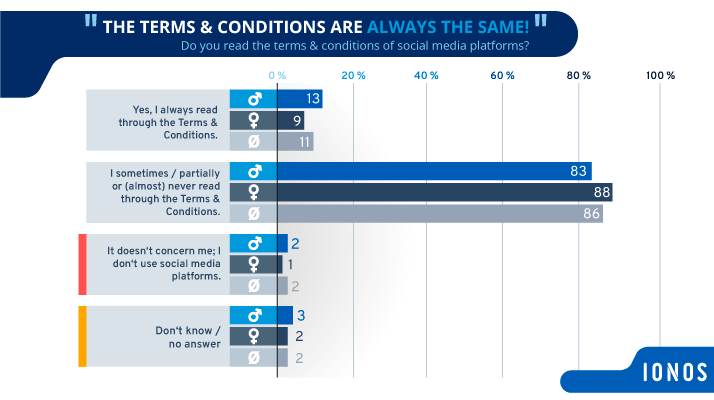
The General Terms and Conditions (GTC for short) cover the rights for the transfer and use of personal data in social networks, which users must agree to when creating an account. Data transfer or vague data policies can lead to unwanted publication or dissemination of personal data. Since Generation Z spends a lot of time in front of a screen, they consider the T&Cs to be a great protection for their own data. Nevertheless, a full 86% of respondents say they only partially or never read through the T&Cs when creating a new account on social networks. It can be assumed that the dependence on social media outweighs one's own interest in data protection. Therefore, Gen Z is rather negligent with regard to their own data protection. Female participants in particular take little interest in data privacy: two-thirds never read through the terms and conditions. Only one in ten respondents takes full note of the terms and conditions and thus attaches importance to a reflective approach to social networks.
Head of Privacy Management at datenschutzexperte.de Katharina Schreiner understands the GTC tiredness of Generation Z and at the same time emphasises the importance of data protection in social media.
"One cannot blame Generation Z for their GTC tiredness - even GDPR experts find it difficult to get a complete picture of the contractual situation and data protection information. The relevant information is scattered in a thicket of sub-pages and cross-references and often translated from other language and legal circles. Social networks use data to get to know their users better and keep them on the platform as long as possible. It becomes problematic when data is used to shape political opinion or exert an ever-increasing influence on our purchasing decisions."
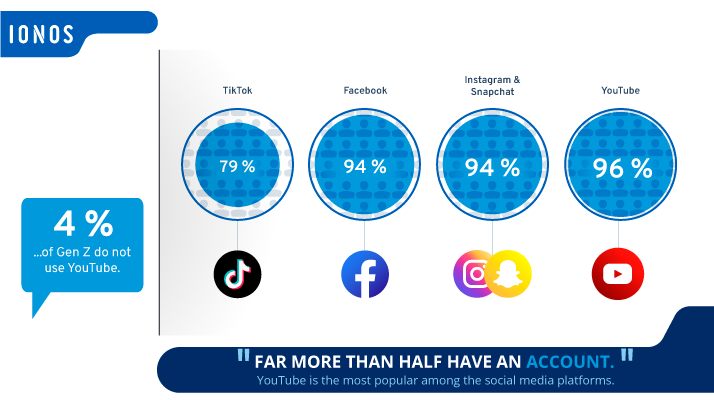
TikTok is considered the platform par excellence for Generation Z. Day in and day out, millions of videos are uploaded, liked and shared. With 23 million users in the United Kingdom, the platform can be considered the most popular of all (as of 2022). However, in the survey, the proportion of non-users of TikTok was the highest. According to their own statements, 21% of the Generation Z respondents are not active on the platform! And this despite the fact that the platform's target group includes Gen Z in particular. However, the platform can be used from the age of 13, which is why the main target group comprises the even younger cohorts under 18, who could not be surveyed for technical reasons. Generation Z includes. Who would have thought that the Meta network, which includes Facebook, would have higher user numbers among Generation Z than TikTok, at 94%. The same applies to the Instagram and Snapchat platforms. But only one platform has almost all of Generation Z: YouTube has the highest number of users at 96%.
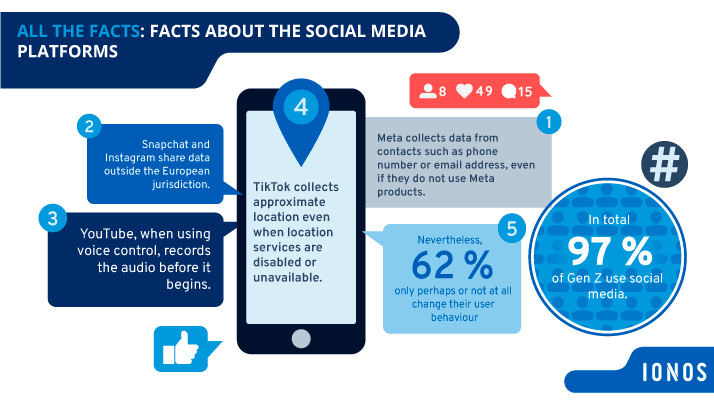
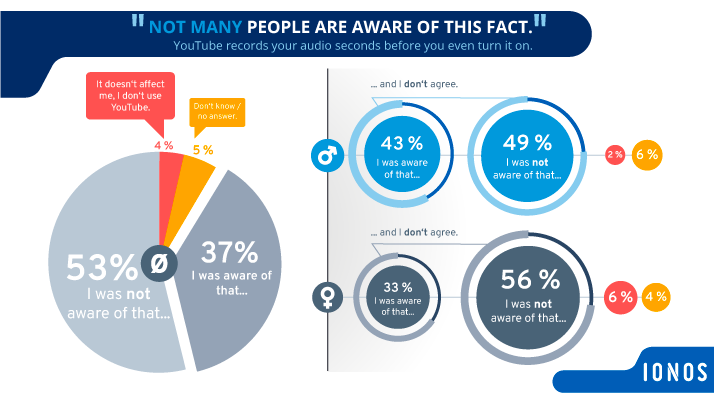
Does Gen Z not care about data protection on the Internet? Concrete facts do. The fact that YouTube starts an audio recording seconds before the audio is started does not please the majority of those surveyed. A look at the female participants is particularly exciting: With the most votes (41%), women said they did not know about YouTube's audio recording and did not agree with it. For female participants, audio recording represents an invasion of privacy, and this despite the fact that at the beginning, women were more averse to reading the T&Cs. Only 14% of the total respondents were aware of the fact and find the recording okay.
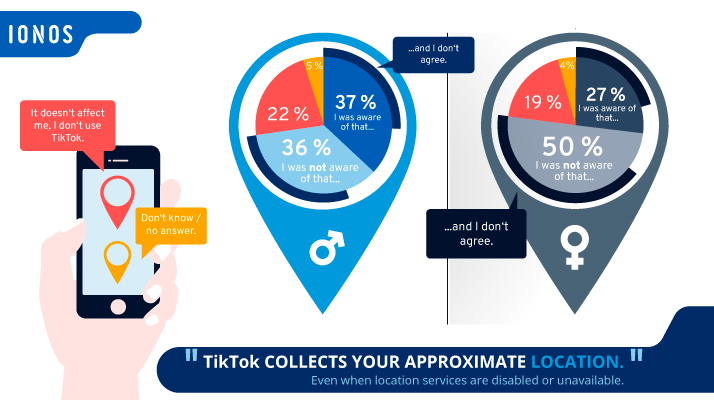
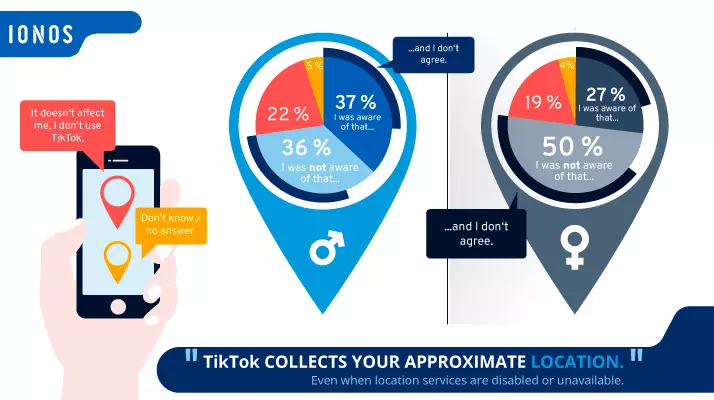
TikTok provides quick fame and is especially loved for the user-adapted clips about comedy and entertainment. When bored, users can briefly scroll through the app - and when interest fades, the app can be closed. However, user behaviour on the platform is not that self-determined. TikTok users do agree to the terms of use on TikTok when they create an account. However, almost two-thirds of respondents stated that they did not agree with the approximate determination of location if the users had deliberately issued the location. The Chinese technology company ByteDance, to which TikTok also belongs, is repeatedly criticized, especially because of its proximity to the autocratic Chinese government, as well as because of accusations of espionage. Generation Z also perceives the unauthorized location tracking as an invasion of privacy.
"The decisive factor is which companies are behind the platforms. Meta and Google each operate several platforms, they can easily merge information from different apps into one profile and thus strongly influence our behaviour. With TikTok, on the other hand, users should be aware that Chinese authorities have access to their data."
Katharina Schreiner, Head of Privacy Management at datenschutzexperte.de
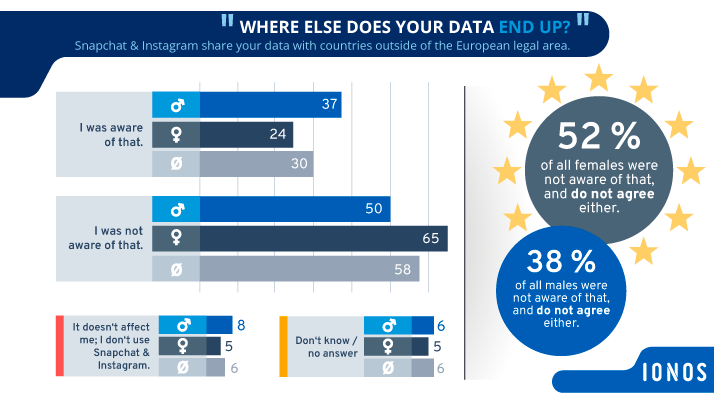
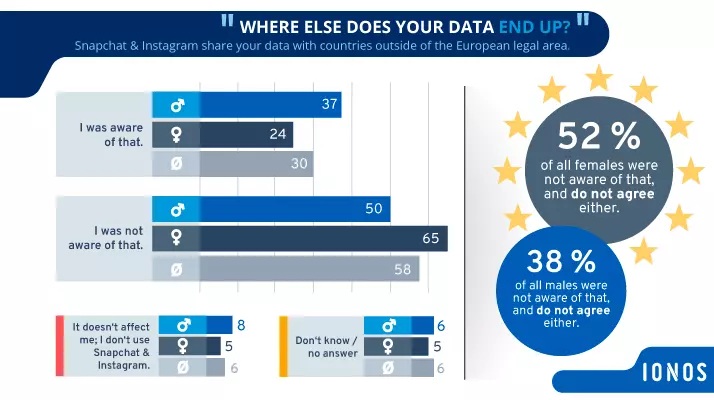
The Instagram and Snapchat platforms enjoy great popularity among users. Despite the high user numbers, here too more than half of the Gen Z respondents do not agree with the transfer of data to countries outside the European legal area. Since the General Data Protection Regulation (DSGVO) does not apply in this area, different data protection laws apply here.
Here, too, more than half of Gen Z are critical of the transfer of data. A full 65% of respondents do not trust the data guidelines outside the EU and do not agree with the passing on of data on the platforms. Nevertheless, 20% of respondents are more relaxed about the whole thing and have no problem with the transfer of data.
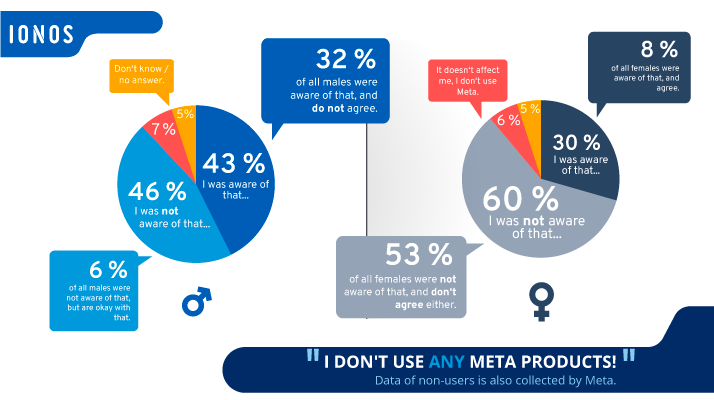
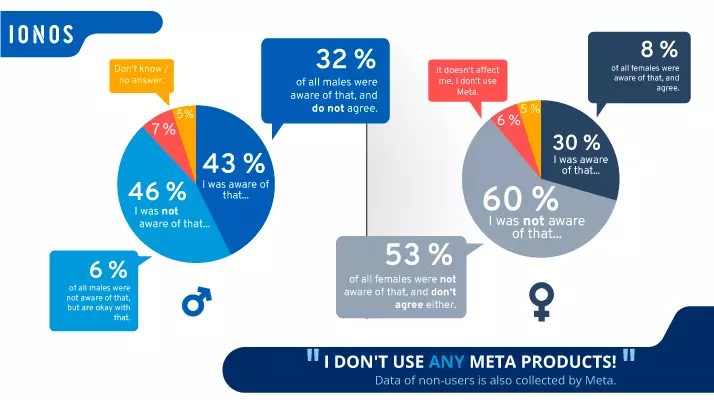
More than 2 billion people worldwide use the WhatsApp meta-platform to exchange pictures, send voice messages and communicate with each other. This also results in the transfer of a huge mass of personal data, which is why a close look at WhatsApp's data protection is required. However, this is not a problem, since the users have agreed to the data transfer at the beginning. Or not? Meta collects the contact data such as name, mail address and phone number of contacts of account holders, even if the contacts themselves do not have a Meta account. Here, too, Generation Z does not approve of data storage: two-thirds of respondents say they do not approve of the collection of data. Only 15 % find the data storage of their contacts okay.
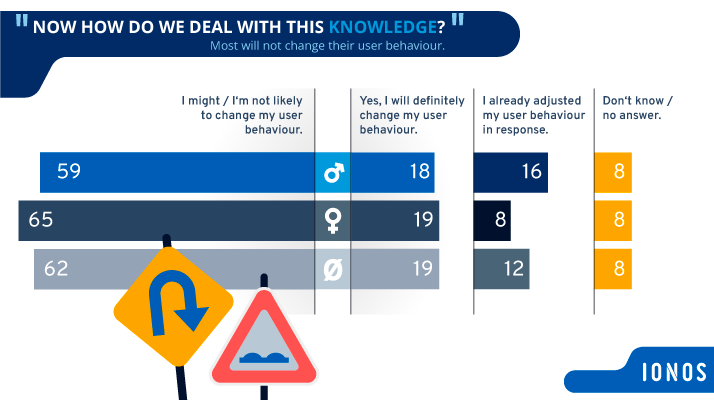
Is Generation Z turning a blind eye to social media privacy? Not all members of this generation are carried away by the hype of the platforms. After all, even one-third of those surveyed now reflect on their relationship with social media and stated that they were planning to change or had already adapted their user behaviour in light of the GDPR. This means that some users started reading the T&Cs more closely or deleted accounts completely. Although most respondents said they did not agree with the data protection regulations regarding the platforms, more than two-thirds of Gen Z still said they might consider changing their behaviour if at all. Is this generation already too deeply involved in the data vortex of social networks? Or does the strength of user habit blind them to potential dangers? The fear of missing out (FOMO) on something displayed on the platforms could be a key reason for such careless user behaviour.
"Generation Z must understand that they contribute to data collection and its effects through their user behaviour. The knowledge that personal data is used to observe, predict and influence our behaviour is the basis for protecting their own data. Something would already be gained if Generation Z became more aware that they pay for the benefits of social media with their data sovereignty and freedom of choice."
- Katharina Schreiner, Head of Privacy Management at datenschutzexperte.de
The investigation of the platforms YouTube, TikTok, Instagram, Snapchat and WhatsApp (Meta) was carried out in September and October 2022. The full T&Cs of the platforms were read through, and the most exciting facts were noted. The selection of the most exciting interventions was made subjectively to the best of our knowledge.
The data used is based on an online survey conducted by YouGov UK, in which 2,502 people aged 18-25 participated between Feb. 03 and Feb. 13, 2023. The results are representative of this age group. The information about Generation Z was taken from the following source: https://en.wikipedia.org/wiki/Generation_Z
The data presented here is based on the best of our knowledge and belief. However, IONOS does not guarantee the completeness of the data sets. Use of these is at your own risk.