

Complaint management

Even in the best companies, not everything runs smoothly all the time: Ultimately, it is very difficult to anticipate the wishes and needs of every single customer. It could be that the great majority of the target group is in fact satisfied with your offering, yet some of them nonetheless have problems with your product or service. There are also times when something simply goes wrong during manufacturing, provisioning, or delivery. The product that the customer receives isn’t quite like it’s advertised, or the service isn’t provided as you had planned. Mistakes can happen – yet the fact that paying customers are not happy with it is something that probably every business professional can understand.
This is why it is so important to establish a functioning complaint management process. One that ensures a good rapport with the client even after a mistake has been made and that keeps them from turning away from your company in anger. Furthermore, a well-organised complaint management process reduces the risk of delivery or manufacturing errors. This is because customer feedback only has to reach the right department for the product to be made even better in the future.
What is complaint management?
The term complaint management describes the handling of customer complaints within a company. Criticism is supposed to be evaluated in a way that is systematic and orderly, and used to create a positive impact. It is also supposed to resolve the issue that prompted the customer’s criticism. The goal of complaint management is to strengthen customer loyalty as well as quality assurance.
Just about every company receives complaints from customers – no one is completely immune to it. As a company gets larger, the number of critics usually grows as well. Eventually the number of complaints gets so big and the company structure so complex that one must introduce a complaint management process.
This is because chaos rules without a well-thought-out system, and this can have a significant impact on the success of your company. An unsatisfied customer who doesn’t have their feedback taken into consideration will probably no longer trust your offering and will also tell others about how frustrated they are. In the past, it was perhaps only a few friends and family members who were likely to be influenced by a negative report. However, in the internet era, complaints often reach countless readers.
Complaint management is standardised in the UK: under ISO 10002:2018 you can find exact info on duties and responsibilities, resources as well as term definitions.
Complaint management is all about methodically handling customer criticism. Strategies must be developed and it must be determined where complaints should be received, how one should react to feedback and which departments or individuals the criticism should be forwarded to. The allocation of responsibilities also falls under complaint management. Only once it’s clear who needs to react in each instance can an actual negative criticism be transformed into something positive.
Complaint management is part of customer relationship management. CRM provides a basic framework for customer care and also contains, among other things, an analysis of customer relationships.
Customer management complaint process: what are the procedures?
The complete complaint management process is conducive to achieving two goals:
- Customer satisfaction: Complaint management is supposed to reduce customer dissatisfaction and ideally even strengthen customer loyalty.
- Quality assurance: Through complaint management, customer feedback reaches the right departments and contributes to the improvement of the product or service.
Tasks
The goals mentioned above influence the tasks and as a result the complaint management procedures as well. In accordance with the customer satisfaction and quality assurance goals, the tasks can be grouped into two areas. In this way there are several tasks that above all contribute to a positive customer rapport.
- Simplify complaints: So that unsatisfied customers turn to you first instead of venting their dissatisfaction on social networks, you should offer the opportunity for feedback in the simplest way possible. Only when the customer’s justified criticism is first reported to you can you make use of the complaint in a positive way.
- Ensure that the initial contact is positive: The customer is supposed to feel that they are in good hands when they submit their complaint. To achieve this, specially trained personnel must accept the criticism and make the unsatisfied customer feel that their opinion is important.
- Clearly design the process: It must be clear which feedback will be forwarded to which departments. This is why the task of complaint management is to create structures and clarify responsibilities.
- Carry out direct actions: Many responses if anything concern long-term quality assurance. However, one should also initiate some actions immediately and directly after contact with the customer. Whether a price discount or product exchange is appropriate depends on the individual case. However, what the different options are (if any) should already be determined beforehand.
On the other hand, a submitted complaint should also have a long-term effect on the company’s processes, as it is only in this way that performance quality can be improved sustainably.
- Analyse feedback: Customer complaints don’t follow any standardised form. For this reason, all input must be evaluated with respect to content and the customer’s intention. This is in order to be able to recognise patterns, set priorities and implement measures.
- Audit management: Even complaint management itself must be audited regularly so that no negative procedures creep in. Furthermore, audits can unveil potential ways for you to optimise processes.
- Issue reports: Reports based on audits provide decision-makers with important indicators. These can form the basis for initiating changes.
- Use of collected information: Conclusions can often be drawn from the data collected by complaint management. Information acquired by complaint management often provides points of reference for quality assurance and can later contribute to improvements in production and service performance.
Framework conditions
So that complaint management tasks can be successfully mastered, certain framework conditions must be satisfied. First of all, it requires an organisational structure. This is why complaint management must be a fixed component within the company and also recognised as an important factor by company executives. In addition, it is worth clarifying to what extent there are points of intersection with other business divisions.
Then it is worth finding the right personnel and to train them as is appropriate. This relates especially to direct contact with the customer. Employees must be skilled in diplomacy and de-escalation, and also must be able to deal with stressful situations, as not all customers are constructive in their criticism.
Finally, a functioning infrastructure is also among the framework conditions. This mainly relates to the deployment of suitable EDP systems. Software and hardware should enable employees to shape both contact with customers as well as internal organisation in the best possible way.
Procedures
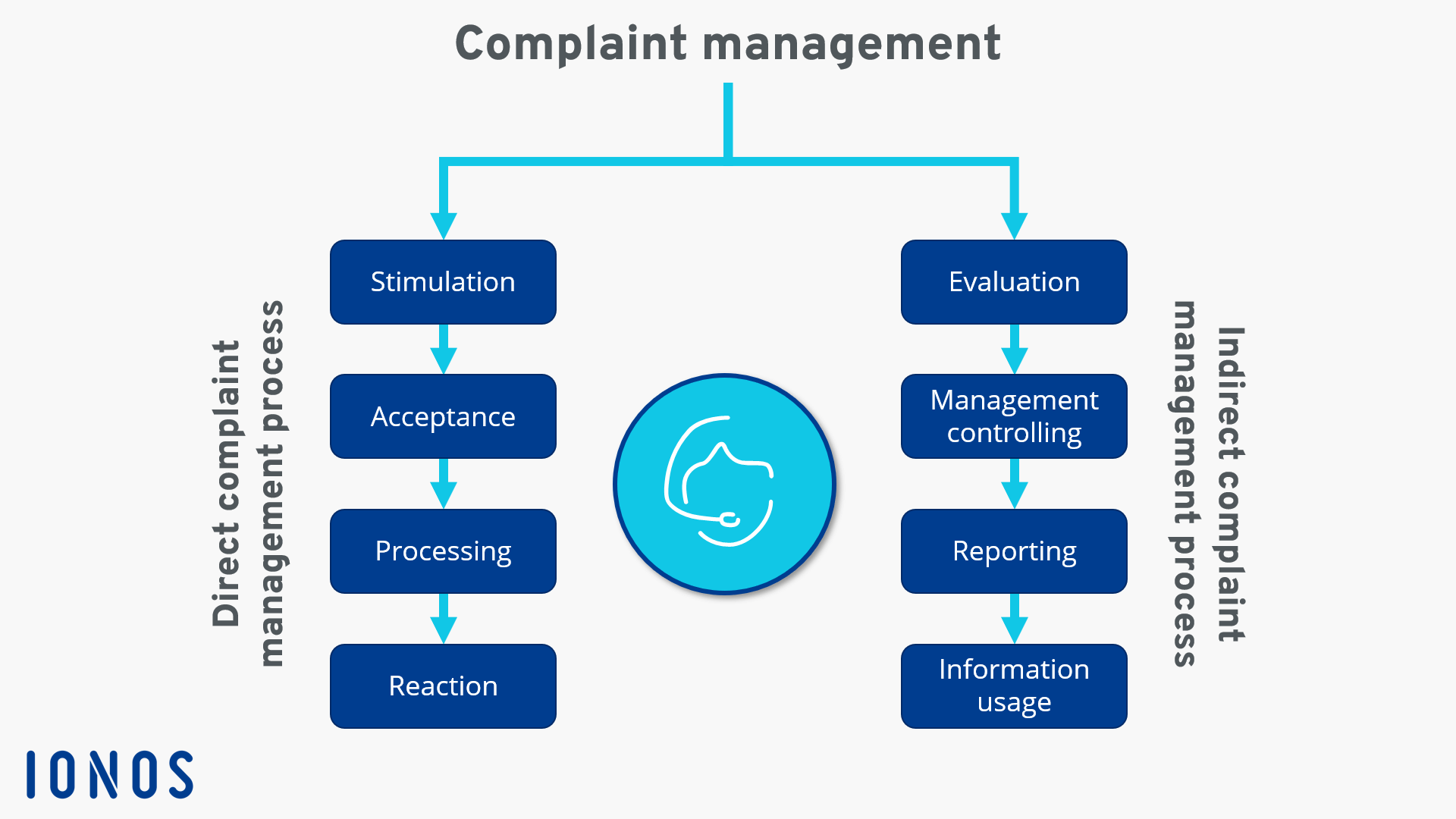
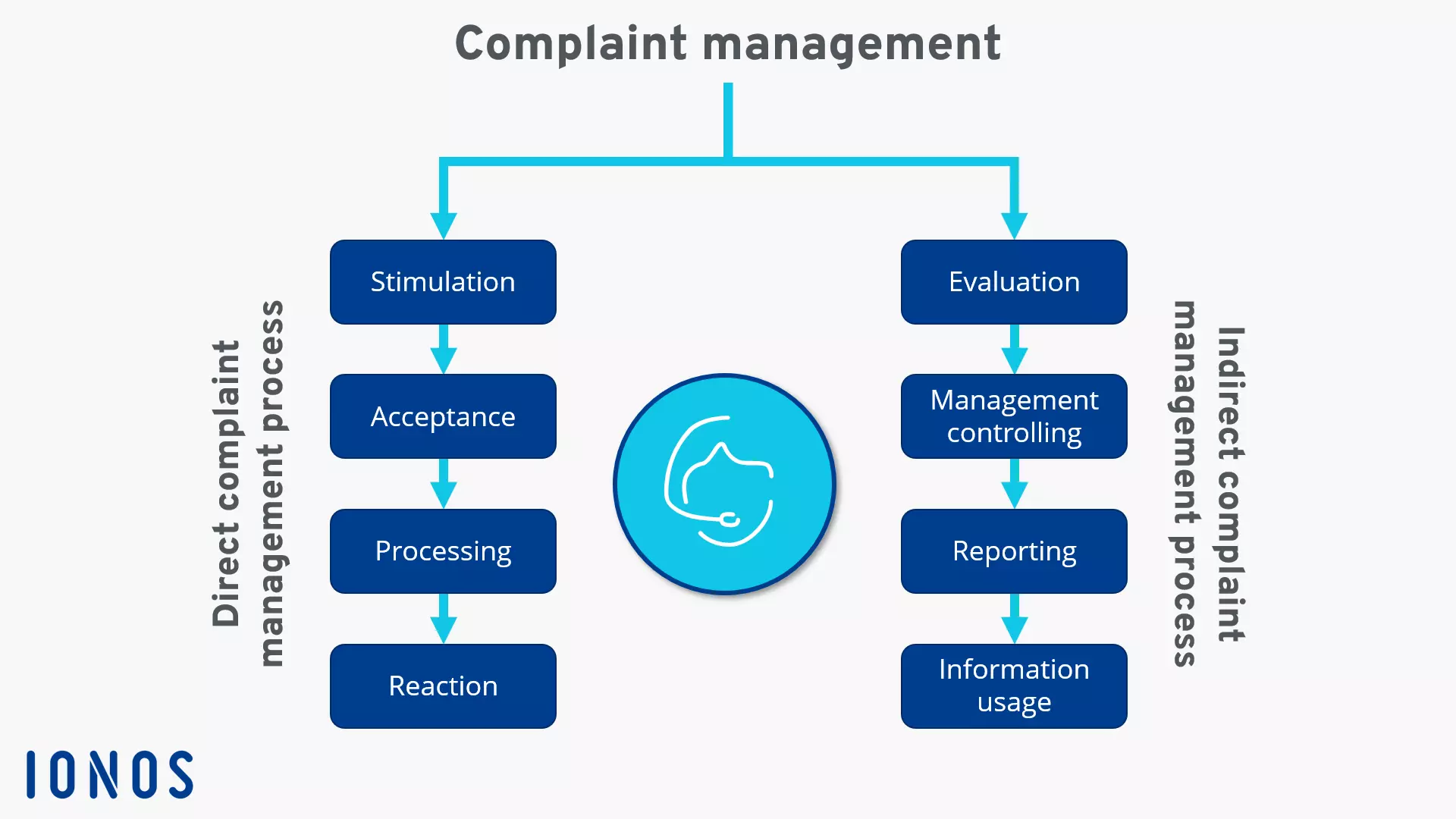
In the complaint management process, a complaint passes through various stations. So that the customer can submit a complaint in the first place, your company should set up simple options for providing feedback. This can be a hotline, a chat or an email address, but feedback could also be submitted via web forms or postcards. Companies should always explicitly indicate such options. In this way, customers are encouraged to give feedback.
After this, the complaint is processed. Here, friendliness and understanding on the part of the trained employee play a major role. Ensure that your customers also learn what actions will be taken after their criticism. When possible, the customer should be able to understand what sort of consequences their criticism will have. Sometimes, however, ongoing communication regarding a specific matter is not economically feasible. For this reason, business professionals must weigh what type of response still makes sense at that point and what would exceed a reasonable response.
The next step is to handle the customer’s complaint. This also includes forwarding it to the appropriate department. Knowing that their feedback was accepted with appreciation and will lead to a change is already enough for many customers. Others, however, require further action to be satisfied. For this, your support employees must have the appropriate resources available. In this step the employee thus responds directly to the customer and offers a discount, product exchange, repairs or some other perk.
At the same time, the execution of internal tasks begins. The inbound complaint is analysed and categorised, and in this way delivers information on what must be changed within the company. Both the auditing and reporting tasks then follow, i.e. the complaint management process itself is reviewed. At the same time, efficiency is also assessed: Is customer satisfaction adequately represented by the inbound complaint? In this context, one solution may be to encourage complaint stimulation.
The information from the audit is prepared and presented to company executives or other decision-makers. Next, this branch of complaint management also deals with execution. The collected and prepared data must be made use of in order to improve quality management. This could be details that only concern a small production stage and can be expeditiously implemented. In the long-term, however, it is possible to initiate structural changes that have an impact on the entire company.
The process explained: An example of complaint management
Let’s say you sell mugs with prints on them. One of your customers has the problem that the print has already started fading after a few wash cycles. They are rightly angry about it. You have indicated various options directly on the packaging for getting in touch with your company in the event of a complaint, so the customer contacts your hotline.
The support employee’s task now consists of making the unsatisfied customer happy again. To do this, they first listen closely to the complaint and ask sensible questions: For one thing, this emphasises the level of seriousness with which the company responds to the complaint. In addition, the employee also receives important information that they’ll need for the next steps.
The questions can also clarify to what extent support can directly help the customer. In many situations, such as in technical support, employees can provide assistance and resolve the problem. But that can’t be done in our example: The print is already gone. At most, the employee is able to give tips on how to take care of the mugs in the future. However, in order to immediately compensate the customer, the employee gives them a voucher. The customer can use this to order another mug of their choice at no extra cost.
The indirect processes are underway at the same time: While evaluating the complaint, it becomes clear that the deficient printing mostly happens with a very specific type of mug. This information is then communicated to the appropriate production division. Auditors monitor the operations and determine that the complaint management processes are operating very well. However, the majority of complaints are received via the hotline; and it is more cost-effective to handle complaints via an online form. For this reason, the decision is made to promote the latter channel more proactively going forward and to simplify the form.
All the information ends up in a report. Because this report is geared toward third parties who aren’t part of complaint management, it is the task of reporting to prepare all required information in a way that it is easy to interpret. As a result, the company executives increase the budget for complaint management and instruct the lab to experiment with other dyes in order to improve durability.
Five tips for successful complaint management
If you follow the procedures in your complaint management, then you already have a solid system in place. However, we have compiled some extra tips for you so you can win over your customers with excellent service.
Invite them to complain
A complaining customer is not a nuisance, but an opportunity. You learn important information about your products or services from their feedback. Furthermore, you provide the person with an outlet: When their anger subsides and they then receive satisfactory support from you, they’ll most likely perceive your company as customer-focused. Customers who are unsatisfied and don’t even notify you are far worse. This is because you have probably lost them for good and don’t even know the reason. This is why you should absolutely ask your customer base to provide feedback on products, your service, or the company as a whole.
To be sure, everyone likes to receive positive feedback, but continued development works better when flaws are pointed out. This is why you should make it as easy as possible for your customers to address a concern with you. Make them feel that their opinion really is important.
Really listen
If a customer voices their dissatisfaction, you should first of all let them express their concern (or calmly read their message). Don’t make the mistake of placating the customer before you can even comprehend their problem. Oftentimes, however, the customer can’t specify the exact cause of their anger. This is why follow-up questions are also considered an essential part of listening. By doing this, you show the customer that you are interested and can also gather important information for improving your product.
Respond quickly
Few things annoy an already unsatisfied customer as much as being stuck forever in a telephone queue. But that doesn’t mean that companies should only respond as quickly as possible to customers contacting them by phone. They should also focus on responding as quickly as possible to customer concerns expressed in e-mail and social media feedback. Otherwise the customer’s anger continues to grow and eventually reaches the point at which damage control is no longer possible. If a company has established a clear system for complaint management, however, this type of problem shouldn’t actually occur.
Take the blame
Once in a while it appears that the problem did not originate with your company or product but with the customer themselves. However, you should never tell them this. There are two reasons for this: Obviously, it isn’t a good idea to blame customers who are already upset and angry, especially since they are contributing to your company’s success with their payment. Secondly, their complaint can also contribute to improving your offering. Perhaps the operating instructions can be made simpler or communication across the board must be improved. Either way, you should assume full responsibility for the problem.
Think in terms of solutions
On the one hand, an unsatisfied customer would like to vent their frustration on you. On the other hand, however, they need a solution to their problem. That’s why it’s not enough to only show understanding. Offer sensible solutions – preferably before the customer makes their own demands. This way you maintain control and can also better determine the accruing costs of compensation. Regardless of how important the customer is, you can also customise the solution according to the customer.
Good complaint management means wanting to really help your customer and recognising the feedback as an opportunity to improve your company. If you manage to also make this noticeable in your communications with your customer base, unsatisfied customers will become regular customers.
Please note the legal disclaimer relating to this article.