The DISC assessment: Outdated test or useful tool?

How can you find out more about applicants’ soft skills? How do you figure out if they’ll integrate well into the team, if they’ll boost the company’s success, or how they deal with conflict? Often, the comparably short job interview is enough. Combined with a personality test, companies are able to optimally position themselves and maximize their success. The DISC assessment is one of the oldest but also one of the most widely used personality tests to this day, although it has also been criticized.
What is the DISC assessment?
The DISC personality test is based on DISC theory, which was developed in the 1920s by the American psychologist William Moulton Marston. In the 1970s, the American psychologist John G. Geier developed it into the personality test that is so widely known today.
As the test is not copyright protected, it was continuously further developed by other test providers. But to this day, the original 1920s DISC assessment model remains the most widely used version.
DISC assessment: The DISC assessment defines four behaviours in humans: dominance, influence, steadiness, and conscientiousness. A DISC personality test can determine a person’s primary personality type, and the results are used to improve communication and collaboration, especially in the workplace.
How does a DISC personality test work?
The DISC test categorizes people based on their own assessment. Interviewees are asked to choose adjectives that, in their opinion, best describe them. The exact method differs based on the provider and area of application.
DISC tests can be completed online through various commercial providers or in written form.
When evaluating the test, it’s important to note that results are not graded. Every personality type is regarded as equal. The result also doesn’t mean that the interviewee does not have any of the other three behavioural styles, only that one of these is strongest, and that the other three types require more effort to come through.
In addition, results cannot be compared in a quantifiable way. This means that person X cannot read from test results that they are more conscientious or more impulsive that person Y. The result only shows one dominant behavioural style.
The DISC types
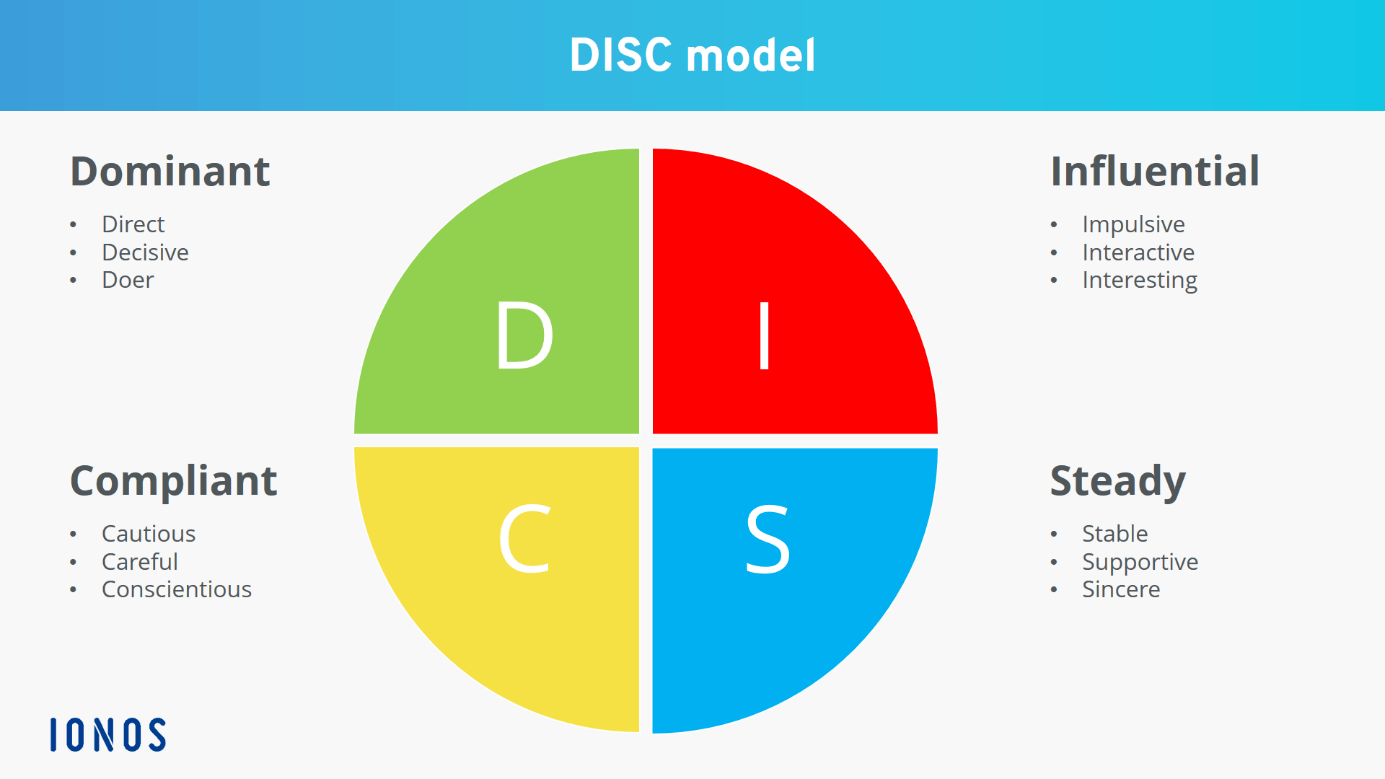
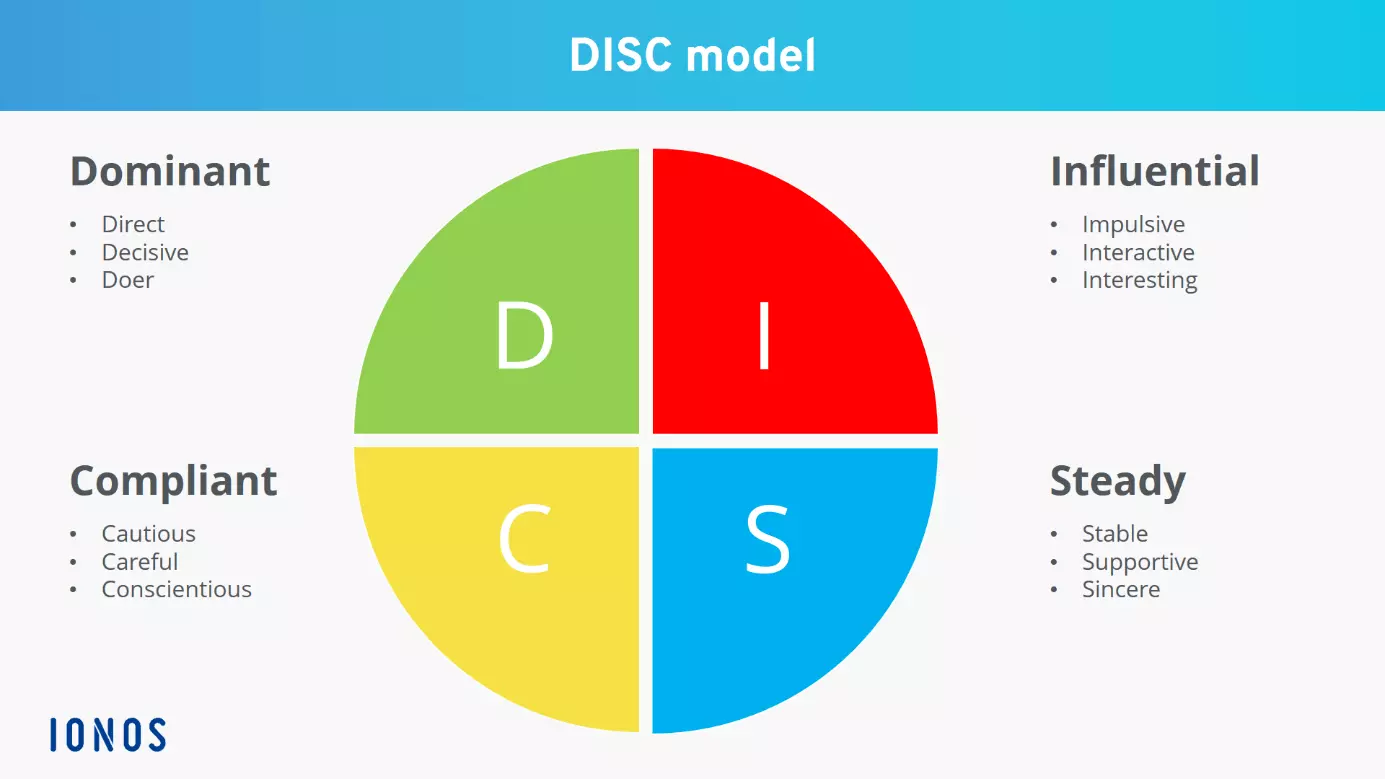
The DISC assessment defines four personality types that each have been attributed with different behaviours:
D = Dominant
The dominant personality type is strong-willed, confident, and firm. They enjoy challenges and like to take the lead. They communicate directly and act in a consequential and goal-oriented manner. Sometimes they are perceived as aggressive and ruthless.
I = Influential
The influential personality type is easily enthused by new situations and ideas. They are good communicators, open towards others, and enjoy working in a team. They talk a lot and enjoy it. Others perceive them as open and charming. However, they are not very detail-oriented, and are instead highly creative and outgoing.
S = Steady
The steady personality type is very helpful and likes to work on the sidelines. Harmony and stability are important to them. They enjoy teamwork and are regarded as likable and patient. The steady type is more conservative. They don’t deal well with change, and they appreciate a consistent work process as well as loyalty and long-term relationships.
C = Compliant
The compliant personality type is fact-oriented and aspires perfection. They work in a systematic way and like to plan ahead in a highly analytical way. Next to their hunger for knowledge and quality awareness, they are also defined by their diplomacy. However, they have difficulty in toning down their expectations of themselves and of others.
How to apply the DISC personality test in a company context
The DISC test has various areas of application in the workplace, as the results are useful when communication and collaboration need to be improved.
Personnel departments make use of the DISC text for existing employees – for example, to determine the most suitable department for them to work in – as well as for job applicants, to find out whether a candidate fits into a team. The DISC assessment is also applied in management training schemes, in sales, and in conflict situations.
It’s not only the company that benefits from the test, but also the interviewees. Employees (including CEOs) that complete this kind of test learn a lot about themselves and their needs, and can better determine where to specifically apply their strengths. At the same time, by being confronted with the peculiarities of each type, they are in a better position to understand customers, colleagues, and co-workers’ behavioural styles.
The test evaluation not only explains which characteristics make up a given type, but also provide detailed and practical information to apply in daily working life. For example, the evaluation explains:
- Under which work conditions a specific type is the most productive
- With which working style the person achieves the best results
- Which communication style is preferred by a given type
- The strengths and weaknesses of the DISC type
- How colleagues should act when working with this type of person
- What kind of conflicts this type is predestined for and how these can be avoided
Based on the area of application, some providers have specific DISC personality tests, which tailor results more specifically to the workplace context. Managers receive input on how their management style can be more effective, and sales representatives learn how DISC can help them gain more customers.
Criticism of the DISC assessment
The DISC assessment is among the most widely used personality tests in the corporate world. But it has been under scrutiny.
Critics say that the assessment tool is outdated. Scientific findings in personality psychology post 1920 are not considered. An empirical, science-based foundation does not exist. Quality criteria such as validity (are values that should be measured actually being measured?) and reliability (are results the same every time?) are not fulfilled. The fact that DISC personality tests seem to make applicable statements can be traced back to the Barnum Effect. According to this, we like to ascribe to desirable, widespread, or vague statements, although they are applicable to many different people.
In the last few decades, new assessments in personality psychology have been designed that speak of five key personality types: openness, conscientiousness, extraversion, agreeableness, and neuroticism. Four personality types alone are no longer regarded as true to our time.
Alternative personality test for your job and career
In companies, personality tests are very popular, because questions can be easily tailored around them (who is most suited for a managerial position? Which applicant is the best?) and show us ways to be more productive and improve collaboration.
The DISC test is only one of many personality tests. On a regular basis, new tests are developed that take current research results into consideration. Next to the DISC test, some of the most popular tests include the Myers-Briggs Type Indicator (MBTI), the Reiss Motivation Profile, and the CliftonStrengths assessment.
All tests however also have their weaknesses, and none can truly mirror the complexity of a person’s character. In addition, personality tests promote pigeonholing. Once we’ve labelled someone, it’s more likely that a person’s development is hindered rather than encouraged, since it’s reduced to type-specific strengths.
Using a personality test like the DISC massively depends on where it’s applied, the quality of the test, a competent evaluation of results, and their responsible implementation that takes into consideration that no test result can deliver absolute truth.
Please note the legal disclaimer relating to this article.
Reviewers

Anne-Laure Wolber
Anne-Laure has been part of the IONOS Digital Guide since its inception in 2016. As an expert in the startup category, she focuses primarily on the strategic integration of SEO, GEO and conversion rate optimisation. Over the years, she has also gained extensive experience in related performance disciplines such as lead generation and native advertising. As a polyglot, she leverages her multilingual background to develop content strategies with precision and impact for international audiences.

Christian Heldmaier
Christian Heldmaier is an experienced online marketing and SEO specialist from Karlsruhe. He has been working as an SEO Manager at IONOS since July 2020.