

Soft skills: definition and lists

Are you particularly team-oriented, ambitious, critical, empathetic, communicative, and well organised? Can you present well, manage your working hours, learn new skills, and work independently? Are you resilient, curious, self-reflective, and engaged? In application procedures, soft skills like these are often specifically sought after and almost every employer asks these questions when looking for new employees. These soft skills are not usually certified, but they have a significant impact on your character, it is therefore important to know the definition and types of soft skills if you want to be successful in the labour market.
What are soft skills and how do they differ from hard skills?
Soft skills primarily mean qualities such as the ability to motivate others and work in a team, but in a broader sense, they also refer to those character traits that make someone the person they are and are for that reason, hard to verify. Soft skills are roughly divided into three categories: personal, social, and methodical skills. These areas essentially deal with the following questions: How do you function as an independent person? How do you function as a social being? How do you deal with challenges? Soft skills like these often play a more important role after all the candidates have been interviewed, especially when there are several candidates with similar skills.
Hard skills on the other hand are relatively easy to verify through certificates and qualifications. They primarily consist of technical skills and competences that can be trained and often play a more important role during the initial application process. However, a soft skill like the ability to quickly adapt to a new role or to learn new skills may make up for a lack of specialist knowledge in a certain field.
Why are soft skills so important?
No matter how impressive your hard skills may be, it could be very difficult to cope with modern working life if you don’t have the necessary soft skills. Although there are jobs that require highly qualified experts rather than social skills, these jobs are rare. Team skills, communication skills, and organisational talent are required much more frequently – in other words, qualities that help you to influence the working atmosphere to a high degree.
Some jobs require more teamwork than others; it could be that one job presents you with new challenges almost every day and therefore requires a high degree of independence and flexibility, while another job requires a high level of mental resilience and discipline. It is therefore impossible to say which soft skills are generally more important than others, but as long as you have a sufficient set of soft skills, this should be of tremendous help in any job.
How do I communicate my soft skills?
While hard skills are often listed in your curriculum vitae, it's not easy to list your soft skills. Even if you’ve got an idea of what to write, you can't really say you're a sociable person or that you're a quick learner without having any proof. Ideally, you should make your soft skills implicitly clear in your application letter. Here are a few examples:
- You can influence whether you appear sympathetic, creative, or headstrong with the way you formulate your cover letter.
- You can underline your character with the way you present your application documents. An original design can show your self-confidence and creativity, for example.
- If you worked during your studies, this usually demonstrates high stress tolerance and self-discipline. Depending on the type of activity, you can also draw conclusions about your team skills.
- Stating that you worked voluntarily in your CV can point out that you are a socially competent person with a high degree of self-motivation.
- A CV often includes hobbies and interests. A team sport, for example, promotes your social skills; an interest in strategy games indicates strengths in solving problems.
- Last but not least, your application photo also says a lot about you. If you can present your authentic self without seeming unprofessional or uptight, you will stand out in a positive way. In any case, invest in a photographer who presents you accordingly.
Thanks to our interview tips, you can learn how to recognise your strengths – which definitely include your soft skills – and how to communicate them during the interview.
What soft skills are there?
No list of soft skills is really complete; after all, there are many human traits that are often difficult to conceptualise. In addition, many of the traits listed below intertwine so that they interact constructively. The soft skills ‘resilience’ and ‘stress resistance’ overlap as often as ‘analytical skills’ and ‘self-reflection’. Therefore, the amount of soft skills is just as important as how well they work together.
No-one is perfect. Nobody expects you to master all soft skills comprehensively. Depending on your job profile, colleagues, work environment, etc., some are more important than others. Sometimes one characteristic is mandatory, while another plays a subordinate role. So don’t read this list as a guide to what you need to know, but rather as a glossary of possible important soft skills.
As mentioned above, soft skills can be divided into three categories:
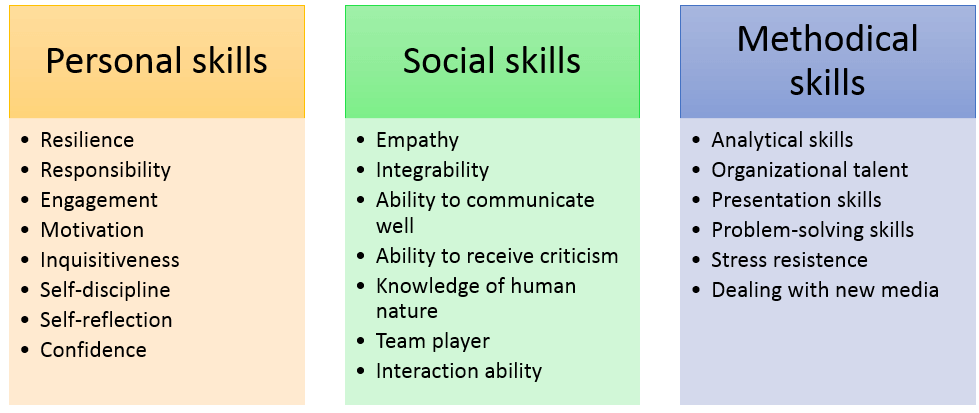
Personal skills
Personal skills include all the skills that distinguish you as an independent person. Many of them are overridden by the other categories. Therefore, it can be easier for a confident and self-reflective person to motivate others in social situations. Motivated and committed people are usually more willing to acquire or expand their methodical skills.
Resilience
You work a lot, but rarely find it overwhelming. In times of increased expectations, you manage to fulfil requirements without suffering from a subsequent drop in performance. You face unforeseen events and developments with determination and have a high stress tolerance. This also makes you a role model for less resilient colleagues. Every employer appreciates reliable employees who can withstand turbulent times.
Responsibility
You can work well independently and assess the consequences of your actions correctly as well as accept them and use them for further development. People with personal responsibility stand up for what they do; they are mature and self-determined, but also solidary. Personal responsibility does not rule out taking responsibility for others. As a self-reliant person, you master the challenges of everyday life on your own. This also includes standing by your own mistakes, being liable for any damages that may have arisen, and remedying them independently.
Commitment
You are ready to leave your comfort zone, tackle new challenges, and use your skills for purposes that you don’t necessarily profit from directly. Dedicated people invest time and energy in helping others, for example, by working on social projects. At work, commitment means not just doing your job, but giving more than what is expected. Committed employees often have a positive effect on the entire work environment, this is also one of the soft skills that can help you advance your career.
Motivation
You are willing and striving to achieve certain goals and perform tasks well. Motivation is your inner drive, which makes you a reliable and satisfied worker. However, for this to work, you have to enjoy what you do, because real motivation comes from within. Many people motivate themselves by setting themselves a realistic goal and promising themselves a reward at the end. Sometimes, being appreciated by colleagues and superiors, financial security, or a quiet evening after work is enough. Everyone motivates themselves differently, it is just important that you establish your own motivation factors.
Inquisitiveness
As an inquisitive person, you have an inner desire to experience new things and to get to know the unknown. Finding out information is as appealing to you as finding out the interests of others that you’ve never really talked to before. Inquisitiveness does not always have positive connotations in our society; people who are too curious are often regarded as annoying. A healthy curiosity is an important motivation for people to seek new challenges and to explore previously unfamiliar territory. In the workplace, this means that you are interested in tasks and skills that initially have little or nothing to do with your job profile.
Self-discipline
You’re in control of yourself and know how to act. It’s hard to distract you from your main tasks. You react confidently to unforeseen events and do not lose sight of your goals. Certain phases of your day-to-day work require concentration and focus, which you master with self-discipline. The basis of intact self-discipline is an ongoing process of self-control.
By always critically questioning your actions and correctly arranging your priorities, you achieve a high degree of self-discipline. At work, this means that you prioritise your tasks appropriately and successfully control anything that could distract you, such as private interests and idleness.
Self-reflection
You can critically evaluate yourself and your work and learn from your mistakes. At the same time, you know when you did a good job. Self-reflection is one of those personal skills that has the most internal effect. At the same time, the effect can also be felt on the outside: Self-reflective people are quick learners and grow with their tasks. This also includes knowing what you cannot do. For good reasons, certain tasks are better left to experts and should not be performed by non-professionals (e.g. server maintenance, backend programming). Self-reflective people run less risk of overestimating themselves and causing damage.
Confidence
While self-reflection requires you to be aware of your weaknesses, confidence requires you to recognise and implement your own strengths. Self-confident people never sell themselves short, but know their value. A strong sense of confidence spreads to many other skills and areas of life because self-confident people have a solid character. This means that they are not afraid of new challenges or of expressing their opinion.
Social skills
Soft skills often refer to those skills that involve social interaction, i.e. colleagues and superiors. For many employers, for example, it’s important to know whether an applicant is a team player or is particularly communicative during an interview. Social skills cannot replace professional qualifications, but they can enhance them and, in some cases, make all the difference. Depending on the job description, they can even be a key prerequisite.
During the application process, employers try to get a realistic picture of the applicant's social skills. Conversely, your social skills often determine how settled you feel at work and how you interact with other colleagues, which is what most jobs require – even in offices with computer workstations.
Empathy
Being empathetic means that you put yourself in your colleagues’ shoes – whether it be in the event of success or failure. Your social intuition also enables you to react sensitively and respectfully to certain situations. Some external or personal factors may also have an impact on your work. If, for example, an employee’s performance isn’t up to scratch because they are going through a tough time in their private life, show understanding. Empathy in the workplace helps you stay human in difficult situations.
Integrability
Social structures are often difficult to break down. When you start a new job, however, you don’t have to try too hard to integrate yourself into the existing social groups and help them flourish. You do not remain the ‘new’ person for long, but manage to become an independent part of the social group in the workplace. Colleagues quickly turn into acquaintances or even friends. Integration does not mean merely complying with the prevailing conventions. Capable of integrating well, you manage to help shape the environment. You will quickly become an essential part of the social construct.
Ability to communicate well
The ability to communicate well is one of the most important skills in many companies. As a communication expert, it’s easy for you to formulate your thoughts concisely and to be a suitable conversation partner. This often also extends to digital platforms on which you maintain a pleasant tone (e.g. in chat or by email). You will also be able to correctly interpret signals and understand instructions. You can also communicate any concerns you have confidently and this skill will more than likely be put to the test during your interview.
Ability to receive criticism
You have the (quite rare) ability to deal well with any criticism you may receive. This means that you neither react impulsively nor emotionally to it, but use the input to improve yourself. Criticism often hits people unprepared and harms their self-confidence – they feel attacked and are pushed out of their comfort zone. However, criticism usually has a justified origin; those who know how to deal with it and use it constructively will tend to advance quicker.
Knowledge of human nature
Knowledge of human nature is a rather vague term. At its core, it describes the ability to assess people as correctly as possible based on certain indicators. Knowing a lot about human nature, you are more likely to achieve the desired result through your own actions. At the same time, you anticipate the actions and reactions of others very accurately. This ability is extremely practical in everyday life. Knowing a lot about human nature is particularly advantageous in professional fields where you work directly with customers, patients, or clients.
Team player
Working in a team is the main feature of many workplaces. As a team player, you can deal with dividing tasks, group communication, authority, and many other aspects that are important when working with other people. It is easy for you to get involved. The ability to work in a team also requires you to make profitable use of other social skills. People who are able to work in a team usually carry a wide range of soft skills that will help them in every workplace. In the modern world of work, the ability to work in a team is one of the most frequently desired skills for which applicants are consciously tested.
Interaction ability
This is the way you interact with people. There are people who often joke and thus create a relaxed atmosphere, but who sometimes run the risk of not being taken seriously. On the other hand, there are people who act very seriously in the workplace and attach great importance to goal-orientated communication. They look professional, but could also come across as boring.
A ‘good’ style of interaction is being in the middle of this spectrum. You should appear competent and reliable without being considered boring or uptight. Your interacting style influences your effect on other people to a large extent.
Methodical skills
This category comes closest to hard skills, because methodological skills often manifest in practical expertise. However, these skills are not so easy to demonstrate since they are often the basic prerequisite for acquiring verifiable hard skills. For example, the soft skill ‘presentation skills’ is an essential basis for the hard skill of being able to operate ‘PowerPoint’, while problem-solving competence is necessary for learning programming languages.
Methodical competencies (e.g. stress resistance) also often overlap with personal skills (e.g. resilience). Nevertheless, methodological skills belong in a separate category because they not only cover the personal spectrum, but also support or even define much more direct professional skills.
Analytical skills
Analysis means uncovering the mechanisms behind complex facts and breaking them down into their most important components. Your analytical skills make you a precise observer who puts the knowledge gained into practice in order to constantly help yourself, your method, and your team improve. Especially when it comes to failures, it’s important to use your analytical skills because this is the only way you can learn from them. A certain degree of self-reflection, and communication skills will help you tremendously.
Organisational talent
Sometimes professional life means you have to juggle several tasks since they cannot be completed at once. The ability to arrange lots of tasks makes you a reliable individual. If you have a distinct organisational talent, you can prioritise things in a meaningful way and structure your day-to-day work and that of your employees in such a way that they work as efficiently as possible. Organisational ability is a soft skill that becomes all the more important the more independently you work and the broader your range of tasks is.
Presentation skills
You have a confident demeanour and an engaging way of speaking, and can therefore present excellently. Whether it’s a PowerPoint presentation to present a specific project or a summary of your progress in a team meeting, your presentation techniques will ensure that the issues are communicated in an understandable way. This soft skill increases in importance as you move up the corporate ladder.
Problem-solving skills
This soft skill is closely related to your analytical skills. Problem solving requires an appropriate strategy, and to find it, you need to have a clear understanding and analysis of the problem. As a competent problem solver, you will face any challenging development with an alert mind and creative ideas. No matter the problem: You find its source, recognise the consequences, and develop a suitable strategy to solve the problem. This ability can easily be trained in a playful way, for example, through challenging computer games or mind sports.
Stress resistance
The ability to deal with stress is primarily based on your personal skills. Resilience, responsibility, and motivation work together in order to reliably master the often unpredictable challenges of everyday life. There are many techniques for coping with stress, but stress resistance comes from a strong character. As a methodical skill, it also refers to the ability to nip any possible stress in the bud through a high degree of discipline, self-organisation, and self-reflection.
Dealing with new media
Today's digital landscape offers many possibilities, but also many dangers. Using new media (social networks, online platforms, business networks, etc.) in a skilful and sensitive way is an important soft skill for representing not only yourself, but also your colleagues and the company to the outside world. Using this media in a careless way can cause significant damage, e.g. if you reveal sensitive company information via private accounts or complain about your workplace on social networks.
Be aware that social networks, in particular, have changed the way we present ourselves to the public, so use them in a way that doesn’t damage your reputation or that of your company. In general, you should develop a certain flair that enables you to use your personal and social skills successfully online.