

What is a paywall?

A paywall describes a method of restricting access to online content via a paid subscription. Especially digital content providers like newspapers or magazines and their respective publishing houses use paywalls to monetise their websites. According to a recent study by the Reuters Institute for the Study of Journalism, 33% of newspapers and weeklies in the United Kingdom now have a pay model in place. In other words: Internet users can no longer read a spectrum of online content entirely for free, and instead are increasingly being met with paywalls.
In the analogue publishing industry, the paywall concept has already existed for a long time in the form of subscriptions: If you want regular access to current articles and to the contents of a print product, then you have to complete a subscription. Likewise, if you want to pick up your morning paper at the newspaper stand, then you’re expected to pay. In the past, newspapers, journals, and magazines were financed by subscriptions, retail sales, and ads, and continue to do so to a lesser extent today. Increasingly, publishers now also carry this payment model forward to online media.
A paywall is a digital payment barrier that publishers set up for select online offers. Users can only access content behind the paywall after paying a fee or by completing a subscription.
With a growing online journalistic offering, the revenue made through print subscriptions and retail sales has decreased, as during the 2000s the greater amount of digital content belonging to online newspapers was still free. In the mid 2010s, a shrinking amount of readers were buying newspapers and magazines at a physical shop: The internet became more and more important for information gathering, and the behaviour of newspaper readers changed with it. Newspapers’ print versions were being bought more rarely.
Today, journalistic content is for the most part read online. So, publishers have had to find a way to monetise their journalistic work online. The solution: payment barriers. Overall, the UK charges the highest average fees for newspapers and weeklies per month, but has the lowest proportion of titles requiring such payments.
Different paywall types
Different kinds of paywalls exist: publishers use different models to offer customers a variety of digital subscription offers. Some are so subtle that readers won’t even perceive them as a paywall, while other models act as hard payment barriers that can’t be worked around. Paywalls are therefore classified in different friction levels.
Hard paywall
In this model, a selection of web content is closed to non-subscribers. Users that don’t complete a digital subscription with the provider also don’t have the option to read any of its articles. This kind of barrier is not as common, because when readers stumble across hard paywalls then they’re usually inclined to find the desired information elsewhere. The risk that otherwise interested readers should leave for a competitor is therefore very high.
In addition, a tough payment barrier will hugely affect a website’s visitor numbers. For this reason, fewer advertisers might be prepared to show their ads on these platforms. However, well-known newspapers and magazines with a hard paywall do exist: the Wall Street Journal, the Financial Times and the British Times are among them.
Soft paywall
A soft paywall (also known as a freemium model) provides free content and premium offers. Users can read a big selection of articles on websites with a soft paywall without paying fees or completing a subscription. However, individual articles are offered as premium content, and are only visible to paying customers. This freemium model is the most widely used method to partially monetise digital content in the newspaper landscape. While this model is particularly strong in France and Germany, in the United Kingdom this type of paid content is rare, with only 5.5% of publishers putting it in place.
Metered paywall
Another option that provides a softer payment barrier is the metered model. Stemming from the word “meter” for “measure,” a metered paywall is a payment barrier that dynamically adapts to its users. Generally speaking, all content displayed on a website with a metered paywall is free, but every user has a cap on the number of articles that can be accessed.
With the assistance of technical materials (newspapers often use cookies, publishers are able to follow how many articles a visitor has read per month. Once the limit has been reached, the user must buy a subscription or wait until the next month, when they’re able to read free articles again. While users can easily leverage on this model, many websites using this model require user registration, allowing them to better understand their readers’ behaviour. In the United Kingdom, the Telegraph launched a metered model in 2013, but in 2016 decided to replace it with a premium digital subscription.
Dynamic paywall
Next to the metered model, different dynamic payment barriers exist, which perfectly adapt to a website visitor’s behaviour. Publishers can, for example, evaluate data on returning customers and user profiles. After just a short time, publishers are able to understand their reading habits, interests, and the anticipating selection of articles they will read every month.
For a user who returns to the page several times a day to read business news, a dynamic paywall will relatively quickly point to the payment barriers. On the other hand, a reader who visits the page just a few times every week and reads only a few articles will continue to be able to read content for free. New York Magazine employs this kind of dynamic paywall and calculates the probability that a reader will complete a subscription based on data. The challenge is to consistently deliver value to make sure readers return.
Voluntary donations
The most unobtrusive payment model to monetise digital content is one based on voluntary donations. More than a million readers financially contributed to The Guardian so that it could stay free and outside of a paywall, either through one-off or ongoing support to help make the newspaper sustainable. In this open paywall model, donations are made by readers who value the newspaper’s editorial independence and commitment to investigative reporting. While readers can freely engage in all content on the site, a sidebar links to various funding options.
Many individuals working independently in the media and creative industries are also looking for ways to give readers the chance to pay voluntarily. On Patreon, users can support a chosen content creator with a monthly payment, receiving exclusive offers in return.
An overview of paywall models
| Hard paywall | Soft paywall | Metered paywall | Donation model |
|
|
|
|
| Financial Times, The Times | BBC, German tabloids including Bild | Washington Post, New York Times | The Guardian |
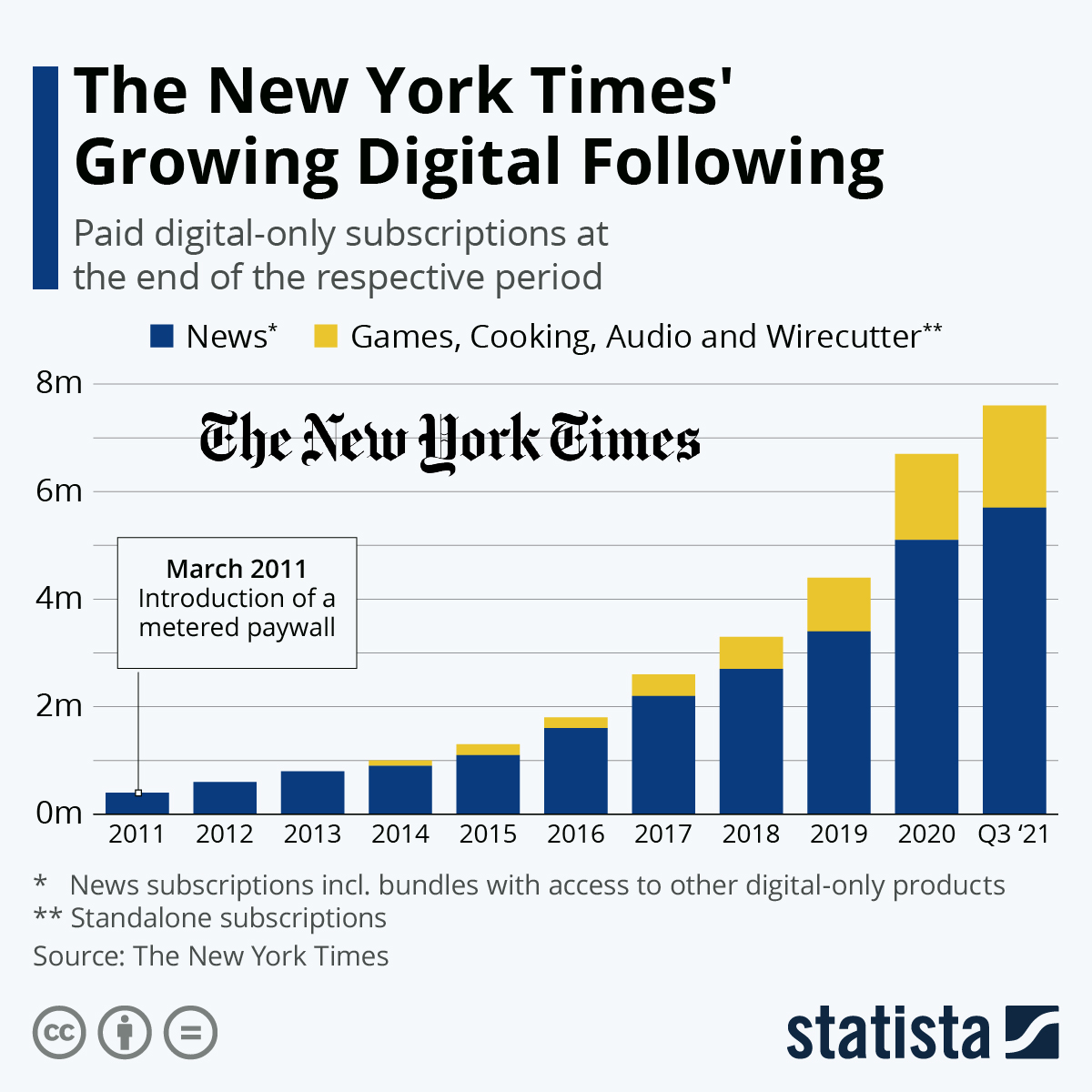
Seven and a half years after the introduction of its metered paywall, the New York Times managed to acquire more than 2.5 million digital news subscribers. This number accounts for 36% of the company’s subscription revenues in the first nine months of 2018.
 You will find more infographics at Statista
 Paywall critiques
Paywalls are especially problematic when altogether relevant information and news is sealed behind payment barriers. Critics argue that those with a lower income don’t have the financial means to pay for this kind of premium content. The principles of the open internet and freedom of speech are buried due to this. In addition, paywalls can also promote digital bubbles, since readers with a monthly digital subscription will be more inclined to read articles written by that source. Moulding public opinion therefore becomes easier.
Paywalls can also have negative effects on the marketing efforts of media providers. Hard paywalls can lead to a decreased number of website visitors. And since fewer users will see ads on this website, advertisers may instead choose to run their ads with publishers employing soft paywalls or metered paywalls.
Different paywall providers
A host of paywall providers exist for the UK market. Their sophisticated mechanisms allow publishers to monetise on a single article by employing a paywall.
Steady
The German start-up Steady offers paywalls for different kinds of online content. Different memberships allow providers to turn everything from articles, podcasts, and newsletters into money. Besides the membership option, Steady offers possibilities like advertising and donation models.
Blendle
This Dutch company has until recently offered individual articles for sale in a digital newspaper stand. Via micropayments, users had access to their articles of choice, without having to commit to a subscription. In August 2019, this strategy was given up in exchange for a premium subscription model. Now, Blendle offers select news articles for a small monthly fee, oriented around the business model of big streaming providers like Netflix and Amazon.
MPP Global
The award-winning subscriber management and billing platform of MPP Global, eSuite, is designed for the media and entertainment industry to power paid content strategies. It supports freemium, metered, and dynamic paywalls with maximum flexibility, and boasts a client list that includes Sky and NBC Universal.