

Working as a team: How teamwork leads to success

When people with different skills and personalities work together on a project, share tasks, and take joint responsibility for the bigger picture, they are often said to be working well in a team. But what exactly characterises ‘work as a team’ and what factors determine its success and failure?
- Familiar Google tools all in one place
- Using Gmail with your domain from IONOS
- Configure business Gmail for your domain
Teamwork definition
Traditionally, teamwork refers to the process of several people working together on a single project or toward a unified goal. Everyone takes on their individual tasks and regularly exchanges information with team colleagues to update on status and progress. However, there’s much more to good teamwork, because in the best-case scenario the team shares responsibility for the success (of a project or a company), trusts other members, and enjoys working together.
Why successful teamwork is important
Before we look at the prerequisites and the characteristics that make up good teamwork, let’s look at the advantages of working as a team (for companies and employees). The emphasis here is on ‘good’ teamwork because unsuccessful teamwork can have numerous disadvantages.
Teamwork has the following advantages:
- Knowledge transfer and power of innovation: Once tasks have been assigned to team members according to their skillset, other members can benefit from this knowledge transfer. Regular exchanges also foster new insights and ways of finding solutions. As a result, challenges can be solved that an individual employee may not have been able to handle alone.
- Increased productivity: Problems are eliminated more quickly and everyone can focus on what they do best.
- Increased motivation: On the one hand, ‘friendly’ competitive pressure spurs on employees to give it their all or improve their performance. On the other hand, teamwork can foster a sense of community.
- Greater personal responsibility: If inter-team communication runs smoothly, individual employees tend to work more independently.
- Joy and well-being: Working in a good team is more fun than everyone fighting for themselves. This also leads to a higher staff commitment and a decrease in staff turnover and fluctuation.
How to teamwork successfully
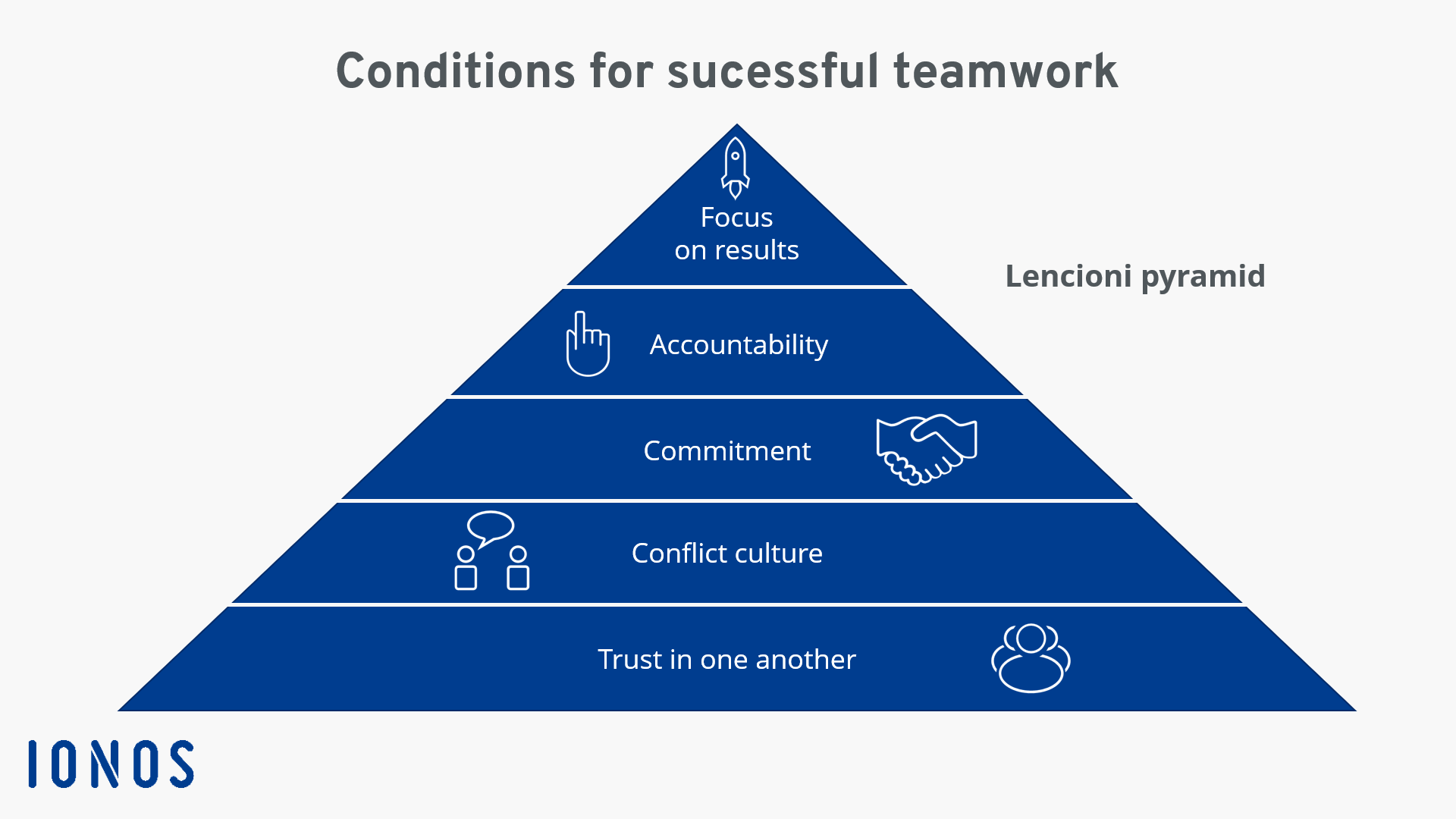
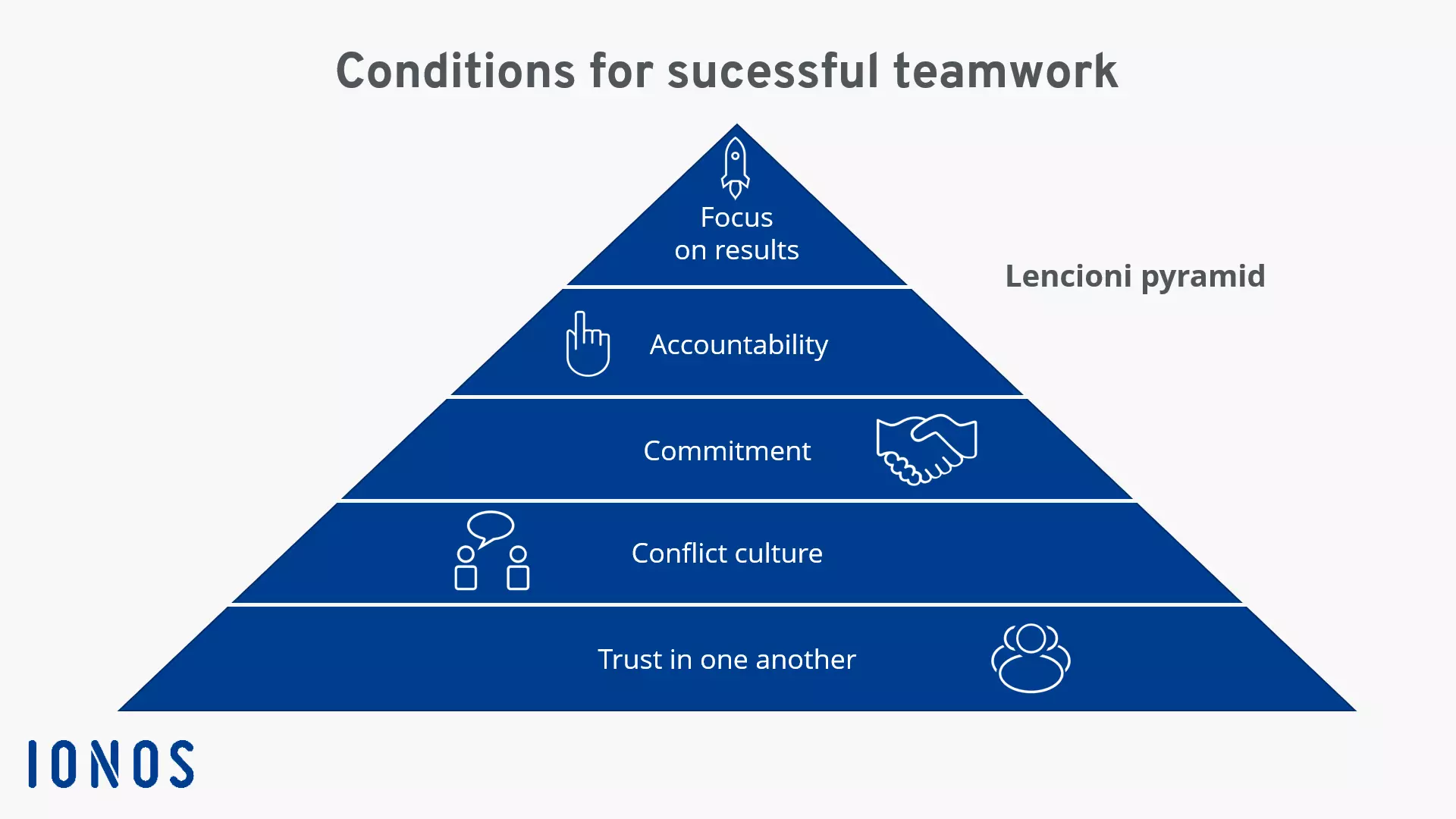
American management consultant Patrick Lencioni developed the so-called Lencioni Pyramid, that highlights five blocks which are decisive for good teamwork – each block building on the other. The pyramid highlights which characteristics are required for successful teamwork. Based on trust, a conflict culture can be developed, and commitment is created based on mutual trust. This extends the sense of responsibility or accountability for the whole team and enables members to focus on results.
In addition to the Lencioni Pyramid, there are other studies and observations discussing the conditions for successful working in a team. The most important ones are:
Open and regular communication
Regular meetings to discuss work in progress are indispensable. Ultimately, each team member should be aware of what another one is doing at all times. When it comes to workplace communication or communication within a team, it is important that every voice is heard equally and that even unpleasant topics can be addressed openly – be it issues with solving tasks or issues among team members.
Common understanding of goals, values, norms
On the one hand, there should be agreement on what exactly should be achieved by when, but above all: how is it achieved? How do individual team members want to collaborate? How often do they want to exchange ideas? How do they deal with issues? In order to be able to answer these questions, it is important to work out common values and norms on how to discuss, debate, and communicate with others.
Knowledge and function must go together
People tend to work more productively when they are doing what they’re good at and enjoy doing. That's why tasks should be distributed in such a way that position and function fit together. It should be possible for team members to be promoted to new positions if they so wish. As new areas of responsibility arise within a team, all staff should be involved and heard when these areas are distributed.
Diversity
Even if a team is dealing with a specific task, it is important that team members with similar experience and skills do not work together exclusively. The broader the skillset of the team, the better. This does not only refer to technical expertise. Different personalities and ways of thinking, diversity and inclusion are good foundations for teamwork.
Working as a team instead of a one-man show
Good teamwork only works if no single member pushes themselves to the fore. Comradery is quickly destroyed if one person starts to act as a leader. Progress must be celebrated as joint success.
The working environment should be team-friendly
If teamwork isn’t working out, it may not be the fault of its members. Sometimes, the environment isn’t working in their favour. This could be due to a counterproductive leadership style of the management or because a company undermines successful collaboration through outdated working models or not enough meeting rooms and tools.
Useful tools for successful teamwork
Aside from using the right software, the right way of working is important: Agile working, for example, is a method that relies on a dynamic working atmosphere for teams: autonomous, collaborative and making optimal use of the technical possibilities.
Cloud solutions such as Microsoft 365 or Google Workspace, support digital collaboration. Cloud-based offerings, such as HiDrive storage including backup function, are also recommended for storing and editing files collaboratively. For team communication, Slack, Zoom and alternatives have become established players in the field. For organising tasks and projects, there are extremely powerful solutions such as Jira or free offerings like Asana or Trello.
All these tool ideas are easy to implement and help teams work together successfully.
Challenges and problems when working in a team
Though the advantages of working in a team generally far outweigh the disadvantages, there are some potential stumbling blocks that managers should be aware of and aim to counteract in good time. These include:
- Increase in effort to coordinate projects and communicate with others.
- Individual team members’ successes depend on the work, motivation, and quality standards of others.
- Antipathy between two or more members inhibits teamwork.
- Employees may withhold their true opinions to avoid being singled out (Group Think).
- Individual employees rest on the ambition and success of others (social loafing).
Team leaders and supervisors counteract many of these dangers through regular exchange with individual team members. A good basis of trust and an open team culture are central here.
- Up to 50 GB Exchange email account
- Outlook Web App and collaboration tools
- Expert support & setup service