

Targeting

Targeting is rooted in online marketing. Companies often spend large sums of money on marketing campaigns. The goal: to make a product as public as possible in order to increase sales. However, not all people are equally interested in the product being advertised. Only potential customers should see advertising banners, videos, or search engine ads when targeting is done correctly. Targeting finds the right group that might be interested in the respective product or service. The more precise the filter restriction, the less scattering loss a company will record. What you’re advertising will determine which targeting methods are suitable. Combine various methods to adapt your marketing measures to future or existing customers as well as you possibly can. By not displaying ads too frequently (frequency capping), you can prevent a degree of rejection, or even banner blindness, meaning customers will be more likely to buy.
Targeting is an online marketing process that refers to the targeted placement of advertising elements on websites or in search engines. Target groups are addressed as directly as possible. Individualised advertising is designed to avoid waste, increase sales, and retain customers. Keyword targeting is a common tactic. There are several technical and text-based targeting methods.
Short explanation of terms: scattering loss
If you reach more people than the planned target group, it’s a waste of your company’s energy and you will miss the mark. Since only a small percentage of these users are interested in your product, the scattering and potential sales don’t correlate with each other. The difference between distribution and dispersion is known as scattering loss. It causes unnecessary advertising expenditure. You should define a target group and analyse their data on visited pages, cross-topic preferences, and competitive keywords. Thus, implementing your scattering plan in a targeted manner.
How target marketing works
Within an advertising network, websites exchange data with each other in order to obtain the most accurate customer profile they possibly can. This is often done using browser cookies. The small files contain not only a website’s preferred settings in the respective browser but also target group relevant customer data such as age, gender, region, purchase decisions, and search history. Network partners use the data from the cookies to place targeted advertising on other network sites. Before you start a campaign, analyse your customer data and make sure you define your target group.
Advertising networks such as Google AdSense, Amazon PartnerNet, and Facebook Audience Network impress third parties with a multitude of statistical data. This is due to the fact that these operators are market leaders in their respective fields (search engine, online trade, social media). Millions of users around the world provide personal information, use the search function, and share their interests through likes. Advertisers configure their distribution planning based on these criteria. Ideally, users will then only see ads that interest them. For example, if you are looking for local bathing facilities and have specified your relationship and whether you have children on Facebook, you may receive offers for family-friendly accommodation at the nearest lake or ads for beach toys. Why and how each user sees a specific banner depends on the respective targeting method.
By addressing the right target group, you theoretically provide users with everything they need or could want. If you are also in direct contact with your customers e.g. via newsletter or social media, they will feel directly addressed and valued. This is how you build up a loyal customer base. In addition, the information pool is growing, which helps you to anticipate your target group’s wishes.
Do you want to place targeted advertising? Read more about advertising networks such as Google AdSense and its alternatives for smaller shops.
However, the use of personal data has also been criticised. On the one hand, people are becoming more and more sensitive when it comes to data protection. The idea of a 'transparent client' where there is a treasure trove of personal data that is analysed and evaluated (or misused) is no longer a futuristic vision. That’s why, despite all the eagerness for personalised advertising, the security aspect cannot be ignored when customer data is at stake.
On the other hand, if you follow your customers everywhere they go online it’s going to have the opposite effect. Potential customers might get irritated if they are confronted with personalised advertising every time they click on a new site. Some of them will delete their cookies. Frequency capping helps you to not go overboard with ads by regulating how often they appear.
Targeting methods briefly explained
When gardeners plant turnips, they don’t just spread the seeds on the plot. They actually make ruts to keep a precise distance between the vegetables and then plant the seeds one to two inches deep. Grass seed, on the other hand, is easily thrown on the soil and then kept watered. If these cultivation methods were switched, neither the turnips, not the grass would grow. Similarly to this example, the result of a marketing campaign depends on customer demands and the targeting method chosen. You need to really think about your target group and combine the relevant targeting tactics. We have put the methods in two categories: technical targeting and user and environmental targeting.
The technical methods analyse at which times your target group uses the internet. They determine the location and the technical requirements. These methods enable you to reach your target audience when they are at their most receptive to advertising. In addition, you can ensure that devices and browsers optimally display your advertising material. The strategies that deal with users and your content rely on a detailed analysis of search queries and the ways your customers behave online. Only place advertisements that users will find helpful or interesting.
| Technical targeting methods | Technical targeting methods |
|---|---|
| Temporal | By keyword |
| Regional (Geo targeting) | Semantic |
| Bandwidth | Contextual |
| Compatibility with operating system and browser | Sociodemographic |
| Behavioural | |
| On one channel | |
| On social media |
Temporal targeting
This method includes frequency capping and limiting how often advertisements are shown. With frequency capping, advertising within an ad network only appears to a user a limited number of times. You can also restrict the absolute number of times an ad is displayed per user. This way you can avoid bombarding users, especially those who reject your content or barely notice it. In addition, it is possible to limit your ad’s display time, ideally to certain days or times when the majority of your target group is online. This is how you get the most out of your campaign.
Regional targeting
Geo targeting takes the user’s location into account in relation to your offer. Regional service providers such as artisans or events such as trade fairs benefit from a site-specific strategy. For example, if you are looking for a locksmith, the results will suggest services close to your own location. Regional vendors avoid scattering loss because they limit themselves to their real customer base. Regionally limited advertising also makes sense in media offers whose copyright is regulated differently from one country to another. You can define the catchment area to continents, countries, individual cities, or even districts.
Bandwidth targeting
With this strategy, you can set the bandwidth at which your ad appears. If your smartphone or device has slow internet access, detailed banners or videos will increase upload times. In some cases, browsers even abort the download process, which is annoying and disrupts your time online. It also means that your ad isn’t seen by the audience. Broadband surfers, on the other hand, are able to see funny videos or informative banners.
Compatibility targeting
The appearance of websites differs depending on the browser and operating system being used. In addition, devices such as PCs, tablets, or smartphones all differ in size and format. Customise your ad banners for popular formats and browsers so they look good no matter which device is used. As a provider, it’s helpful to know which operating system is used most frequently so that you can design the banner ad for this system. Others, such as software developers, customise the content of ads to the operating system. Do potential customers use Windows, Mac, or Linux? Relevant advertising offers products that are compatible with the respective operating system or indicates which updates can be performed. If your audience only browses with Chrome or Firefox, it’s sufficient to distribute the ads for these browsers.
Keyword targeting
Keyword targeting is a marketing method that presents users with promotional content based on their search input and helps with search engine advertising (SEA). Beforehand, you have to select individual keywords relating to the advertised product. You set these as target keywords when you book your campaign in the ad network. As soon as internet users enter these words into the search engine, your advertisement will appear in the results. For example, if you’re offering a travel package including flight and hotel in Tenerife, you should select related keywords such as 'beach holiday', 'snorkeling in Cancun', and 'Cancun flight'. When users search for 'snorkeling' and 'Cancun', they will receive your offer as sponsored content or as a sponsored ad in the search results – providing the ad is tailored enough and there isn’t competition for the best position in the search results.
Contextual targeting
Contextual targeting doesn’t display ads according to individual search words or phrases. Instead, the method focuses on the interest surrounding a topic that potential customers are focusing on. That’s why this involves placing ads on websites that match the topic. Topic-relevant keywords are especially important. This screenshot from the web EatSmarter! shows banners and text ads in an article dedicated to healthy eating on a budget.
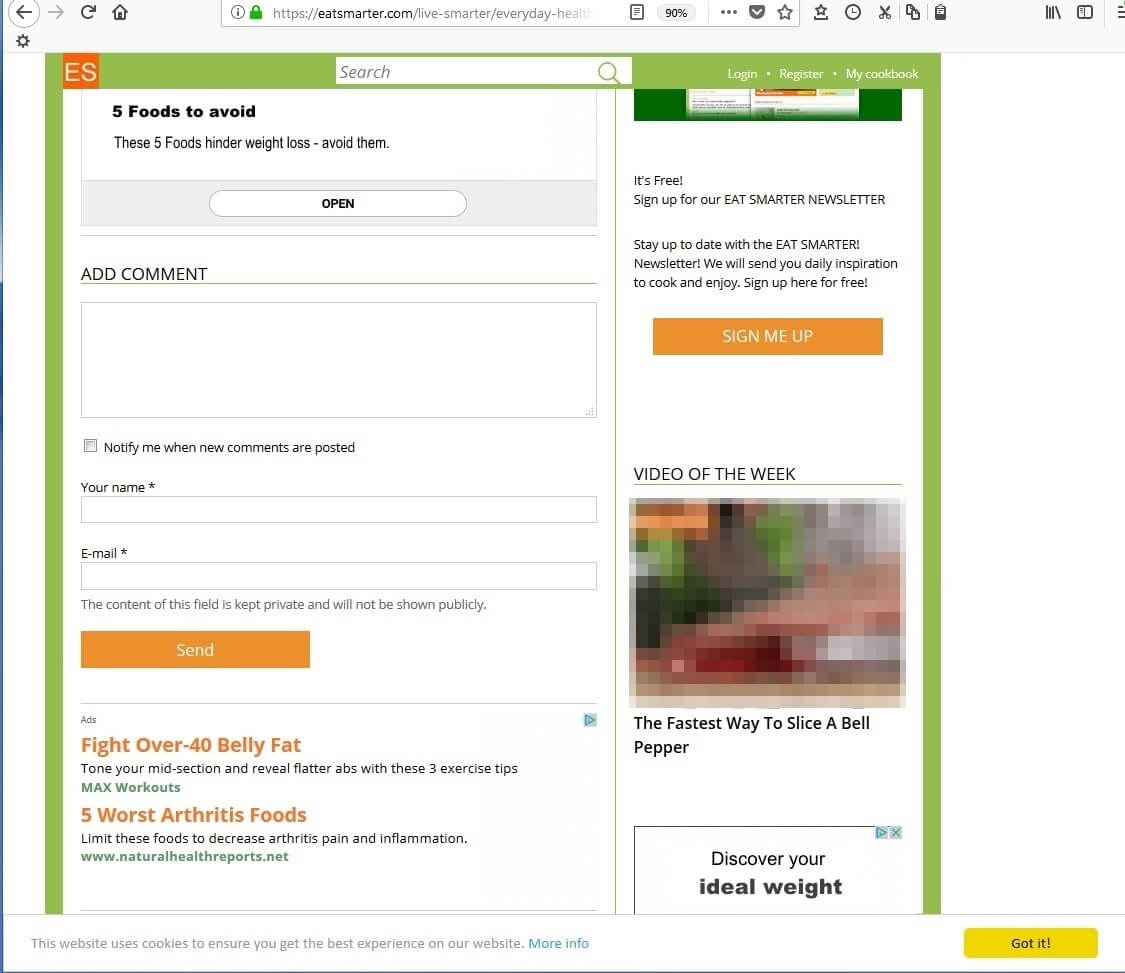
The keywords here are 'food', 'health', and 'cheap shopping'. Three out of the four advertisements are to do with food and health:
- 'These 5 foods hinder weight loss – avoid them'
- 'Fight over 40 belly fat'
- '5 worst arthritis foods'
The banner in the lower right corner ('Discover your ideal weight') advertises a BMI calculation app. Thus, it comes under the category 'health/weight loss'.
Contextual targeting, just like keyword targeting, focuses on keywords. It looks at them in connection with other thematically relevant keywords in the text. Readers who are interested in the topic may find the adverts relevant, which improves the chance of them clicking on them.
Sociodemograic targeting
Market research provides statistical target group data that marketing analysts can evaluate and use for their needs. For example, if the customer base voluntarily reveals their age, gender, and academic degree, advertisers target content based on this information to set appropriate targeting filters.
Channel targeting
Channel targeting assigns ad media to specific topic channels. A channel includes a number of thematically limited websites or matching subpages of larger domains. Advertising for private homes appears on home and garden portals, construction planning sites, or in the real estate section of a larger news network. Target marketing on a channel is particularly useful if you want to promote your own brand. This way, you can limit the distribution to channels that require a basic interest in your products or content.
Semantic targeting
Semantic targeting is a marketing tool that is constantly changing. Instead of individual keywords, this method decrypts the full textual content of a website. Synonyms are recognised as well as full expressions. Existing databases are continually being expanded since language is constantly evolving. False drops (wrongly-placed ads that have nothing to do with the topic of a website) can be damaging to businesses and should be avoided. The tool also improves targeting since it recognises matching subpages on domains that would otherwise be located outside the thematically relevant categories, thus avoiding false drops.
Behavioural targeting
Behavioral targeting accompanies potential customers through the web. The tool creates customer profiles based on cookies and search entries. If users are doing a lot of research about holidays, they will then receive travel-related offers. If users keep repeating searches, click on banner ads, or stay on relevant sites for a long time, the tool registers this information in an algorithm chain. The data collected forms the basis for a customer profile with which the network can coordinate all existing advertising campaigns. Retargeting works in a similar way but its focus is on winning customers back.
If you want to know more about the behavioural targeting method, read our article on behavioural targeting.
Social media targeting
Facebook and other social media platforms have an enormous reservoir of user data. Customers trust social media with their personal preferences, communicate with providers, and bring friends with them that could potentially join the customer base. With the help of social media targeting tools, you can promote personalised advertising on the platforms. For detailed information on social media advertising, take a look at our social media advertising article.
Sources of error and the limits of targeting
When targeting, false drops (also known as 'false hits') occur. Common triggers include ambiguous terms (homonyms). If a keyword has more than one meaning, the display might appear in the wrong place. If users are looking for a combination of 'Cancun' and 'swim', the search engine might suggest swimming lessons in local pools instead of the best beaches to visit to swim in the sea. Both terms belong to the topic of 'Cancun' but different users will expect different results when searching for these words.
Bigger problems occur when it comes to completely irrelevant or detrimental keywords. False drops like this harm the campaign because the keyword either appears in a negative context or addresses people outside the target group. These scattering losses affect your budget. Therefore, check beforehand whether your advertisement could appear in the wrong context due to the keywords you’ve chosen.
With Google AdWords, you can easily create targeted display network campaigns. AdWords support explains how to fine-tune targeting.
In contextual targeting, banners also sometimes appear at unsuitable times. We will use the Cancun travel package as an example. If you enter 'Cancun', 'flight', and 'travel' as keywords, your advert may appear in an article about a plane crashing at Cancun airport in 1977 since your keywords appear in the article. Readers could then associate your brand with the negative statements in the text. To refine the method, a semantic context analysis is possible.
Channel targeting seems to be a secure form of marketing. However, this method does not enable particularly precise targeting. Subpages often open up more defined topics, which is why more targeted marketing is possible. Channel targeting works with more roughly-defined categories. As the number of potential buyers in the group will be comparatively low, there will be some scattering loss.
Even behavioural targeting has its problems. Although a customer profile is created over time, advertisers do not access the information until the user has left the website. Advertisements follow users through the internet, even if they have already made a purchase or are now interested in something else. This method’s timing shouldn’t be underestimated. Predictive behavioural targeting goes one step further. This method expands information about surfing behavior in order to carry out an immediate analysis on registrations and survey results. Marketing algorithms use the resulting profiles to address customers directly on the site.
Targeting helps marketing be what it should be: target-oriented advertising. If you know your target group and display your adverts in a tailor-made way, you can reduce scattering loss. Targeting methods are becoming increasingly sophisticated. With daily analyses, you can record how effective your targeting filters are, adjust them, and react quickly to market changes. This way you can make the most out of your marketing budget.