

Stakeholders: Definition and examples

The decisions you make as a business owner affect not only yourself, your company, or your employees but also various groups of people who are directly or indirectly connected to your business. These stakeholders can significantly influence the success of your company. Therefore, it is essential to thoroughly understand the goals and interests of your stakeholders.
Stakeholders include all internal and external groups who are directly or indirectly affected by a company’s activities, have claims and expectations, and therefore exert influence on the business.
What is a stakeholder?
Imagine you are planning an investment in a new product line and relying on external financing, such as bank loans or government-backed loans. In the future, not only you and your employees but also banks and government lending programs will have a vested interest in the project’s success. Banks expect interest payments on the capital they provide and timely repayment of loans, while public funding often comes with specific conditions, such as job creation or sustainability commitments. However, many other stakeholders also play a crucial role:
Suppliers who support your production are key stakeholders. Their success or failure directly impacts your revenue, and understanding their business processes is essential.
Additionally, keeping an eye on the expectations of customers is crucial. They demand fair pricing, high-quality service, and flexible customer goodwill policies. Never underestimate the power of your customers—brand reputation and customer reviews can significantly impact your market position.
When you launch new products, you will quickly attract the attention of your competitors and industry players. They may react to your offerings by adjusting their strategies, and they expect fair business practices. Strategic partnerships could be beneficial, as your market behaviour influences industry dynamics.
Other important stakeholder groups include government and society. Government agencies require compliance with tax regulations, employment laws, and industry standards. Additionally, the public and investors increasingly expect businesses to adopt Corporate Social Responsibility (CSR) and Environmental, Social, and Governance (ESG) initiatives.
This is reflected in the expectations set by industry associations, lobby groups, policymakers, citizen initiatives, media outlets, and the general public. Where and under what conditions are your products manufactured? Are you committed to sustainable practices and ethical sourcing? Having clear, proactive answers to these questions is essential for long-term success.
Understanding how to identify stakeholders, take their goals and interests seriously, and address them effectively is the core of the stakeholder approach.
Internal and external company stakeholders
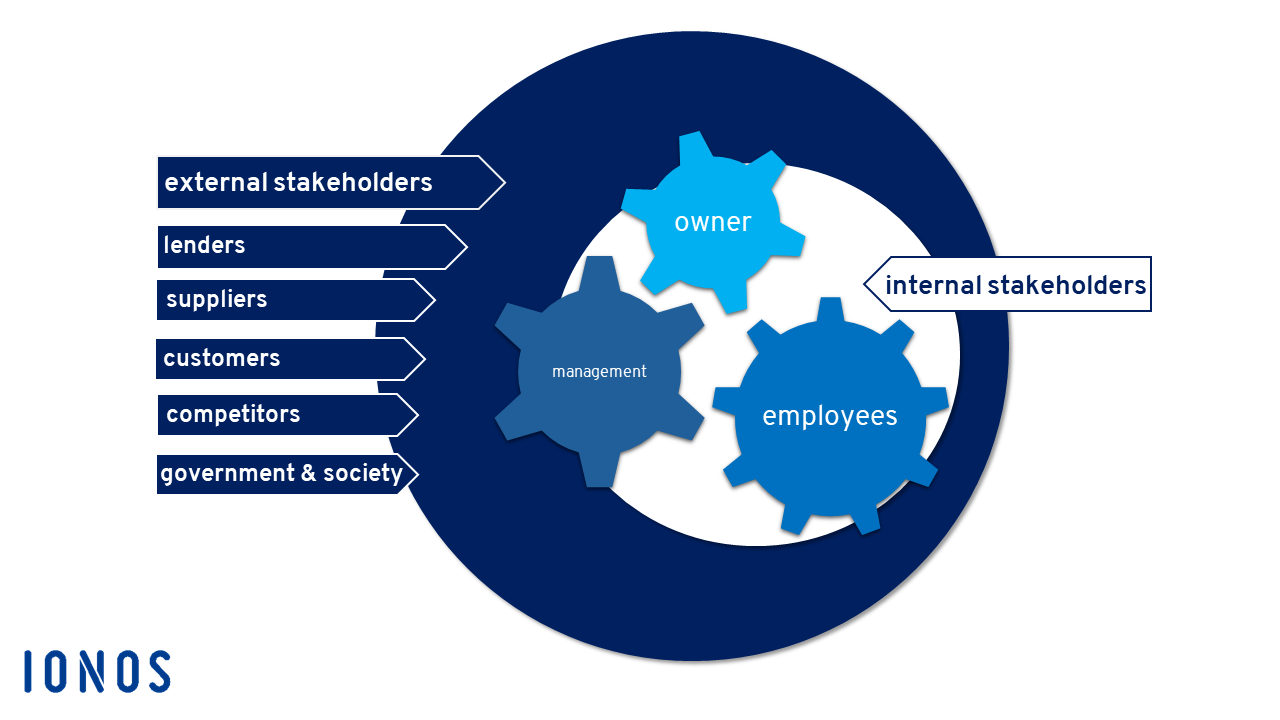
Stakeholders can be divided into internal and external stakeholders. Internal stakeholders are employed by your company or have shares in it. Generally, three internal stakeholder groups with different goals and motivations are identified: owners/shareholders, executives and managers, and employees.
Examples of internal stakeholders
- Owners and shareholders typically strive to maximise profits and enhance the value of their investments while retaining independence and control over decision-making. They also often seek influence, authority, and industry recognition.
- Executives and management typically prioritise a competitive salary, decision-making autonomy, career advancement, and professional recognition.
- Employees value job security, fair compensation, benefits, meaningful work, ongoing professional development, strong workplace relationships, and, like other internal stakeholders, recognition and career growth.
External stakeholders, on the other hand, refer to interest groups and parties that are not directly affiliated with the company. External stakeholders include lenders, suppliers, customers, competitors, as well as government and society.
Examples of external stakeholders
- Lenders and financial institutions primarily seek a secure investment, a favourable return, and assurance of timely repayment.
- Suppliers and vendors value stable business relationships, fair contract terms, and most importantly, reliability and prompt payments.
- Customers expect a strong price-to-value ratio, high-quality customer service, and flexible return or goodwill policies.
- Competitors anticipate fair competition and, in some cases, may consider strategic partnerships or industry collaborations.
- Government and regulatory agencies are also key external stakeholders, including central and local government authorities, industry regulators, trade associations, lobbying groups, political organisations, media outlets, and the general public. These stakeholders focus on tax compliance, employment growth, labour rights, Corporate Social Responsibility (CSR), Environmental, Social, and Governance (ESG) initiatives, and financial contributions such as charitable donations or community investments.
Stakeholder vs shareholder
What is the difference between stakeholders and shareholders? It is important to understand the distinction between these two terms:
-
Shareholders are individuals or entities that own shares in a company and are primarily focused on maximising their financial returns. They have an ownership stake and typically benefit from stock appreciation and dividends.
-
Stakeholders, on the other hand, include all individuals and groups affected by a company’s business activities, such as employees, customers, suppliers, government agencies, and the broader community. While shareholders prioritise financial gains, stakeholders have diverse interests that may also include social, ethical, and environmental considerations.
Why it makes sense to know your stakeholders
According to the stakeholder approach, businesses should not only focus on satisfying shareholders but also identify all groups that contribute to the company’s success. It is the responsibility of corporate leadership to balance the interests of various stakeholders to ensure long-term business success.
Stakeholders are identified through a stakeholder analysis, a specialised form of environmental analysis. Strategies, actions, and recommendations for effectively managing stakeholders are developed and implemented as part of stakeholder management.
There are clear reasons why companies should actively engage with their stakeholders. Only those who understand their key stakeholders can ensure that:
- Potential obstacles and resistance are identified early, and
- Affected parties are included in change processes at the right time.
Stakeholder analysis is also a component of the SWOT analysis, which compares external market opportunities and risks with a company’s internal strengths and weaknesses to develop strategic business plans.
Please note the legal disclaimer for this article.