

Job reference: structure, content and examples

Employees are likely to ask for one when leaving, and you as an entrepreneur, are likely to request them from any potential candidates you may be hiring: we’re talking about a job reference, of course! There are two main types of job reference you can provide to employees. The simple job reference provides information on the type and duration of work with a previous employer. A detailed job reference also contains an assessment of the employee’s social and professional skills. Writing a detailed reference is far more common, and is intended to give as accurate a picture as possible of the service provided.
HR and personnel managers can see from the employer’s reference whether an applicant has the necessary experience and skills for the position in question. Whether it’s a simple or detailed job reference, you should consider the following two obligations when writing a job reference:
- Duty of truth: The information in the employer’s reference must be accurate.
- Duty of benevolence: Employer references are generally formulated in a benevolent manner. The evaluation should refer to the actual performance and typically emphasises the strengths where possible. If the employee in question was unsatisfactory, it is rather unprofessional to state so. You are under no legal obligation to provide a job reference, so best practice is simply to decline writing one, rather than write an unfavourable review of your employee.
Simple job reference
The simple job reference contains the essential information about the job and duration of employment. The main contents include personal data on the employee, their previous position within the company, professional development, their field of activity, tasks completed, and the length of employment. The tasks completed should be described in a clear, truthful way so that potential future employers can follow the applicant’s professional experience. When it comes to a simple job reference, you usually omit any evaluation of the employee’s performance. These references are typically requested to provide certified proof that the employee held the position. They are becoming more and more obsolete. The most common way of confirming a candidate’s job history is to contact previous employers with the contact information provided on the CV, rather than requesting a simple reference.
Omitting an evaluation in the simple reference is both an advantage and a disadvantage. If there were any problems with the employee during their tenure, these are not documented. However, a lack of detailed evaluation on the employee’s personal behaviour can lead to mistrust amongst potential new employers. Why does the applicant not have a detailed job reference? However, there are also other circumstances where a simple reference makes sense. If the employment relationship was too short to provide any substantiated information about the employee’s behaviour, a simple reference may be the appropriate choice.
Detailed job reference
In contrast to a simple job reference, a detailed job reference identifies and assesses the employee’s personal and social skills. This is the most commonly requested type of job reference by employees.
A detailed job reference: content and structure
In order for future employers to get a comprehensive impression of the applicant’s performance and behaviour, some elements should be included in every job reference. There are no regulations or standards for the structure of a job reference, since you are not legally obliged to provide one, but there are still certain points that most references are sure to cover. Detailed job references usually also show a certain standard in the structure.
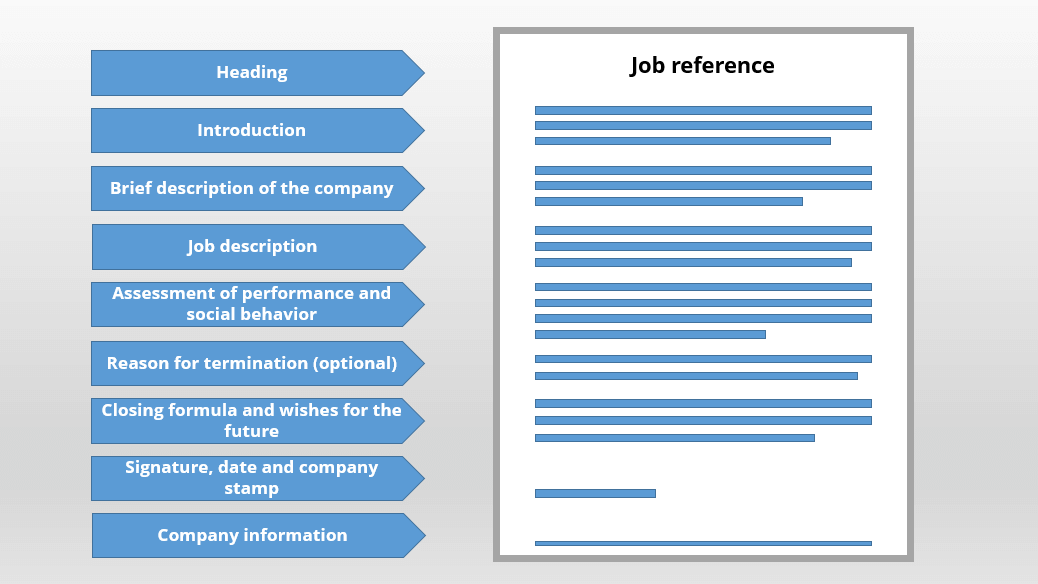
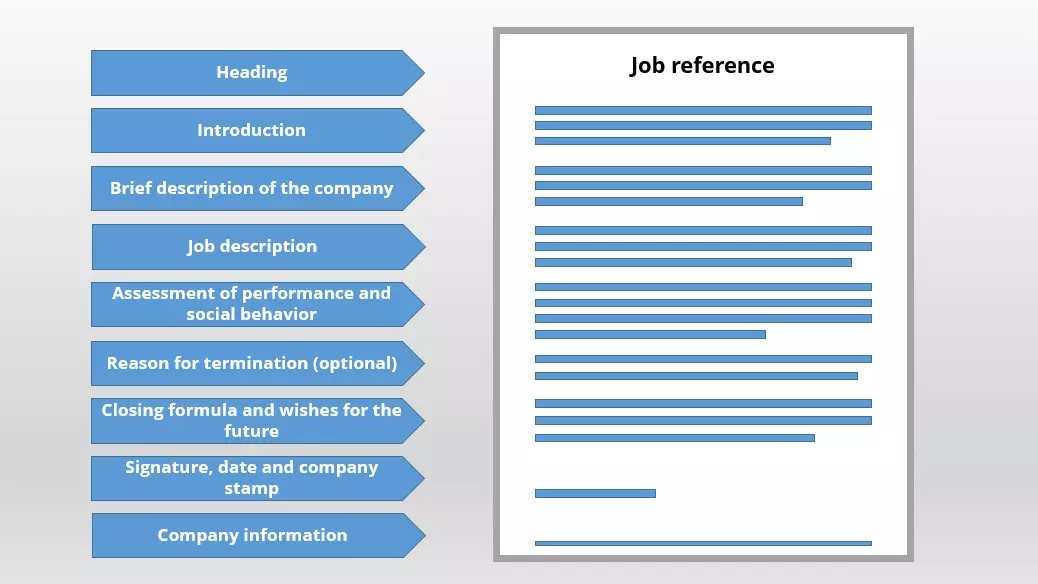
The contents in detail:
- Heading: Depending on the type of certificate, choose the appropriate heading: e.g. employer’s reference, training reference, or internship reference.
- Introduction: The introduction contains the employee’s personal data, e.g. first and last name, date of birth, period of employment, and position. The employee’s address does not belong in the job reference.
- Brief description of the company: Summarise the essential information about your company. What are your core competencies and focal points? Also, state the location of your company and the number of employees.
- Job description: List all activities carried out by the employee during the entire period of employment.
- Assessment of performance and social behaviour: If the employee has special skills and knowledge, these are mentioned here.
- Reason for termination: You can include the reason for termination in the job reference should you wish. If the employee left the company on bad terms, it is best practice to decline writing a reference rather than slamming the employee in their reference. It is also unlikely that an employee, who was terminated for poor performance, will request a job reference if they know it is unlikely to be complimentary. If you do find yourself in the position, either omit the reason or phrase it in neutral language. This is the most professional way of dealing with the situation, and will cover you should you later encounter legal issues for defamation of the employee.
- Concluding paragraph and wishes for the future: At this stage, you can thank the employee for their cooperation and wish them all the best for the future.
- Signature, date, and company stamp: The job reference is completed when the place and date of issue are indicated and the issuer’s signature is included.
How to assess performance and social behaviour
Has your employee fulfilled their tasks to your satisfaction? It’s up to you to answer this question when writing the performance assessment portion of a job reference. Of particular importance is highlighting which competencies were developed strongly by your employee. As a rule, the following competencies are evaluated in a qualified job reference:
- Willingness to work: Determination, sense of duty, commitment, readiness to work, personal initiative
- Work qualification: Judgement, stress resistance, thinking, comprehension, ability to work under pressure, flexibility
- Working method and working style: Personal responsibility, conscientiousness, methodology, independence, reliability
- Work results and successes: Quality, quantity, skills, intensity, productivity
- Special skills and knowledge: Any special achievements
- Existing leadership competencies: Leadership style, employee satisfaction, motivation skills
- Assessment of the overall performance: General satisfaction with the employee’s performance
The evaluation and weighting of individual criteria depends on the concrete requirements for the position in the company. Just like a certain structure and a certain sequence have become established in practice, standardised formulations for the final performance evaluation have become established. These are based on school grades ranging from “very good” to “unsatisfactory”:
- “Always to our complete satisfaction” = very good performance
- “Always to our full satisfaction” = good performance
- “Always to our satisfaction” = satisfactory performance
In addition to performance, the employer’s reference also assesses the employee’s social behaviour. The focus here is on social skills and soft skills. Three aspects should be considered when assessing social behaviour:
- Behaviour towards internal employees: superiors, colleagues, and employees
- Conduct towards external parties: Customers and external contacts
- Other social behaviour and competences: Honesty, integrity, assertiveness, or willingness to compromise
Job reference example
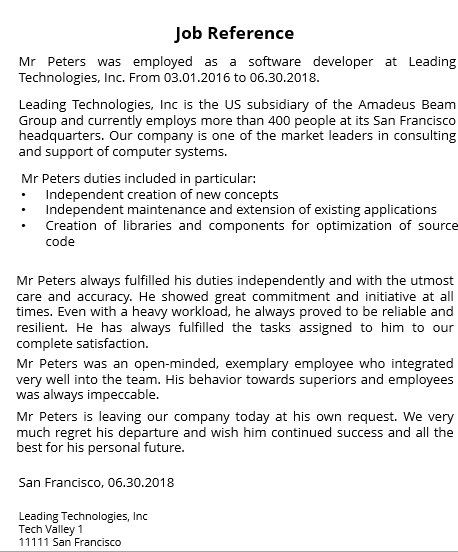
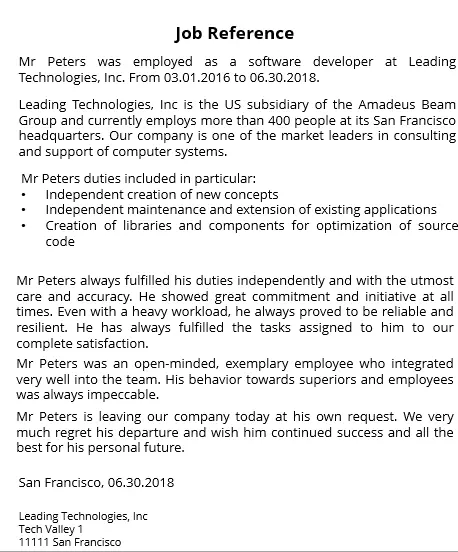
Checklist for a detailed job reference: What is important?
Does the job reference consist of the following sections and contents:
- Heading (job reference/interim reference)
- Introduction
- Brief description of the company
- Job description
- Assessment of performance and social behaviour
- Termination reason
- Closing formula and wishes for the future
- Signature, date, and company stamp
- Company data
Is the form of the reference correct?
- Is the information in the employer’s reference true and benevolent?
- Is the certificate free of subjective evaluations?
- Is the text properly formatted?
- Are spelling and syntax correct?
- Is the job description comprehensive enough?
- Are the tasks ordered according to meaning (the most important first)?
- Was the certificate issued on business paper? (A business paper must contain the company data, the legal form, and the address of the company)
- Is the date of issue the same as the date of the last working day?
Please note the legal disclaimer relating to this article.