

Work-life balance

Today’s working world poses many challenges to employees. While some careers allow a relaxed relationship between work and private life, many others demand significant reductions in the area of leisure and family. According to a study conducted by Totally Money the United Kingdom ranks 13th amongst European countries with the best work-life balance.
With this in mind, employers are becoming more aware of the growing expectations of their workforce in terms of the work-life balance. Companies are now considering how to achieve a work-life balance and implementing targeted measures to promote this. The goal is not only to make employees more productive, but also happier and more balanced.
What is the work-life balance all about?
The work-life balance has grown into much more than just an appealing concept. An increasing number of companies are relying on their employees to lead a more balanced lifestyle, as balanced, happy employees are ultimately more productive and motivated. If a company – either consciously or unconsciously – destroys an employee’s private life with too much overtime or an unnatural amount of pressure, it will inevitably result in dissatisfaction and stress that can then lead to health problems, decreased productivity, and alienation from the company.
The work-life balance definition sets out to achieve an ideal balance between a person’s working life and private life. It is a concept in which the maximum happiness of an employee acts as the fuel for productive and fulfilling work, for which both employer and employee are responsible.
The general dissatisfaction of employees worldwide signifies how far from achieving a work-life balance we really are. However, the working world is slowly changing as more and more companies are beginning to welcome the idea and are also specifically promoting it.
What we know for certain is that all sides benefit from a work-life balance. Our performance-orientated society all too often disregards the importance of the ‘happy employee’ principle, which still causes confusion and scepticism in some levels of management. This is due to competition and the fact that every important link in the chain must function in order to remain competitive – especially in terms of the so-called shortage of skilled workers and demographic developments. Something that is often misunderstood is the fact that employees are not machines that can work incessantly during the day and simply fill their tanks at home at night in order to repeat it all again the next day. In most cases, people work in order to live and not the other way around.
A healthy attitude towards the work-life balance begins with the employer. The employer must view themselves not as the highest authority in the life of employees, but rather as a reliable companion that encourages a healthy lifestyle. It is a narrow line that divides the two, and many companies fall into a similar trap: management still struggle to find the right balance between a fulfilling personal life and a healthy amount of strictness in the workplace. The question often arises: how much freedom should one give their employees and how much discipline is required in the workplace? Companies that operate on a very ‘loose’ basis run the risk of the employees taking advantage of the generosity of the employer, which may then lead to negligence, and a lack of discipline.
At the end of the day, the employee is also responsible for achieving a satisfactory work-life balance. After all, we are talking about striking a balance, as opposed to a disregard for work in favour of a more casual lifestyle.
On the other hand, there are companies whose circumstances have a negative impact on the private and family life of their employees: overtime means less free time while pressure in the workplace can often lead to depressive moods outside of the office. Work then becomes constant and dominates private life in a harmful way. Depressive disorders, burnout, and feeling overworked, are all common consequences of an economic system in which growth is still the maxim and personal happiness is left to the individual. The concept and benefits of a work-life balance seek to change this.
Family plays an important role in achieving this balance. In the modern working world, we run the risk of the family becoming a by-product of a successful career. Companies have a responsibility to foster and encourage a healthy family life. After all, for many employees, family is the key to a healthy and happy life. If this is neglected in favour of a professional life, you run the risk of the entire work-life balance toppling.
What does a healthy work-life balance entail?
A healthy work-life balance involves a number of interdependent factors. Establishing a work-life balance is the art of implementing as many of these factors as possible in both areas without causing damage elsewhere. It is therefore important to know what exactly belongs to a healthy working life and a healthy private life, and how these elements are connected.
Many of the factors listed below can also work together across other categories (e.g. the ‘social working environment’ factor in work life and the ‘friendships’ factor in private life can often be combined). Additionally, it should be clear that the needs in the respective aspects of one’s life develop individually. While one employee may place great importance on hobbies and interests but is not currently interested in family planning, another employee may place more emphasis on family.
We explicitly do not provide specific instructions on how to achieve a work-life balance. One general set of instructions would not suffice, as they would differ greatly from person to person as we all have different needs and values. However, we do assume that employees have a basic interest in leading a healthy and balanced private and work life.
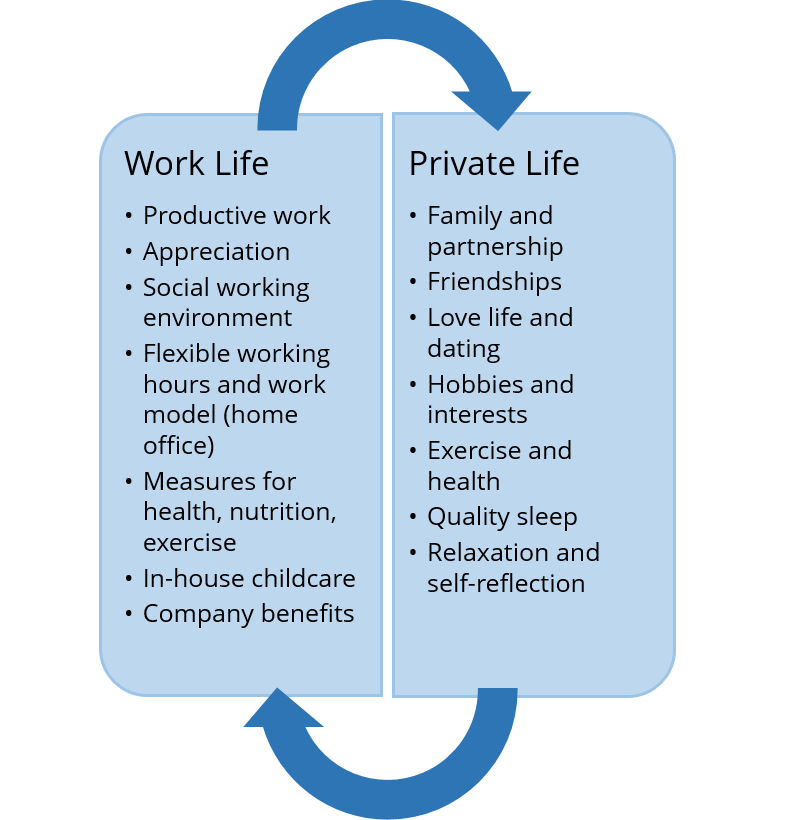
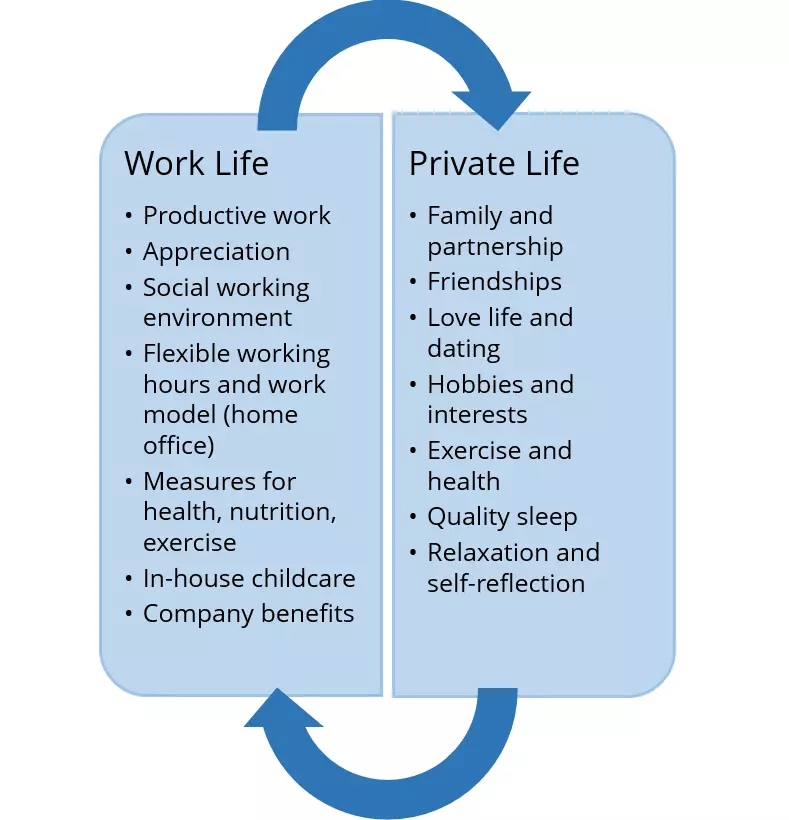
Factors of a healthy professional life
For a healthy work-life balance, it is not only the relationship between the two sides that is important but also the individual factors of each side. When an employee drags problems into their work life or private life, the whole structure will suffer. On the other hand, personal issues can also have a negative impact on professional life. Clearly, a good work-life balance can only be achieved if certain conditions can be achieved within the workplace that ensure it does not stand in the way of the employee’s happiness. Ideally, this happiness is the foundation and goal of a productive and healthy working relationship.
Productive work
For many employees, a satisfying professional life means that their own work brings visible and valuable results. In this sense, ‘productive work’ does not mean maximum performance while disregarding other factors, but rather, the amount of valuable work that is optimal for each employee. For example, an unsatisfactory set of tasks means that an employee may not necessarily identify with their work and could therefore feel alienated from their work, which can ultimately have a negative effect on their work life.
Productive work consists of the right amount of both satisfying and fulfilling work. With the right conditions for productive work, the employer benefits from a high degree of motivation among employees. In contrast, unsatisfactory work may have a negative impact on one’s private life if the employee takes that dissatisfaction home. A work-life balance therefore largely depends on the individual’s quality of work and work satisfaction.
Appreciation of work
Here, the employer is particularly in demand. Most employees need a sense of appreciation both for themselves and their work in order to positively identify with the workplace. This appreciation should include both intangible rewards like praise, as well as tangible rewards like transparent promotion opportunities, fair salary, bonuses, etc. Most employees want to be perceived and treated with dignity. If a company ignores this point, it will treat its employees like machines that are expected to supply the same product over and over again. Appreciation of work simply means recognising the performance of an employee and rewarding it.
A particularly destructive part of any job that can really damage an employee’s happiness is unconstructive criticism. The resulting worry and uncertainty often affects other areas of an employee’s life. The employee may then find it difficult to avoid letting the frustration of their work life seep in to their personal life. The work-life balance only works if the employee feels treated with dignity and appreciation. Otherwise, a downward spiral of stress, frustration, and worry will shake the entire balance.
Social working environment
Colleagues are often viewed as the ‘second family’ because they spend so much time together. This makes the social structure of the environment all the more important. Relationships between people are highly complex and difficult to influence due to many individual factors. Nevertheless, with the right conditions, employers can ensure that the workplace becomes a breeding ground for interpersonal relationships. This includes a healthy interaction of clear hierarchies such as structures and social freedoms, clear rules against antisocial behaviour like bullying and intolerance, team building measures, an ‘open office,’ and much more.
The right corporate structures, a positive corporate philosophy, and a corporate responsibility towards employees all create a good basis for employees to work not merely with colleagues, but rather with people whom they feel comfortable with. If an employee is poorly integrated into the social structure of the workplace, or if they experience harassment or bullying, this can have devastating consequences on both the employee’s professional and personal life. Here, both areas overlap; if the social work environment suffers, so too does the employee and therefore the problems seep into their private and professional lives.
Flexible working hours and structures
The term work-life balance is often understood to be a simple means of time management, but this is just one element of the work-life balance definition. However, the right timing is essential for the balance and provides the basis for many other factors. In order to ensure that there is enough time for private or family life and working life, the employer has a number of options. On the one hand, home office is becoming increasingly popular, especially with so-called desk jobs. It affords employees the opportunity to work from home – all that is usually required is a functioning computer and an internet connection.
Advantages of home office are:
- Without any commuting time, employees have more free time
- The employee can often enjoy a more relaxed working environment without certain workplace rules (dress code, break times, social pressure, office noise, etc.)
- Parents have the opportunity to spend more time with their partners or kids, as long as they remain sufficiently engaged with their work
However, home office always runs the risk of businesses being ‘exploited’ for personal purposes because employees are normally deprived of social control. Many find it difficult to concentrate at home, so home office is therefore not the universal tool for achieving a good work-life balance.
A somewhat easier method for achieving this balance is with flexible working hours. The more freedom employees have with regard to their start and end times, break times, and the organisation of weekly hours, the better they can adapt their professional life to their personal life. This is already the case in many workplaces, for example, it is often down to employees to decide when they begin and when they leave work, as long as they are fulfilling the required hours according to their contract. A general framework can be set (e.g. 8 hours between 7am and 8pm), and the more generous this is, the more flexible employees can be with their working hours. Many employers make Friday an exception to this framework so that employees can start their weekend sooner if they have already worked the full number of hours.
The subject of sleep and the recovery through sleep (more details below) is also very relevant to this (and the following) area. Since adequate sleep is conducive to concentration and performance, employers can use flexible working time models to do something not only for the health of their employees, but also for the quality of their work.
Measures for health, nutrition, exercise
Many activities have a negative impact on the health and wellbeing of workers. The employer can combat this with certain measures. For desk jobs, in addition to back-friendly facilities (good chairs, height-adjustable desks, optional standing desks, etc.), it is recommendable to offer things like exercise classes and regular health education (back training, yoga courses, etc.).
A healthy diet is mostly the responsibility of the individual employees. However, employers have various opportunities to create conditions that may encourage healthy nutrition. If there is a canteen in the workplace, it should ideally offer a wide range of meals (vegetarian, vegan, gluten-free etc.) and also make sure to provide transparency in terms of ingredients and additives used. Additionally, regular deliveries of fruit and drinking water facilities (water cooler, etc.) are other common ways of doing something for the health of the workforce.
In-house childcare
Employees often have difficulty spending enough time with their children. The search for day care centres also presents working parents with serious challenges. This means that kids can upset the work-life balance greatly. On one hand, there are parents who spend too little time with their children because their work takes up too much time and attention. On the other hand, there are employees who, because of their obligations as parents, perform worse and are often absent.
A company kindergarten is an effective solution to the above problems. Parents and children are then within a comfortable distance from one another. If a company provides the appropriate personnel and childcare facility, it can result in an inspiring, familiar atmosphere in the workplace. Generally speaking, in-house childcare is an effective way to help employees manage their work-life balance.
Company benefits
Company benefits can also have a positive impact on an employee’s work-life balance. For instance, a company pension scheme defines how life in old age should be financed. Another popular company benefit is a public transport ticket, allowing employees to use public transport without incurring their own expenses.
Employers should not underestimate the positive effect of corporate responsibility in practice. A company that takes its responsibility towards society, the environment, and its employees seriously, leads to a better all-round connection with the employer. Employees are generally more willing to perform for a ‘good company.’ Another popular option are days off where the employee can volunteer with local charitable events.
Factors of a healthy private life
The factors that contribute to a healthy personal life differ greatly from person to person. Everyone understands personal happiness to be something different. However, there are of course certain factors that play an important role in the personal lives of most people. If part of one’s private life is unpleasant, this can often have direct consequences on one’s professional life. Some employees have the ability to compensate an unfulfilled private life with a successful professional life. However, the following is probably true for most: a good work-life balance starts in your free time.
Family and partnership
For many, family is an essential part of leading a happy life. For most professionals, the end of a working day consists of time spent with family or a partner. If this time is stressful, the employee will not get the desired rest and a vicious circle of work and ‘work after work’ begins to develop, which can eventually disrupt the entire work-life balance. In extreme cases, some employees will voluntarily do overtime at work in order to avoid going home. This, of course, also works the other way around: when the employee takes too much time for the family and endangers their job.
The exact elements of a good family life and a good partnership are very hard to explain. Nevertheless, the personal happiness of many employees is based on the strong support of their families. Both employees and employers have many opportunities to create good conditions for a full family life.
Friendships
Many employees find it difficult (especially the older they get) to cultivate friendships outside of their professional lives. There are many reasons why meeting friends becomes more and more difficult with a full-time job. Firstly, many professionals are simply too exhausted after work for social activities, so friendships may therefore suffer. Secondly, a full-time job often leads to scheduling problems, especially if there is a family and kids involved.
Additionally, many workers tend to make their colleagues their new social anchor points that may previously have been filled by external friends. While this can often lead to a generally more pleasant working environment, it can also result in a friendship that is too heavily defined by the job itself. These friendships often end when the employment relationship ends. If the employee then neglected his/her external friendships, the employee may experience some social isolation.
Personal happiness, which helps forge a work-life balance, is often the result of longstanding friendships forming relationship anchor points outside of the workplace. This way, people do not feel reduced to a mere employee in the workplace. External friends are very important for one’s own well-being because, to put it simply, they allow access to the world outside of the workplace. This is essential to the work-life balance, which is why friendship should never be underestimated.
Love life and dating
This factor mostly applies to employees that are single. A stressful job that may require a lot of overtime and is exhausting can have a negative impact on one’s dating life. If employees do not cope with the loneliness and (sexual) frustration typically associated with an unsuccessful love life, this, in turn, can damage one’s private life and considerably shift the work-life balance.
The love life factor is similar to the family and friends factor in its large scope. If work takes up too much place in an employee’s life and compromises their dating and love life, this may have consequences on a person’s emotional well-being. In extreme cases, depressive moods can lead to serious illnesses. Pent up frustration is often released in the workplace, for example when an employee begins to look for a partner during working hours. This, in turn, can damage the social fabric of a company.
An employer cannot prevent intimate relationships from occurring between colleagues. It is the responsibility of the employees concerned to define and reconcile between their professional and personal relationships. Generally speaking, it is recommended to inform your employer about the relationship, but in many cases you are not obliged to.
Hobbies and interests
Most employees have a number of hobbies and interests that they want to pursue in addition to their jobs. However, many jobs make this considerably difficult. Certain hobbies that follow fixed schedules must sometimes be ruled out due to inflexible working hours. Additionally, a stressful job can often leave the employee too exhausted to pursue any interests or hobbies after work. Here, the individual’s self-realisation during leisure time is at stake – private life makes room for a demanding work life. The work-life balance suffers noticeably.
In addition to more flexible working hours, employers have several ways of valuing the individual interests of their employees. Internal social networks are popular platforms for the exchange of interests. This enables employees to network and arrange joint activities. Sharing hobbies and interests with colleagues has two key benefits: firstly, planning activities in a group means that others can work around your schedule, as opposed to an individual joining a class. Secondly, this strengthens the social dynamic within a workplace, because shared interests do wonders for relationships. However, it is also important to remember what has been said above on the subject of friendships.
Exercise and health
The topic of health affects all areas of a person’s life and is therefore a central part of the work-life balance. Almost all factors – social, personal, family, psychological, or physical – are closely linked with health. Exercise has been proven to play an essential role in both physical and mental health.
Many employees seek balance through movement and exercise, especially because they spend most of their working life sitting down. With desk jobs it is particularly important to exercise for at least half an hour a couple of times a week. It is also advisable to be on your feet for at least five minutes for every hour you spend sitting. Physical fitness is important to most people, which is why sporting activities during free time are of great importance.
In addition to providing healthier working conditions (see above), companies can also ensure their employees lead a well-balanced life in terms of sports. Possible activities they can offer may include company runs, football tournaments, or fitness studio discounts. Ultimately, however, it is the employee’s responsibility to ensure whether or not, and to what extent, they would like to partake in such offers.
Finally, it is of great importance that both the employer and the employee pay attention to the topic of health. This means, on the one hand, that employees take care of their health in their private time, and, on the other hand, that the employer is understanding towards sick employees and is obliging, to a certain extent, towards absences and medical appointments during working hours. This can prevent a sick employee from getting into a dangerous downward spiral.
Sleep
An often underestimated factor of one’s overall health, is a healthy sleep cycle. Sleep deprivation can result in poor performance, mood swings, increased physical susceptibility, and many other risks. A person’s sleep is often a good indication of their work-life balance status. It is therefore not surprising that many psychologists and doctors consider healthy sleep to be a key factor of a happy life.
Sleep is a valuable resource that is often overlooked by many employees. Those with leisure activities planned after work often forgo a few hours of sleep in order to partake. This may result in the work-life balance shifting out of sync.
Professor James Gangwisch of Columbia University insists that healthy sleep is an extremely important factor in workplace productivity. In his study on sleep as a factor of the work-life balance, Gangwisch states that flexible working hours are a particularly suitable means of promoting healthy sleep for employees. In particular, generous regulations for the starting hours of a workplace allow employees to adjust their working hours according to their own needs and preferences. This can result in increased performance, which in turn benefits the employer.
At the same time however, Gangwisch warns against providing too much freedom and flexibility as the employee may take advantage of this and therefore lose their own day-night rhythm. We must therefore agree on a working system that is flexible and binding enough for everyone.
Healthy sleep is an extremely complex issue and cannot simply be resolved with suitable working times. After all, almost all factors in professional and private life can have both a positive and negative impact on sleep. Many people have problems falling asleep because of their own worries, while others are rarely able to sleep peacefully because of the stress of their private lives. Aside from the individual physical and mental factors such as diet, exercise, and mental health, influences such as the place of residence, noise, and the weather can often play a large role in the type and duration of rest.
Relaxation and self-reflection
This factor largely depends on how each individual perceives relaxation and how much of it they require. Many people enjoy a healthy professional and personal life, yet still struggle to find peace. Your life has the same flow every day: head to work in the morning, have lunch with colleagues, go home to your family after work, spend time with your partner and/or your children, exercise, and go to bed. What sounds like a good work-life balance can often feel somewhat superficial for the individual as they may feel like they never have time for themselves.
The ability for self-reflection must be cultivated and refreshed over and over again. In essence, it is about maintaining a personal compass and remaining grounded throughout life. For this, a variety of questions centring on self-realisation, fulfilment, and personal desires play a large role: am I really where I want to be? What are my dreams and goals? What have I already achieved? What do I fear? What makes me happy?
Many people deal with such questions during their hobbies and interests through which they define themselves. Some may manage this time for self-reflection during exercise, while others may find certain places that allow them to switch off. With this in mind, meditation is becoming an increasingly popular spiritual practice that allows one to gather their thoughts and reflect on important questions.
Therefore, the work-life balance does not simply mean striking a balance between professional and personal life, but also regularly reflecting on it and questioning it. It also depends on the right measure: anyone seeking to achieve a good work-life balance more than to live, is missing the entire work-life balance definition.
Ways for companies to promote a healthy work-life balance
The work-life balance concept views the success of a company largely in the happiness and productivity of its employees. More and more employers are therefore looking at suitable strategies to promote these particular factors. Often, the responsibility of planning and implementing such strategies lies with the human resources department. A company’s sense of responsibility and self-understanding can determine the direction.
The term corporate social responsibility (CSR) covers a wide range of factors from environmentally-friendly operations and social responsibility, to competition and the correct treatment of employees. Ultimately, CSR is the moral compass of a company. If this is lacking or misaligned, many employees may suffer – and not least their work-life balance.
In the following overview, you can find possible measures employers can take in an effort to improve the work-life balance of their employees.
| Measure | Explanation |
| Flexible working hours | Employees can adjust their daily rhythm according to their individual needs and will therefore have more freedom for family, free time, rest, etc. |
| Home office | Many jobs can easily be done at home or away from the office. Home office allows employees more time to spend with their families and recover better during the week. Additionally, employees have more free time as it eliminates the commute. Home office also loosens up the five-day week and adds some variety to work life. The employer also saves money when the office is not used as often. |
| Healthy supply of food | Ideally, work canteens should offer suitably nutritious food with a certain transparency regarding the use of ingredients and the preparation method. Additionally, a free supply of fruit and drinks can have a positive impact on the health of the employees, which is important for the work-life balance. |
| Healthy workplace | Physical health is very important for striking a good work-life balance. Particularly with office jobs, it is up to the employer to provide a good framework for a healthy work environment. This can include ergonomic office chairs, height-adjustable desks, standing computer places, and working conditions that encourage movement. Other factors include adequate lighting, noise protection, and a good climate. Additionally, the work environment should never give employees the feeling that they cannot get up and stretch. In-house training on issues like the right desk posture are other recommended measures. |
| In-house childcare | A company kindergarten can relieve the burden on employees with children of finding the right day care options and also can provide a healthy opportunity for professional life and family life to cross over. Employees can spend more time with their children, which can potentially result in reduced parental leave, less career disruption, and ultimately, less turnover. |
| Exercise opportunities | Back training, yoga sessions, sport events, and many other offers ensure a better working atmosphere by giving employees the opportunity to be active together. |
| Options for stress management | In today’s service-orientated society, the ability to cope with stress is extremely important. Employers can offer meditation courses, autogenic relaxation training, time management courses, and so on. The most important thing is that employers aim to keep the stress levels of their employees as low as possible, as this is the core of all the other factors of a work-life balance. |
| Company pension scheme | A company pension scheme can provide serious relief for employees. It provides a partial solution to their possible worries about supporting oneself when older. Worrying about the future can prove to be largely debilitating; the less people worry about the future, the more time they have to concentrate on the present and achieve what is actually within their power. |
| Sabbaticals | The possibility to take longer holidays (sabbaticals) can have a very positive impact on employees. If personnel management allow you to let go of an employee for a longer time, sabbaticals are an effective way to flea office life for a period of time and to concentrate on one’s private life. Any imbalances can often be sorted out this way and the employee often returns revitalised and motivated. This is often the ideal solution when employees are suffering bereavement or when they are burnt out. |
| Constructive feedback | Unfortunately, workplace appreciation is not as common as it should be, but it has an immense impact on the well-being and motivation of employees. Good work needs to be acknowledged and bad work needs to be met with constructive criticism that is respectfully communicated. Measures such as regular feedback talks are good opportunities to show the employee regular appreciation. Moreover, employees can formulate their own goals that will be later worked on together. This way, employees know exactly what is expected of them. |
| Transparent promotion opportunities | Many employees become frustrated with jobs that have no career advancement opportunities and feel like dead ends. The work-life balance does not just mean focusing on a happy private life in addition to a job, but also a satisfying career in addition to a happy private life. When an employee is aware of their opportunities and possibilities to climb the career ladder, this, in turn, can lead to better productivity and a strong identification with the employer. |
| Further training possibilities | Most people will continue to strive for more skills and knowledge throughout their lives. A successful professional life is also defined by the constant growth of one’s own skills, which in turn enables professional advancement. The employer can actively support the further training of its employees with courses, additional qualifications, and opportunities for continuous vocational training. |
Criticism of the work-life balance model
Although the work-life balance model is generally accepted and more and more companies are beginning to promote it, there are also some voices who regard the concept as problematic.
One common criticism views the work-life balance as a myth. It is an ideal situation that is practically unachievable because life is unfortunately not so easy to plan. The concept ignores the chaotic nature of life, which simply cannot be brought under control by careful planning. Additionally, the model ignores important skills such as adaptability and improvisation. At the same time, it tries to prescribe people a “life management” concept that is essentially impossible in this form. Ironically, too much stringent life planning can often add even more stress to any situation.
A further point of criticism is the term “work-life balance” itself. This suggests that work and life are two completely different fields. Critics of the model often argue that this division is next to impossible because there is so much crossover between the two areas. Additionally, if an employee is dissatisfied with their work, this cannot simply be mended by improving their work-life balance, but rather by changing jobs.
In reaction to such criticism, work-life integration was introduced, an alternative concept that takes a slightly more modern approach to the idea of a work-life balance. It focuses on a seamless combination of one’s personal and professional life rather than the separation or division of the two elements. Work-life effectiveness, another alternative, also follows a similar notion.
Many critics also criticise the prioritisation of “balance” in the work-life balance model. People are inherently unbalanced, which is not necessarily a negative thing. For many a successful professional life is enough to be happy and productive; some employees even gain more strength from an inner restlessness, which drives them to even better achievements. Additionally, many divide their lives into periods of concentrating more on their professional or private lives. It is important to remember, however, that the work-life balance aims to provide an ideal general state of health that should not, and could not, be applied to everybody.
Further criticism is directed against the individual measures of the work-life balance. Flexible working hours do not suit everyone, while a strictly planned work day could also have many advantages from planning security to better sleep (although there are many scientific uncertainties about sleep). Facilities such as company childcare centres can sometimes be a source of additional stress as some people enjoy their time at work and away from their families.
Many of the factors listed above have been described by critics as contradictory: if employees are offered fresh fruit and flexible working hours, and then go out and enjoy themselves, this does not exactly mean they have a sufficient work-life balance. Critics of the work-life balance tend to lean towards a positive corporate social responsibility that creates a healthy framework for good work. This then deems concepts such as the work-life balance as superfluous and the term itself as a redundant buzzword.
Overview: the benefits of a healthy work-life balance
The aim of the work-life balance is to see that both employers and employees equally benefit from a work-life balance. The model must be adapted to each individual person. Nevertheless, some general benefits can be identified for both parties that have been proven in practice in many businesses. In the following overview, we outline the mutual interaction of a healthy work-life balance.
| Advantages for employees | Advantages for employers |
| More importance is attached to one’s private life and personal happiness … | … so that the employee works more comfortably, more balanced, and more satisfied. |
| Flexible working hours make it possible for employees to better organise their private lives … | … which also makes the working time of each employee more effective. |
| A work-life balance encourages a healthier way of life … | … and healthier employees are more productive, inspired, and satisfied. |
| Home office has a positive impact, especially on those with families … | … and the employer saves money and other resources with fewer people in the office. |
| Social events encourage more harmony between work and private life … | … and such events also have a positive impact on teambuilding. |
| Fitness offers and further training help develop the employee as a person … | … and this also leads to higher productivity in the workplace. |
| In-house childcare helps to keep work and family life in balance … | … which can make it easier for parents to return to work after the birth. |
| A health-friendly working environment can increase the quality of work … | … and happy employees mean increased performance. |
| Constructive feedback and transparent career development opportunities regulate professional life and alleviate private life … | … and the employer can better assess employees and communicate both praise and constructive criticism efficiently. |
| Sabbaticals are a great opportunity for employees to straighten out their work-life balance without risking their career … | … which helps retain high-performers in the long term, lowers the risk of burnout, and strengthens employees’ identification with the employer. |