

What is case-based reasoning?

Case-based reasoning (CBR) is an AI methodology that addresses problems by leveraging past experiences to tackle challenges efficiently. It adapts proven solutions to current situations through a four-step process. Common applications of CBR include help desk systems and medical therapy recommendation tools.
What does case-based reasoning mean?
Case-based reasoning is a machine learning method in the field of artificial intelligence. This approach uses past experiences to solve new but similar problems, relying on analogy. The core idea of this experience-based method is that similar problems tend to have similar solutions. Instead of analysing each problem from scratch, the methodology leverages a database of previously solved cases. These cases act as references to identify suitable solutions for current challenges.
Case-based reasoning forms the foundation of a novel approach to machine learning, that enables computer systems to adapt to new situations. This problem-solving approach originated from the research of Roger Schank, an American communication and computer scientist, and his students in the 1980s. Their work explored human episodic memory, revealing that successful problem-solving frequently draws on past experiences from comparable situations.
In the ‘Deep Learning vs Machine Learning’ article, we explain the differences between the two concepts.
How does case-based reasoning work?
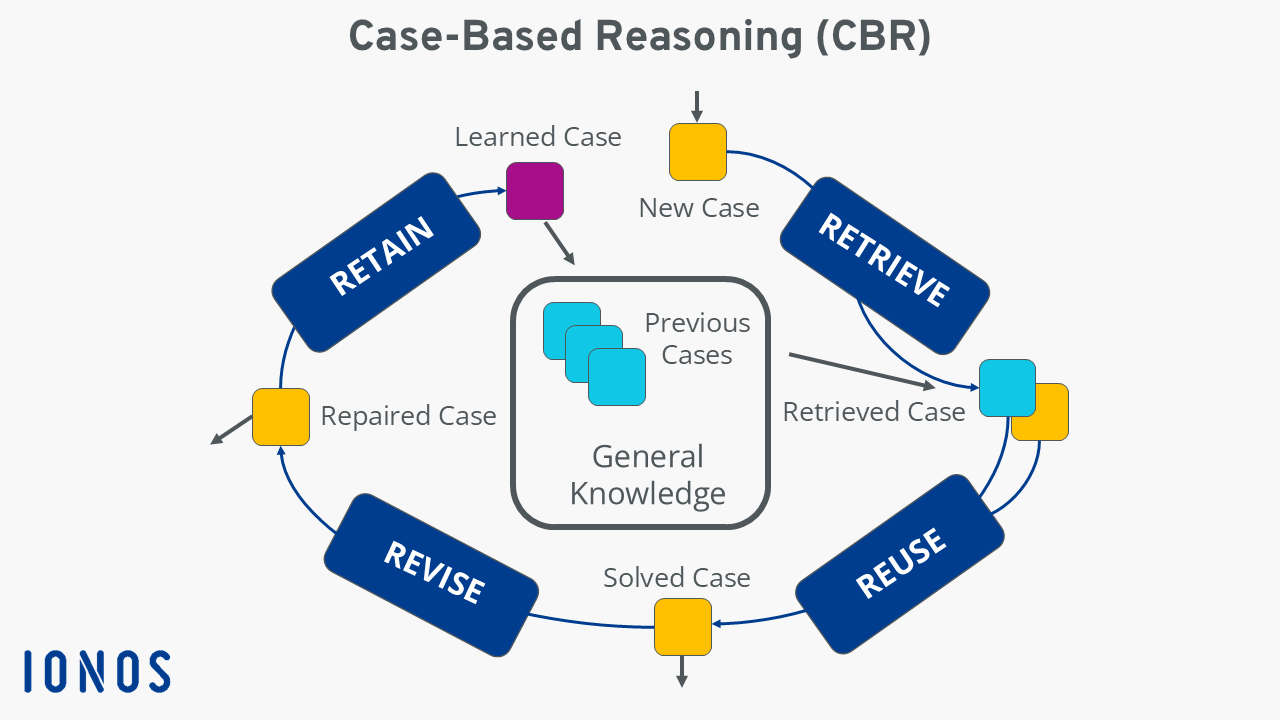
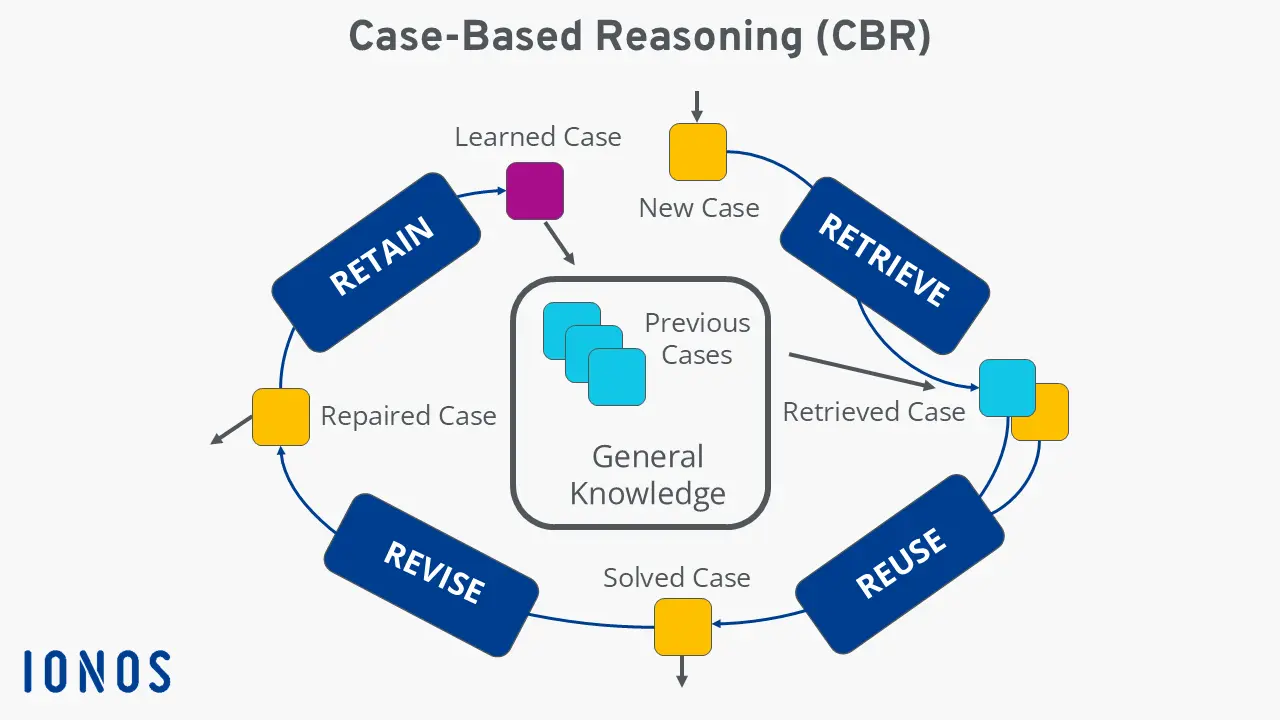
Case-based reasoning is a process that usually consists of four steps:
- Retrieve: The CBR system examines the case database to find experiences most similar to the current problem based on its description.
- Reuse: As a problem-solving approach, the solution of the case that is most similar to the description of the problem is used first. The first approach serves as the starting point for working on the new problem.
- Revise: The proposed solution is tested in the new context and refined as needed to fit specific conditions. Adjustments or corrections are made if required.
- Retain: The new problem-solving method is added to the case base for future requests. This creates an incremental learning process that ensures that the performance of the process increases with every case solved.
What are the main areas of application for CBR?
Since case-based reasoning relies on the intelligent reuse of previous solutions, it is particularly useful in situations where patterns can be identified and similar challenges occur repeatedly. However, CBR is also well-suited for poorly structured problems, those with incomplete descriptions, or scenarios where precise knowledge of causal relationships is lacking. Unlike other AI methods, CBR systems can perform effectively with a small number of reference cases. Common application areas include:
- Medical diagnostics: CBR is used to analyse previous diagnostic cases based on patient data and to identify diagnoses or suitable therapeutic approaches for the individuals currently being treated.
- Troubleshooting of technical systems: In IT support and system maintenance, CBR helps identify solutions quickly. A robust case database can also enable early fault detection to prevent significant damage.
- Customer service: CBR systems are also used to answer support queries by referring to tried and tested solutions.
- Product advice systems: In eCommerce, CBR is increasingly used to recommend products to potential buyers based on previous customer preferences.
CBR has many other applications. In finance, it can assist institutions in making decisions about loan approvals, risk assessments, and evaluating investment strategies. In the legal field, CBR tools analyse previous court cases to develop arguments for new cases. In transportation and logistics, CBR is used for route planning and resource allocation.
What role does CBR play in relation to AI?
Case-based reasoning plays an important role in the field of artificial intelligence, as it provides a methodological basis for simulating human-like problem-solving behaviour. While other AI techniques such as neural networks are based on the processing of large amounts of data, CBR uses experience in the form of past cases to solve new problems. Case-based reasoning also makes it possible to continuously improve AI systems and make them more robust and adaptable. Finally, the system expands its knowledge base with each new case.
- Get online faster with AI tools
- Fast-track growth with AI marketing
- Save time, maximise results
What are the advantages and disadvantages of case-based reasoning?
The case-based reasoning learning method offers numerous advantages. The most important advantages include
- Efficiency through the reuse of knowledge: Reusing previous cases as templates reduces the time and cost of analysing problems from scratch, often leading to more efficient solutions.
- Learnability: CBR systems improve their problem-solving abilities over time as they learn from new cases and expand their database.
- High flexibility: By selecting relevant cases, case-based reasoning is able to adapt to different situations and contexts. This is also the reason why CBR can be used in numerous domains.
- Explainability: Since solutions are based on previous cases, CBR is also able to provide transparent explanations for certain solution approaches. This is particularly useful in areas where the traceability of decisions is of great importance.
- Intuitive approach: Since case-based reasoning is based on human problem-solving strategies, it is easy to understand how solutions are reached.
However, CBR systems also have some disadvantages:
- Dependence on data quality: The efficiency of a CBR system relies heavily on the quality and completeness of the case base. If the stored cases are inaccurate or incomplete, the system may produce suboptimal solutions.
- Problems with scalability: As the size of the case base increases, it may take significantly longer to retrieve and adjust cases, reducing the efficiency of the system.
- Case customisation is sometimes difficult: Adapting previous cases to new problems can be difficult. Therefore, it requires sophisticated algorithms to ensure that adjustments are both meaningful and effective.
- Risk of obsolescence: Solutions that worked well in the past may become irrelevant over time, especially in rapidly evolving fields. In some cases, this could lead to outdated solutions being proposed.
Reviewer

Melissa Senn
Melissa Senn has been with IONOS since 2016 and focuses on website, e-commerce, social media, and AI in the Digital Guide. As a digital strategist, she uses her extensive SEO and GEO experience to transform complex technological trends into practical content.