

What is Schema.org?

Schema.org is a collaborative project between the search engine providers Google, Microsoft, Yahoo and Yandex. The goal of the initiative is to standardise semantic annotation for website markup. Its affiliated website contains the Schema.org markup: a comprehensive vocabulary that allows additional information to be entered in HTML code. This machine-readable content makes it possible for semantic contexts to then be read out by programs like web crawlers. This concept, known as structured data, comprises the basis of the semantic web. Schema.org’s markup language supports the formats RDFa, Microdata, and JSON-LD.
Three reasons for Schema.org
Structured data is becoming more and more important for web owners. Unlike human visitors, computer programs need a corresponding markup language in order to process a website’s semantic contexts. Structured data plays a crucial rule when it comes to indexing, but website owners can also benefit from semantic notation. Content that is labeled in a unified matter enables search engines to targetedly extract information and display this in their own formats on search engine result pages (SERPs). The most important aspect for this process is a feature called Rich Snippets. This name refers to the bits of information that expand search results, generating more attention in the process. In order to guarantee uniformity for these semantic annotations (which use many different data types), Schema.org supplies users with standardised schemata, known as ‘types’. These types have the ability to then be further defined with a specified set of ‘properties’. Website owners have three major advantages when they use Schema.org’s markup.
-
Standardisation: Schema.org’s markup is based on an agreement between the world’s largest search engine providers. Content that is annotated according to Schema.org is essentially being labeled with a markup that is largely considered to be today’s de facto standard.
-
Compatibility: standardised types and support from the most commonly used data formats–RDFa, Microdata, and JSON-LD –help ensure for maximum compatibility of semantic annotation. Content marked up according to Schema.org is ready to be processed by the internets most common web clients.
-
Validation: a unified standard offers the advantage of quick, uncomplicated error analyses. Tagging according to Schema.org with Microdata, RDFa, and JSON-LD can be easily validated with Google’s free structured data testing tool.
Schema.org type hierarchies
Schema.org’s markup is a system composed of types and properties. While types are able to assign content elements in order to label these entities as clearly defined items, properties are used to further define these types with certain values. Schema.org provides a hierarchically structured set of types specifically for this purpose; the site also lays out which properties are able to be assigned to which types.
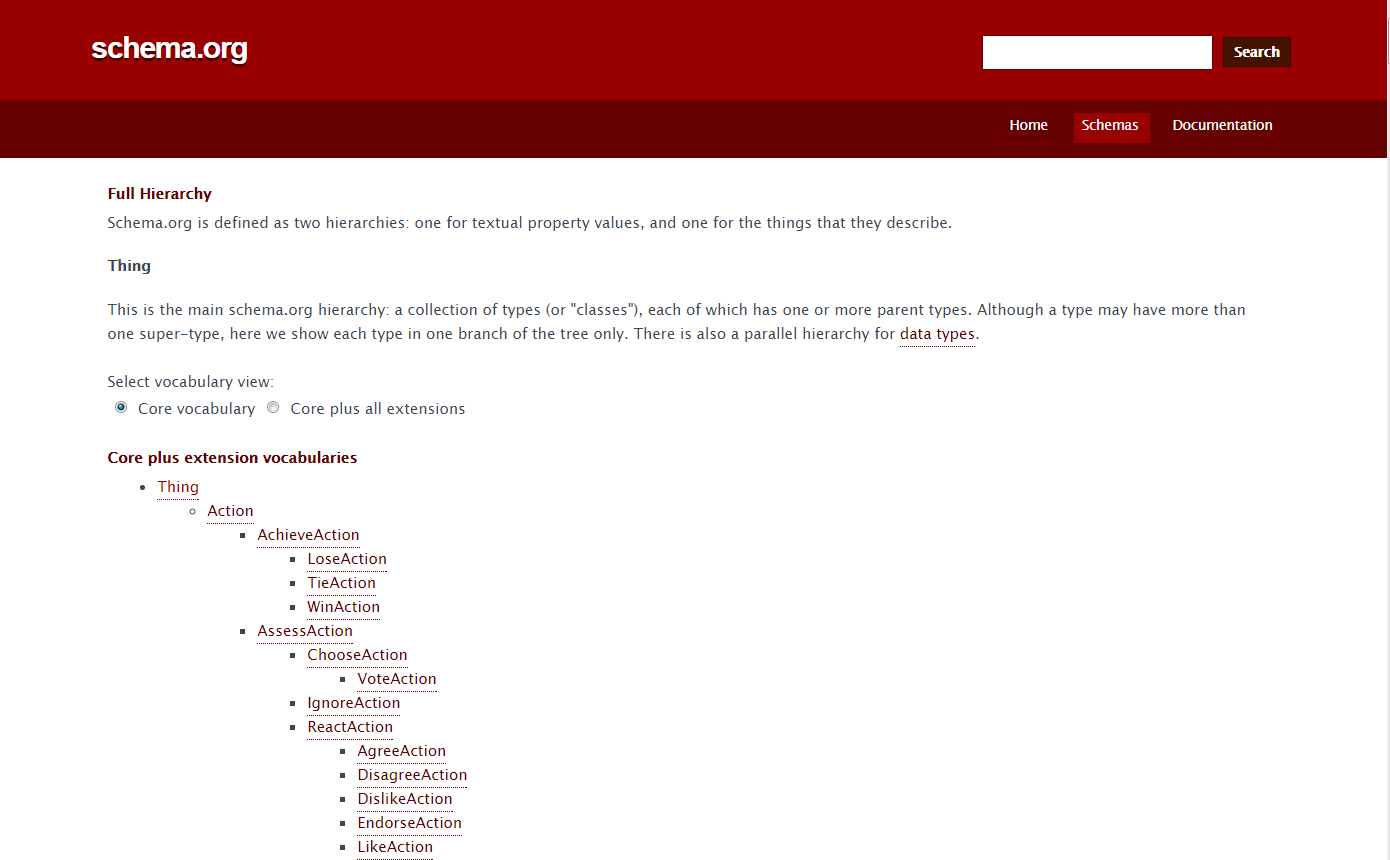
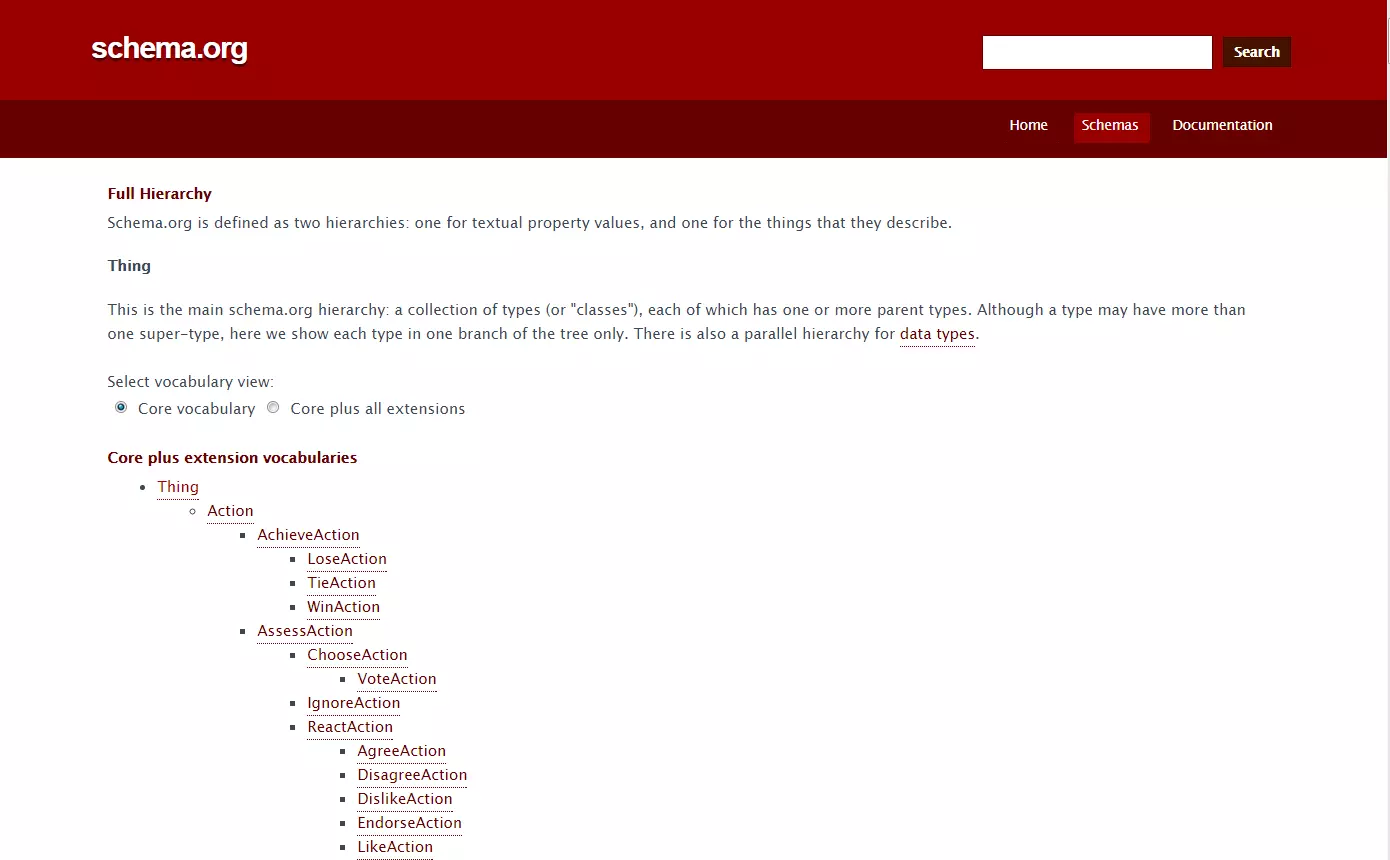
The spectrum of types that items can be assigned to ranges from broadly defined definitions, like ‘Thing’, to more specified types, like ‘Movie’. Each type, with the exception of the unspecified category, ‘Thing’, has one or more parent types.
Thing > CreativeWork > Movie While ‘Thing’ labels an unspecific item, the type, ‘CreativeWork’ labels a more specific aspect related to the category its name describes (e.g. books, photography, or movies). The type, ‘Movie’, is a subcategory of the type ‘CreativeWork’, which in turn is a subcategory of ‘Thing’. This hierarchy shows that specific types are inherent to the properties of their parent types. An item labeled as ‘Movie’ can be paired with the specific properties of a given movie: movies have actors, directors, trailers, etc. These are all possibilities for further defining ‘Movie’.
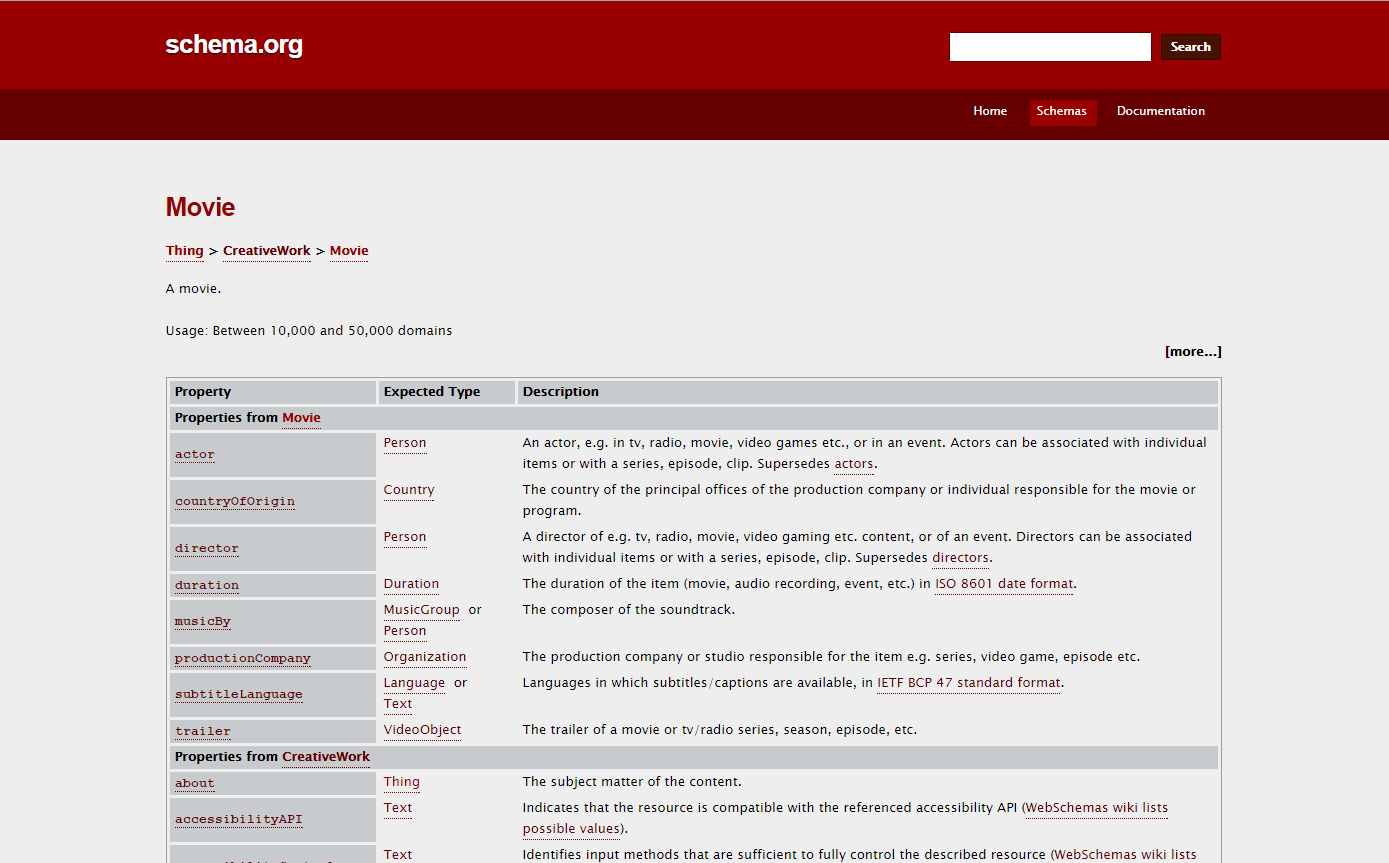
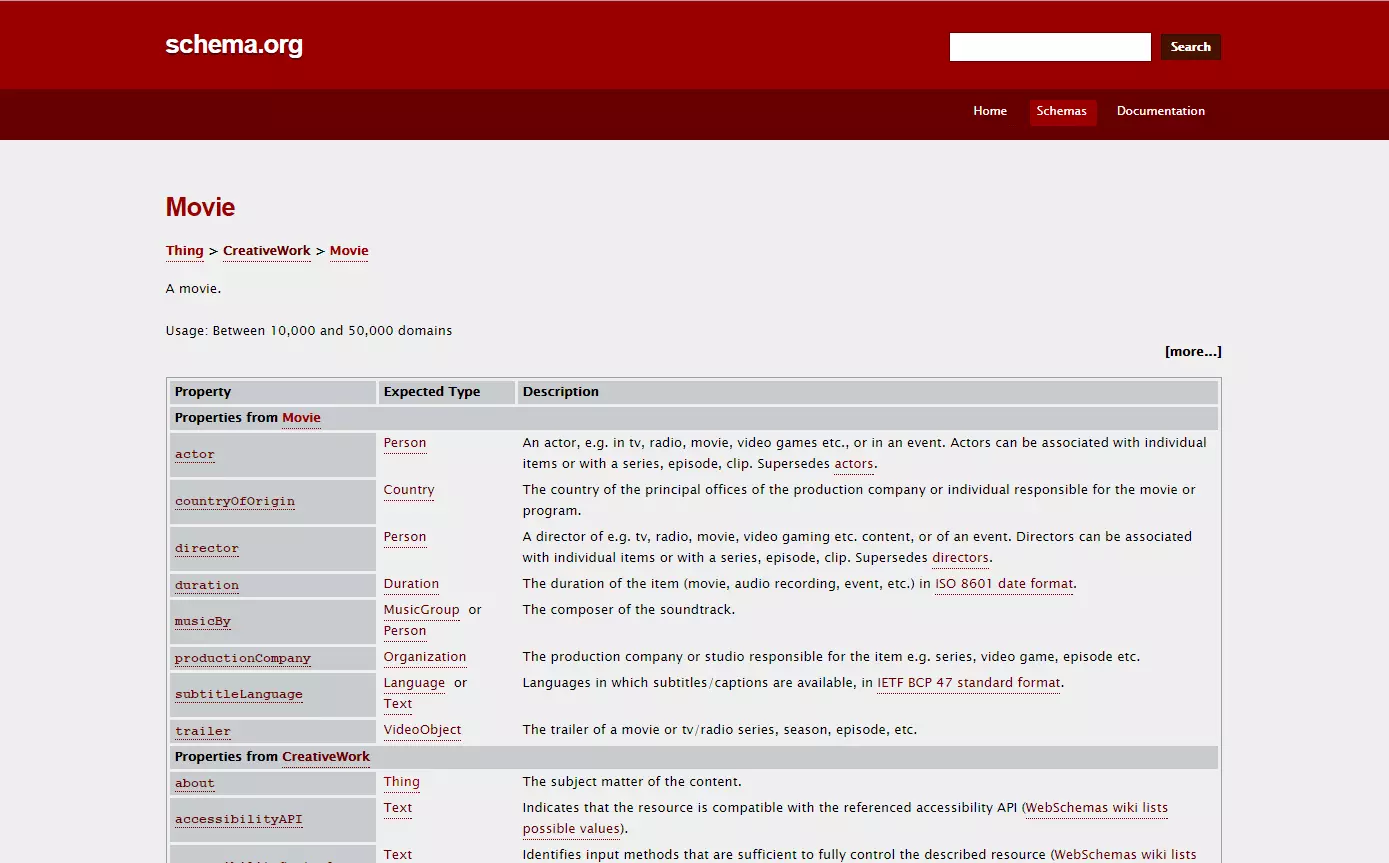
Properties of the parent type ‘CreativeWork’ also apply to the type ‘Movie’. Like all forms of storytelling, movies have an author, a genre, and reviews. The type ‘Movie’ also receives the properties of the parent type ‘Thing’: name, description, URL, and image. All properties can be labeled with individual values according to the item that’s been assigned to them. Types and properties defined on Schema.org are equally used by RDFa, Microdata, and JSON-LD. However, the way in which the markup is incorporated into a website varies greatly depending on which data format is used.
Choosing a data format
Once you’ve decided to use Schema.org’s markup vocabulary, the next step is to choose a data format. A detailed annotation description with RDFa, Microdata, and JSON-LD based on the standardised types and properties of Schema.org markups is laid out for you in the following articles:
- Tutorial: Markup with JSON-LD
Author

Vladimir Simovic
Vladimir Simović has been building web projects with WordPress since 2004. He was one of the first German-speaking WordPress bloggers and has published several specialised books as well as over 60 expert articles, and has managed well over a hundred WordPress projects.
Reviewers

Sven Ignor
Sven Ignor is a TYPO3 web developer with over 15 years of experience and specialises in bespoke solutions based on TYPO3. He is happy to share his knowledge and is committed to TYPO3 and the community

Melissa Senn
Melissa Senn has been with IONOS since 2016 and focuses on website, e-commerce, social media, and AI in the Digital Guide. As a digital strategist, she uses her extensive SEO and GEO experience to transform complex technological trends into practical content.