

Types of taxes in the UK

The UK has had one of the longest tax codes in the world since 2009, making it seem highly complex. However, the tax system is relatively straightforward for most individuals. One notable aspect of UK taxation is that spouses are taxed as individuals, although there are some allowances for transfers of unused personal tax allowances. This article explains what types of taxes there are and which type applies to whom.
When paying taxes in the UK, contributions may go to multiple levels of government, including His Majesty’s Revenue and Customs (HMRC), devolved governments (such as in Scotland and Wales), and local government authorities. It’s also important to note that the UK tax year, also referred to as the Fiscal Year, runs from April 6th to April 5th of the following year.
Main types of taxes in the UK
Income Tax
Income tax is levied on personal income and depends on two key factors:
- How much of your income exceeds your Personal Allowance
- How much of your income falls within each tax band
In England, Wales, and Northern Ireland, the Personal Allowance is set at £12,570 (correct as of February 2025), meaning income below this threshold is not taxed.
- Basic rate: 20% on income between £12,571 and £50,270
- Higher rate: 40% on income between £50,271 and £125,140
- Additional rate: 45% on income above £125,140
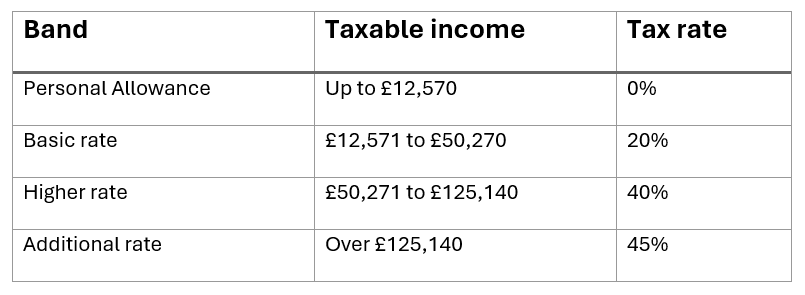
Scotland has a different tax system with multiple bands.
Some individuals may qualify for income tax reliefs, which reduce taxable income. More details can be found on GOV.UK.
National Insurance Contributions (NICs)
National Insurance (NI) contributions help individuals qualify for certain state benefits, including the State Pension.
- Employees (Class 1 NICs) must contribute if they earn over £242 per week (£12,570 per year).
- Self-employed individuals (Class 4 NICs) pay 9% on profits between £12,570 and £50,270 and 2% on profits above £50,270.
Those earning below these thresholds may not need to contribute but can choose to make voluntary contributions to avoid gaps in their NI record.
GOV.UK has more information on National Insurance.
Value Added Tax (VAT)
VAT is a consumption tax on goods and services, making it one of the largest sources of government revenue.
- Standard VAT rate: 20%
- Reduced rate (5%): Certain goods such as energy-saving materials
- Zero-rated or exempt: Most food, books, children’s clothing
Businesses must register for VAT if their taxable turnover exceeds £85,000 per year.
Excise Duties
Excise duties are applied to specific goods, often as a deterrent for harmful or socially sensitive activities. These include:
- Alcohol and tobacco – taxed to reduce health risks
- Fuel duty – aimed at curbing environmental damage
- Betting and gambling taxes – to regulate socially sensitive industries
Excise duties are charged in addition to VAT.
Corporation Tax
Businesses operating in the UK must pay Corporation Tax on their profits.
Since April 2023, the Corporation Tax rate is:
- 25% for businesses with profits over £250,000
- 19% for businesses with profits below £50,000
- Marginal relief applies to profits between £50,000 and £250,000, resulting in a gradually increasing tax rate.
More details on Corporation Tax can be found on GOV.UK.
Stamp Duty Land Tax (SDLT)
SDLT is charged on property purchases in England and Northern Ireland.
- No SDLT is charged on properties up to £250,000
- First-time buyers pay no tax on homes up to £425,000, provided the total property value is below £625,000
- Higher SDLT rates apply to second homes and buy-to-let properties
Scotland uses the Land and Buildings Transaction Tax (LBTT), while Wales applies the Land Transaction Tax (LTT).
For more details on this tax, visit the Stamp Duty Land Tax page on the GOV.UK website.
What happens if you don’t file taxes correctly?
If you don’t file your taxes correctly in the UK, HMRC may impose penalties, interest charges, and even legal consequences. A late filing results in an immediate £100 fine, increasing with further delays—additional penalties apply at 3, 6, and 12 months.
If you don’t submit a return, HMRC may issue an estimated tax bill, which might be incorrect. Investigations and audits can occur if discrepancies are found, and in cases of fraud or deliberate evasion, penalties can reach 100% of unpaid tax, with potential criminal charges. To avoid issues, ensure you file on time (by January 31st for online Self Assessment), keep accurate records, pay promptly, and contact HMRC if you need assistance or a payment plan.
Please refer to the legal disclaimer for this article.