
Hard skills: definition and list

The term “hard skills” contains all those skills that can firstly be learned and secondly proven or demonstrated. This includes language skills, computer program knowledge, programming skills, and many more. Your hard skills are your toolbox full of sturdy skills. In contrast, soft skills are more difficult to measure, and describe character traits such as resilience, endurance, and team spirit. In this article, you can find all the information on what hard skills are, which ones exist, how to include them in your CV, and which professional skills are particularly important to employers.
What are hard skills?
Hard skills are skills that can be actively learned, measured and often proven through qualifications or by demonstrating them. Typical hard skills that you may learn at school include a foreign language, typing techniques, and IT and software skills (e.g. MS Office). In the course of your professional career or training, you will often acquire other hard skills – for example, by expanding your skills at work or attending further training courses. This may include skills and knowledge in areas such as accounting, administration, banking, editing, information technology, engineering and maintenance, server operation, research, translation, project management, and many others. Many of these hard skills can be proven by certificates and work experience.
Hard skills are skills that can be learned and actively applied. They are typically easy to prove or demonstrate. In contrast, soft skills tend to describe your character traits and abilities. Examples of hard skills are language skills, DIY, software and programming skills, and text-writing skills.
By having a personal list of hard skills, you can show a potential employer which set of skills you offer. These skills enable a company to assess whether or not you fit a particular job profile. The less measurable soft skills, on the other hand, are typically checked by an employer during the application process.
Hard skills vs. soft skills
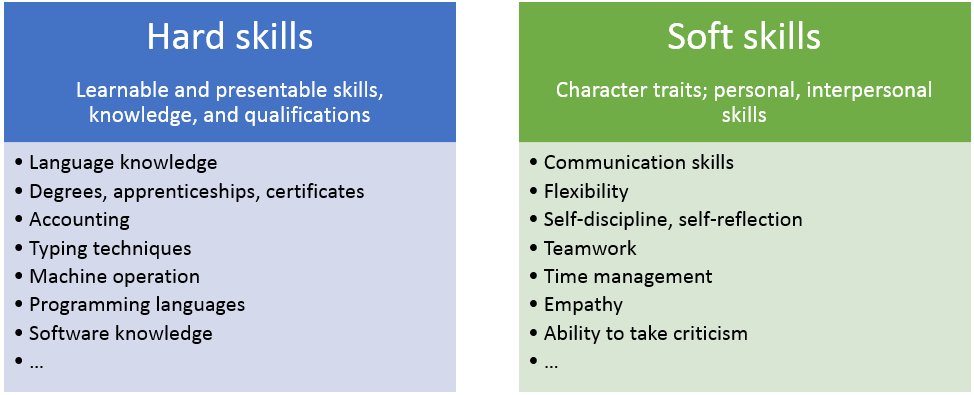
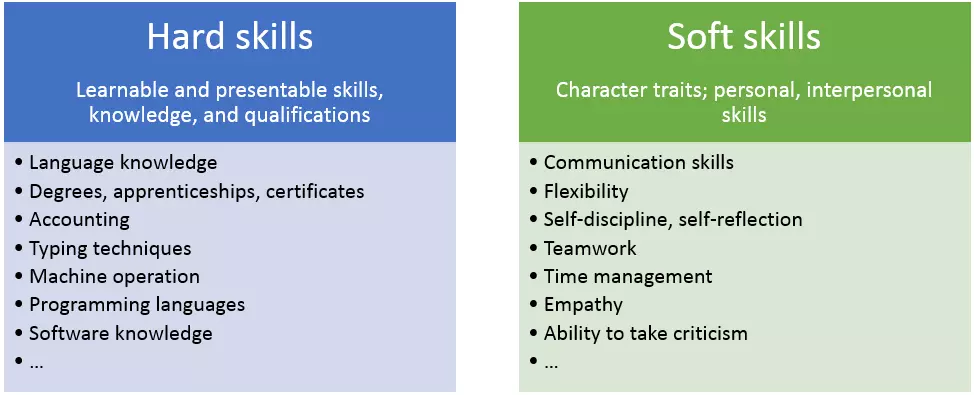
Your application and job skills determine whether you are suitable for a job or a specific task. These skills are roughly divided into the presentable, verifiable, and actively applicable hard skills on the one hand, and the inherent character and interpersonal soft skills on the other hand. Both categories ultimately make you the person or worker you are. Here are some examples as a comparison:
Why are hard skills so important?
Hard skills are important because they expand your CV and make you an interesting person to work with. In addition, your hard skills will tell you whether you specialise in a particular area and have the appropriate expertise. For example, if you have advanced knowledge of multiple programming languages, most employers will think you are a capable programmer. If you speak three or more languages, you have a talent for languages and communication experience. Through internships and apprenticeships, you can expand your portfolio and show that you’ve acquired these skills. Hard skills help you sell yourself as an applicant at the highest possible price; they are what you can offer a potential employer first and foremost.
Hard skills are your most important arguments when applying. Read our article on interview tips to know how to best sell yourself and your skills.
How to communicate your hard skills
To decide how best to present your hard skills, you should first prioritise them. The best idea is to decide for each individual application which skills you would like to highlight in the cover letter, which skills should appear in the CV, and which less relevant skills to leave out. The job advertisement will already indicate which specialist skills are explicitly sought.
Hard skills on your CV
The hard skills relevant for the application should appear on your CV as they can be easily listed: Typically these are subject-specific skills, language skills, software skills, knowledge of programming languages, design, or customer consulting. Soft skills are not usually included on the CV because they need a more detailed explanation.
Use our resume template to create your own resume in no time at all and communicate your hard skills effectively.
Professional skills are usually well placed under the heading “education” or “apprenticeship” e.g. “2012-2015 Bachelor's degree in business administration at the University of Central Lancashire with a focus on employment law and corporate management” or “Manager training with a focus on project management”. This not only keeps your CV nice and streamlined, but also logically links your career with your hard skills.
Skills that cannot be included under the headings “education” and “career” can also be listed in a separate category (e.g. “knowledge and skills”). Please note, however, that only the really important skills should be mentioned here. Usually a section like this appears at the end of the CV.
Hard skills in cover letter/ letter of motivation
If you find one of your main hard skills as a requirement in the job advertisement, you should also stress in your cover letter that you possess this skill. This not only signals that you are a good match for the job profile, but also that you have taken the time and thought carefully about what to submit before sending the application. Depending on the job profile, it may also be useful to emphasise a few important soft skills, such as team spirit and flexibility. This suggests a certain degree of self-confidence – but don’t exaggerate, otherwise the cover letter will be too long and may come across as arrogant to the reader.
List: the most sought-after hard skills
A list of hard skills will never be fully completed, as there are simply too many skills that are relevant to many different professions. LinkedIn published an article revealing which hard skills are currently most in demand among recruiters and personnel. Here’s a short introduction to them:
Data analysis and data interpretation
Data analysis and data interpretation are extremely practical skills in the technological working world. By applying statistical methods, you as a data analyst are able to obtain valuable information from a data set. Whether you’re working with survey research, clinical studies, or data mining, there are hardly any professions today for which a minimum level of data analysis knowledge is not important.
Knowledge management
Knowledge management is a rather superordinate term that includes all those strategic and operational skills that help to deal with knowledge as effectively as possible and apply it profitably. Knowledge management is based on theories and findings, e.g. from the fields of business administration, computer science, or social science.
Project management
With project management, the emphasis is on the word “management”. This hard skill enables you to allocate resources efficiently and effectively to lead a project to success. This often includes an appropriate level of leadership competence if you are supervising a project team from a senior position. When it comes to filling managerial positions, most companies are keen to have practical experience in this area. This is definitely the case when your work is project-oriented.
Change management
Change management refers to the ability to develop new strategies, systems, processes, etc., in order to extensively change and redefine a company or part of a company. This enables the change manager to restructure misguided structures and put them on the right track. You use this hard skill, for example, when a company is re-branding or restructuring itself internally. But it is also useful if you want to reorganise your own team or redefine certain conventions such as work distribution or workflow.
Social media knowledge
Millions, even billions of people today use social media such as Facebook and Twitter. The professional handling of these networks, however, is a hard skill, which shouldn’t be underestimated. On the one hand, it involves knowing how the website in question works and having some experience in generating as much attention as possible. On the other hand, it is important to correctly assess the relevance, reach, and target group of these networks for the company and to communicate appropriately via them. After all, using social media carelessly can have serious repercussions. Modern companies are therefore increasingly listing hard skills in social media as a core competence.
Digital expertise
Digital expertise is not so much a single skill, but rather a collection of hard skills. These skills enable the efficient use of digital tools. In addition to data processing and backup, this includes creating digital content and safely using communication tools and management systems of all kinds. Digital expertise generally refers to your experience with all facets and application areas that use the computer and/or the internet as primary tools.
Corporate management
This hard skill gains relevance when you apply as a candidate for a leadership position. For a position like this, a comprehensive mix of skills is required in order to achieve the company's goal. Two of the most important skills are leadership and performance. This will make you a recognised leader and respected authority. However, company management also places high demands on your organisational talent and therefore demands several of your soft skills. Corporate management is typically a hard skill that is slowly built up over the course of a career and proven by practical experience. However, young founders in particular often find themselves in the situation of having to acquire a basic understanding of corporate management as quickly as possible.
Programming skills
Today, programming is one of the most sought-after skills. Depending on industry and company/project, certain programming languages are more in demand than others. However, an experienced programmer will master a certain set of languages so that they can participate in projects as flexibly and extensively as possible. Some companies ask specifically for certain programming skills; for example, a basic knowledge of HTML is helpful for working with many content management systems (where HTML is actually a markup language, but is often mentioned in the same breath as programming languages).
List: additional hard skills
A definitive list of important hard skills is hard to come by. Depending on the industry and job, the employer requires more specialised skills, while some of the generally important hard skills are seen as less important. The individual job profile is always decisive.
Language skills
The more languages you speak, the more suitable you are for jobs involving international communication. The benefits of more specific language skills are highly dependent on the job profile. In international companies with an international workforce, however, it is always advantageous to say if you have any additional language skills, even if these are rather rudimentary.
Text creation skills
Many jobs require you to be able to express yourself well and effectively in text form. Whether you need to design content, communicate at work via text, or write internal documents in a comprehensible way: Text fluency and text security play a central role in today's working world. In most cases, your education and training will tell you how confident you can be with texts. However, it is sometimes customary to send sample texts with your application in order to prove your textual skills.
Typing speed
Among the hard skills, typing speed is a rather banal ability. However, the faster you can type without making any errors, the more efficiently you can perform certain tasks. However, ten finger typing is only required in very few jobs.
Coaching
Your own abilities are important, but it is also a good hard skill to pass them on to others. Certain jobs require a basic understanding of coaching, i.e. the goal-orientated, personal teaching of other people. Coaching also requires a solid foundation in terms of soft skills, e.g. knowledge of human nature, organisational talent, problem-solving competence, and empathy.
Software skills
Depending on the job profile, applicants are expected to be able to handle certain software safely on the first working day. Most often, employers require basic experience with Microsoft Office programs such as Word and Excel. Depending on the industry, employers want to be confident with more specialised tools such as graphics editing programmes (Photoshop, InDesign), content management systems (WordPress, Typo3), and SEO tools (XOVI, SISTRIX).
Customer service/customer acquisition
Communicating with customers is a major task in many professions. Accordingly, practical experience in this area is often important and should be defined as a hard skill that needs to be learned. Many soft skills are involved: Depending on the industry, target group, product, and customer base, the more empathetic, analytical, organised, and communicative you are, the better customer advisor you will be. Some industries require as much flexibility as possible, while others rely on strict discipline. The hard skill of customer consultation and/or customer acquisition is therefore often learned by means of further education and apprenticeships and documented with certificates.
Marketing skills
This generic term refers to a collection of hard skills that are relevant for marketing. A distinction should be made between online marketing and traditional marketing. Hard skill marketing can only be identified through practical experience. Important skills include communication skills (internal, interpersonal, public, customer-orientated), presentation techniques, analytical skills, and language skills. In addition, there is a mix of social and personal soft skills.
Reviewers

Anne-Laure Wolber
Anne-Laure has been part of the IONOS Digital Guide since its inception in 2016. As an expert in the startup category, she focuses primarily on the strategic integration of SEO, GEO and conversion rate optimisation. Over the years, she has also gained extensive experience in related performance disciplines such as lead generation and native advertising. As a polyglot, she leverages her multilingual background to develop content strategies with precision and impact for international audiences.

Christian Heldmaier
Christian Heldmaier is an experienced online marketing and SEO specialist from Karlsruhe. He has been working as an SEO Manager at IONOS since July 2020.