
ICANN vs. Nominet, what’s the difference?

When it comes to the management and administration of the internet, there are many different parties involved, each of which are responsible for carrying out various tasks. Two organisations that are especially relevant for internet users in the UK are ICANN and Nominet. We’ll explain what they do and what differences there are between the two.
What is ICANN and what do they do?
ICANN (Internet Corporation for Assigned Names and Numbers) is a Los Angeles-based non-profit organisation that is responsible for the allocation and maintenance of internet addresses. The organisation was initially developed under the name IANA (Internet Assigned Numbers Authority. While IANA still exists, it is now one of many departments that make up ICANN.
In order to understand the difference between Nominet and ICANN, it’s important to first look at what ICANN does. ICANN’s main function is managing top-level domains (TLDs) and the domain name system. The organisation’s scope of influence is vast as it is responsible for coordinating all existing web addresses. To this end, the organisation ensures that only one version of each domain exists and that domains are clearly identifiable and can be accessed via a web browser. The organisation, however, does not actively authorise web addresses.
Domain name management
Officially, ICANN is responsible for managing all TLDS; but their scope of influence varies depending on the TLD. As a result, ICANN has more control over some TLDs than others. ICANN primarily coordinates the allocation of unsponsored generic top-level domains (gTLDs), which include well-known domain extensions such as .com, .net and .org. It is also responsible for managing new generic TLDs like .web or .shop. Ultimately, ICANN is tasked with the accreditation of these domain extensions as well as establishing the allocation criteria.
The influence that ICANN has on country-code top-level domains (ccTLDs) like .uk or .ca is significantly lower. Even though the non-profit organisation ensures that every registered ccTLD is connected to the internet, ccTLD registries determine the majority of the requirements for their respective country domains.
DNS operation
The DNS is a cornerstone of the internet. It translates web addresses, like www.ionos.co.uk, into IP address that computers can understand. The domain name system is structured in a hierarchical manner and comprises numerous interconnected DNS servers. At the top are the DNS root servers, which serve as the starting point for searches through the DNS hierarchy.
Across the globe, there are hundreds of root servers, which can only be accessed via 13 IP addresses. While ICANN manages all of these addresses, they are operated by different organisations (universities, companies and government entities). These organisations typically take on all responsibilities related to operating the servers, which include covering the costs of the servers, maintaining the hardware and software, and selecting server locations.
- Free WordPress with .co.uk
- Free website protection with one Wildcard SSL
- Free Domain Connect for easy DNS setup
Domain name registration through ICANN partners
Authorised ICANN partners, which are commonly referred to as domain name registries (often simply as registries) or NICs (network information centres), handle domain registrations. Each top-level domain (TLD) is managed by a single registry. For example, the Public Interest Registry oversees the top-level domain .org. It’s important to note that a single registry can manage multiple TLDs. Nominet, for instance, is responsible for TLDS like .com, .net and .tv.
Registry operators that have been authorised by ICANN manage both the Whois server and some of the nameservers for the TLDs that they are responsible for. While a Whois lookup service provides information about domain availability and domain owners, nameservers maintain records for all domain names associated with a TLD, including their corresponding IP addresses. By maintaining these records, nameservers ensure that domains can be accessed.
Typically, registries don’t take on the actual registration process. In most cases, customers who are interested in acquiring a certain address need to do so through a domain registrar. There are, however, a few registries that offer this service and communicate directly with customers who want to register a domain.
What is Nominet?
Nominet is a public-benefit company that manages multiple top-level domains, including .uk, .co.uk, .org.uk and .wales. In addition to domain registration and management services, they also offer cyber security services and operate critical internet infrastructure for the UK. The company manages over 11 million .uk domains and delivers protective DNS (PDNS) to the UK’s Health and Social Care Network (HSCN) as well as over 900 organisations. Headquartered in Oxford, England, Nominet works together with over 2,500 registrars across the world. To secure an internet address with any of its TLDs, customers can apply to either a registrar or directly to an official website of their chosen domain.
What is the registration process for domains from Nominet?
When registering a web address that contains a TLD offered by Nominet, the registration process may vary depending on which domain registrar you decide to use. Generally though, the steps are as follows:
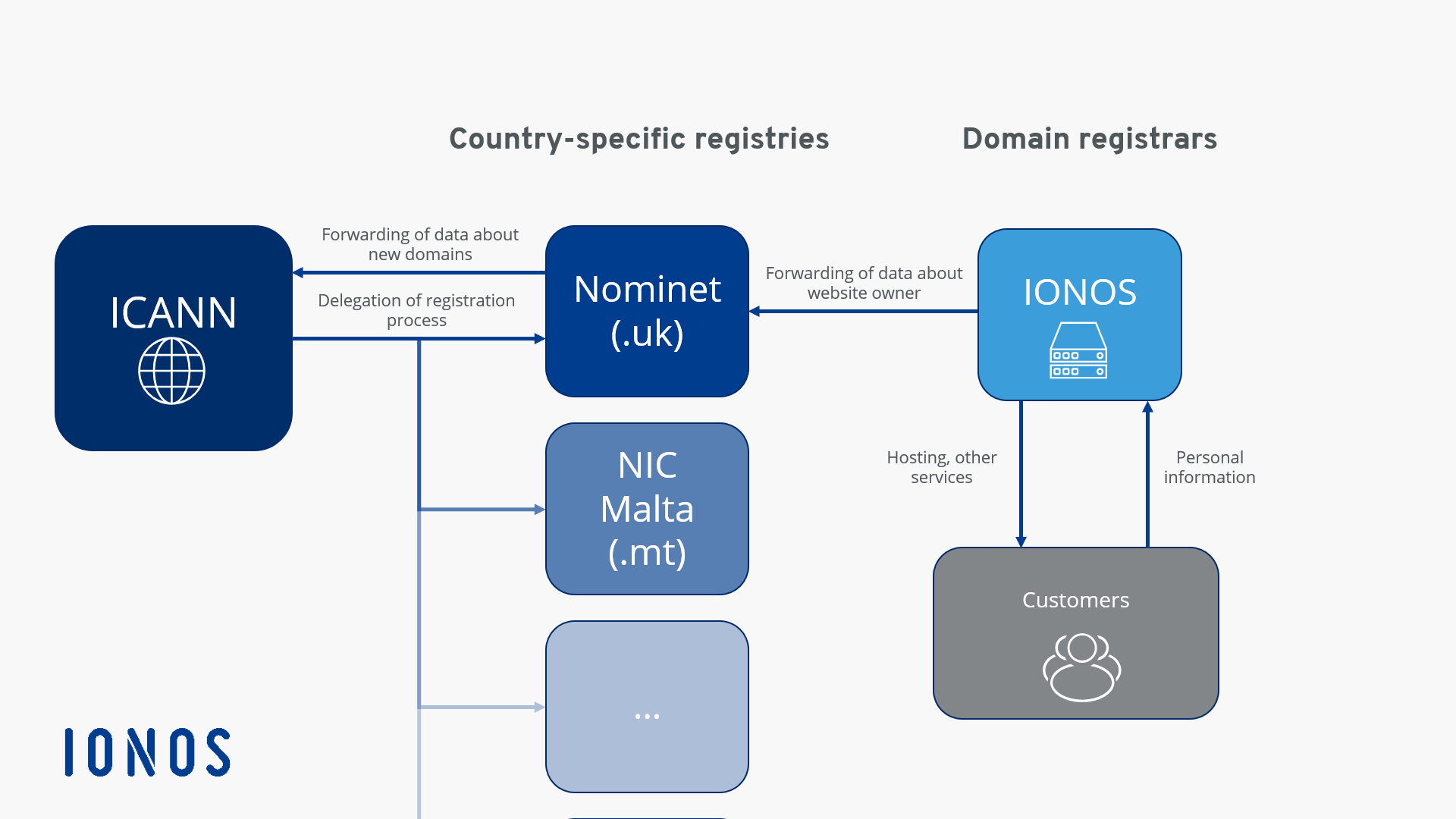
- After checking the availability of a domain with a domain checker, enter the domain you want in the form provided by the registrar. You’ll also need to provide some information about yourself, which is passed on to Nominet as part of the domain registration.
- The domain name you have selected is then entered into Nominet’s database. The personal information you provided is used to identify you as the domain owner. The domain name is then assigned a corresponding IP address.
- After the registration request has gone through, information about your web address is passed on to ICANN. ICANN manages the domain name system (DNS), which, when domains are entered into a browser, locates hosts and accesses the corresponding website. Once ICANN enters the domain you have chosen into the DNS, it will be activated. Upon activation, the domain can be used anywhere in the world.
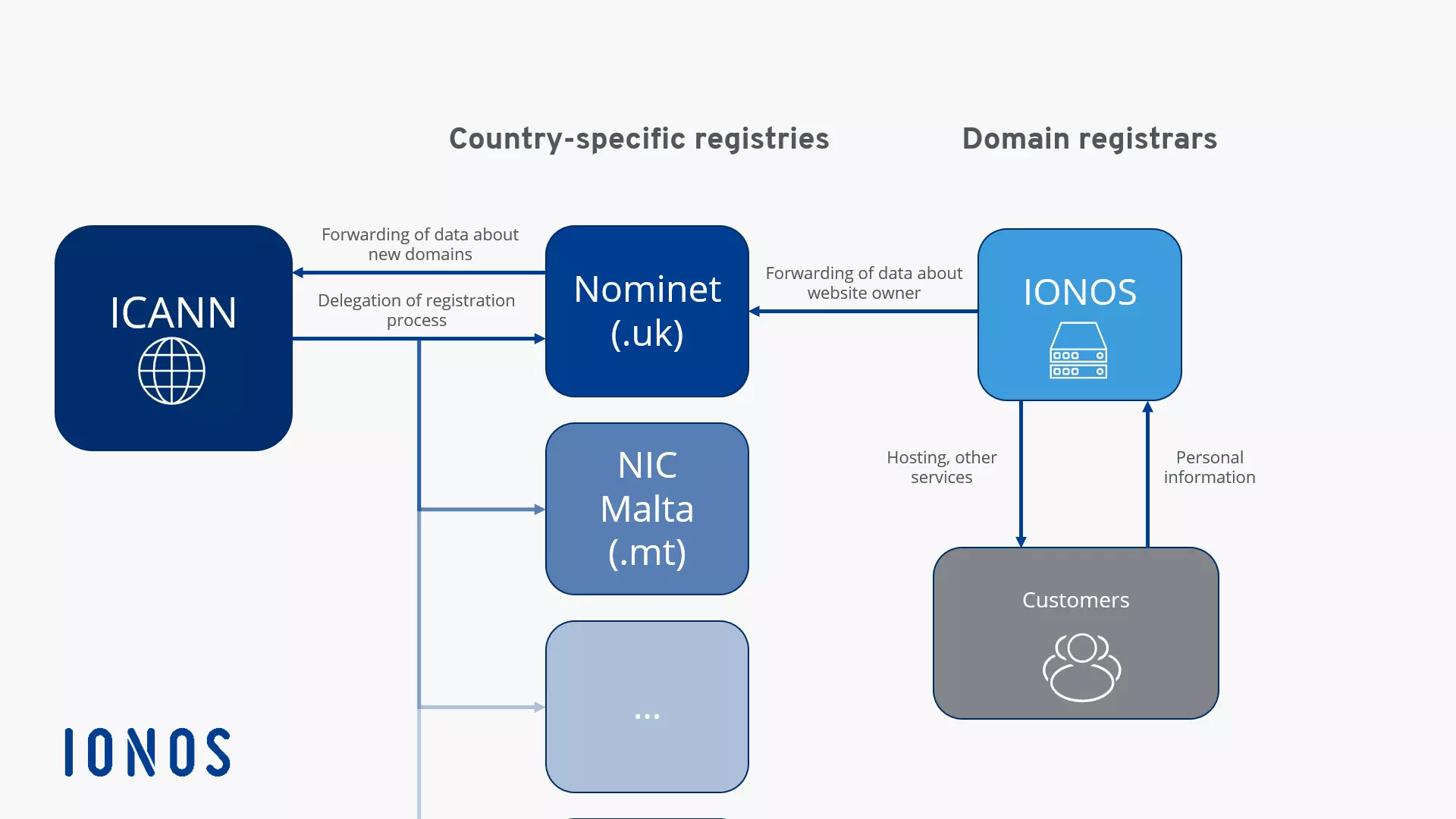
The illustration below should help to give you a better idea of how this works:
ICANN vs. Nominet
ICANN is responsible for almost everything related to domain operation. Its primary task is to ensure that every domain that exists resolves to a valid IP address. This is only possible if the DNS is functioning properly, and each domain name only occurs once worldwide. In order to ensure that these two things happen, ICANN has delegated the necessary steps for these tasks to numerous other organisations. One of their partners is Nominet, which manages multiple domains including .uk, .co.uk and .org.uk.
ICANN and Nominet have very different roles when it comes to operating and managing domains. ICANN primarily establishes rules, delegates tasks and assumes ultimate responsibility for the successful functioning of domains worldwide. On the other hand, Nominet offers domain registry, internet infrastructure and cyber security services. The table below provides a quick comparison of Nominet and ICANN.
| ICANN | Nominet | |
|---|---|---|
| Type of organisation | Non-profit | Public-benefit company |
| Primary responsibilities | Management of TLDs (especially gTLDs) and DNS; ensuring that all domain addresses can always be reached | Management of the*.uk* and .wales domains; provides internet infrastructure and DNS security services; communicates with domain registrars and forwards the data to ICANN |
| Headquarters | Los Angeles, CA | Oxford England |
Reviewer

Julia Hertler
With over 18 years of experience in content marketing, Julia Hertler has deep expertise in digital communications. For the past 10 years, she has specialised in the areas of domains and hosting at the IONOS Digital Guide, making complex technical topics easy to understand.