

Emotional branding: definition and examples

What comes to mind when you hear ‘Coca Cola’? How do you feel when you see McDonald’s, Apple, Bentley or Mini? Can you visualise the products? Beads of condensation dripping down a cold glass in summer; a sleek, futuristic car; a shiny smartphone, elegant as a jewel. But why is it that the simple mention of a brand’s name brings up these images for us? The answer is because of emotional branding.
Emotional branding: a definition
What is emotional branding? The term ‘branding’ originally referred to marking cattle with hot metal. This visible sign of belonging was extended to marketing and helped brands build identities. For emotional branding, this is achieved by evoking strong feelings to ensure the brand stays in customers’ minds.
Emotional branding is, therefore, intended to create a long-lasting, emotional connection between customers and a brand. This emotional bond allows you to build up trust and loyalty among your customer base, increasing the reach and value of your brand. The best way to reel in customers is not through logic, but through emotion. Unlike feelings, emotions occur before we even notice them. They form in the limbic system, an ancient part of our brain that largely eludes our consciousness.
The person behind the idea of Emotional Marketing is Marc Gobé with his 2001 book, Emotional branding: The New Paradigm for Connecting Brands to People. According to Gobé, understanding the human brain and cultural behavioral patterns is more important than any economic theory. He said that money might not be able to buy love, but customers can be led by a strong brand. The customer-brand relationship must be exactly that – an emotional bond built on trust, loyalty, and respect.
Strong emotional branding speaks to our hopes and desires, our fears and needs, and gives us the feeling that the brand is on the right side. A brand’s potential for emotional identification is decisive, and to achieve it, several factors need to be taken into account. This includes design, color psychology, moral standpoints, political and charitable commitments, and emotional marketing.
Emotional branding vs emotional marketing
When we talk about emotional branding, the expression emotional marketing inevitably comes up. However, emotional branding and emotional marketing are not the same thing. The biggest difference between them is their focus.
Emotional marketing pertains mostly to films, concerts, political parties, cars, and tourist destinations. This type of advertisement uses different techniques to create an emotion-based marketing campaign. You can sell your product or offer using colours, music, guerilla marketing, influencer marketing or viral social media campaigns to build up emotions and reach a wider audience. However, there doesn’t necessarily have to be a brand or product behind it. Think of charity organisations that try to raise awareness of social or environmental injustice.
Emotional marketing can work independently from brands. Emotional branding, on the other hand, aims to develop a brand using emotional influences in customers’ minds and lives, thereby setting up a long-lasting customer connection.
Emotional branding rarely works without online marketing. Having your own website is an important step in building your brand. IONOS has created a practical, ready-to-use homepage building package for large or small web projects. Make your first website known and bring your brand to life using emotional marketing.
How does emotional branding work? Gobé’s 10 commandments
To be able to understand emotional branding, you need to know Marc Gobé’s 10 commandments for emotional branding. With these, Gobé illustrated how successful emotional branding lets a brand sell products not just because they are useful, but rather because they create experiences and emotions.
- From consumers to people: Customers must have the feeling that a brand doesn’t simply consider them consumers, but rather respected, individuals.
- From product to experience: Products should not just cover a need, they must also fulfill customers’ hopes and desires, becoming a memorable life event.
- From honesty to trust: Customers expect honesty, so trust and likability are needed to create brand loyalty.
- From quality to preference: Products and brands can only rely on their quality for so long – they also need to consider how the product fits the customers’ lifestyle. Customer preferences dictate which brand is preferred, but preferences can change. Brands should always know the preferences of their target group in order to remain a preferred brand.
- From notoriety to aspiration: Being known is good, but it doesn’t foster emotions. Brands that give customers a good feeling, that improve their lives, build emotional connections through their needs and desires. Think of Apple, Tesla or Gucci, which are not just a part of customers’ lives but rather their whole personality.
- From identity to personality: There are a lot of recognisable brands, but a clear brand identity doesn’t automatically mean personality and charisma. Brands – like people – need ethical and moral values. They should be flexible enough to slot into customer expectations and lifestyles without sacrificing their consistency.
- From function to feel: Products should not simply be practical solutions to a need, but rather embody an emotional experience and the meaning of a customer’s particular aesthetic. Smartphones, which have evolved from bricks into elegant, sleek, and stylish objects, are the best example of this.
- From ubiquity to presence: It is not enough to be as visible as possible. What’s more important for a brand is to be present in places and media where its target customer base hangs out.
- From communication to dialog: Simply advertising the benefits and usefulness of a brand is one-sided communication and does not build customer relationships. An interactive dialog between the customer and the brand involving feedback, social proof, and accessibility is how the relationship is built.
- From service to relationship: A brand that just wants to sell products and services doesn’t build relationships. They first need to connect with the cultural preferences of the customer base to establish loyalty. If you accept and take on board criticism and suggestions for improvement from customers, they will feel like they are part of the brand rather than just a source of revenue.
Emotional branding and the art of convincing
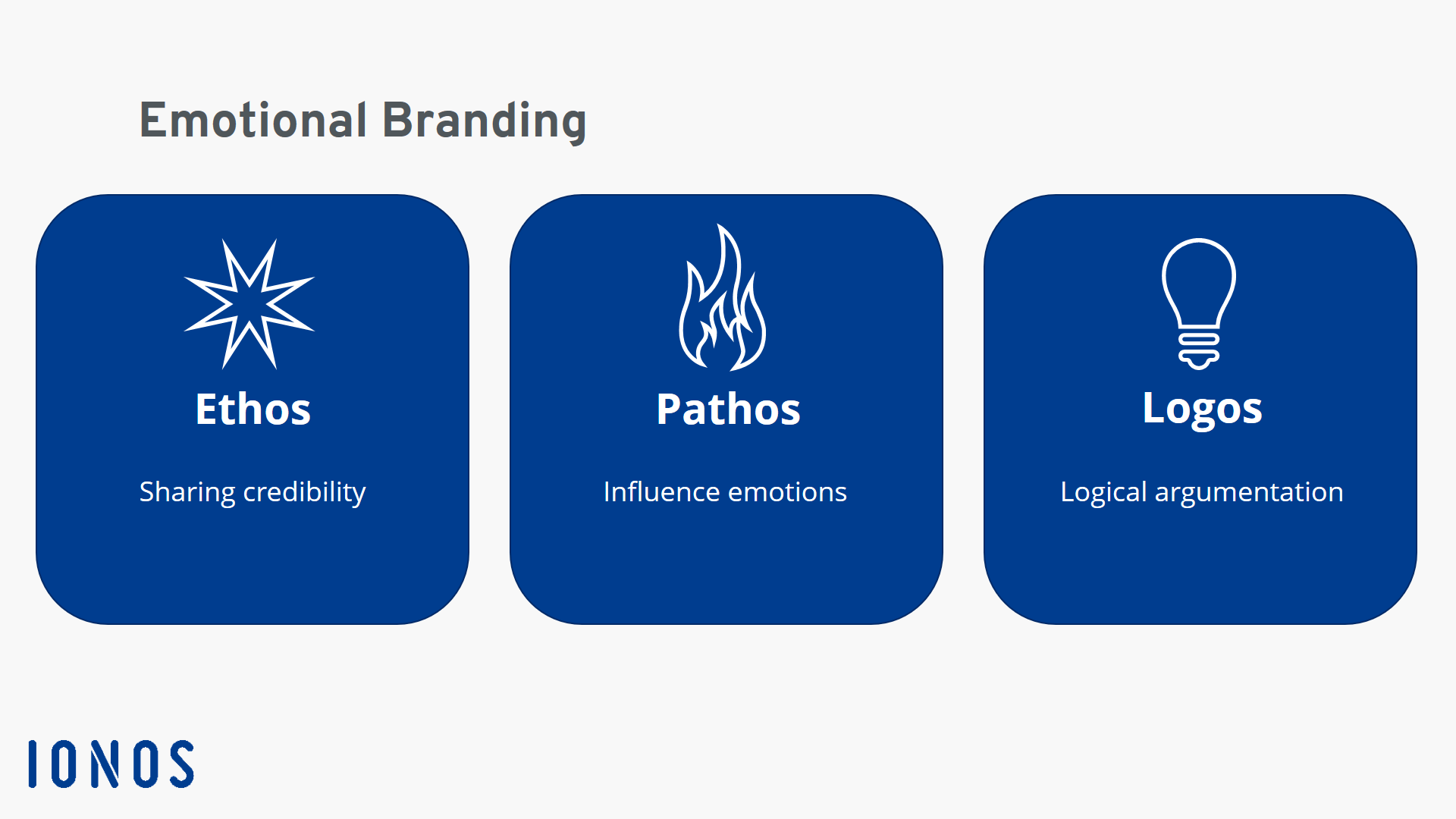
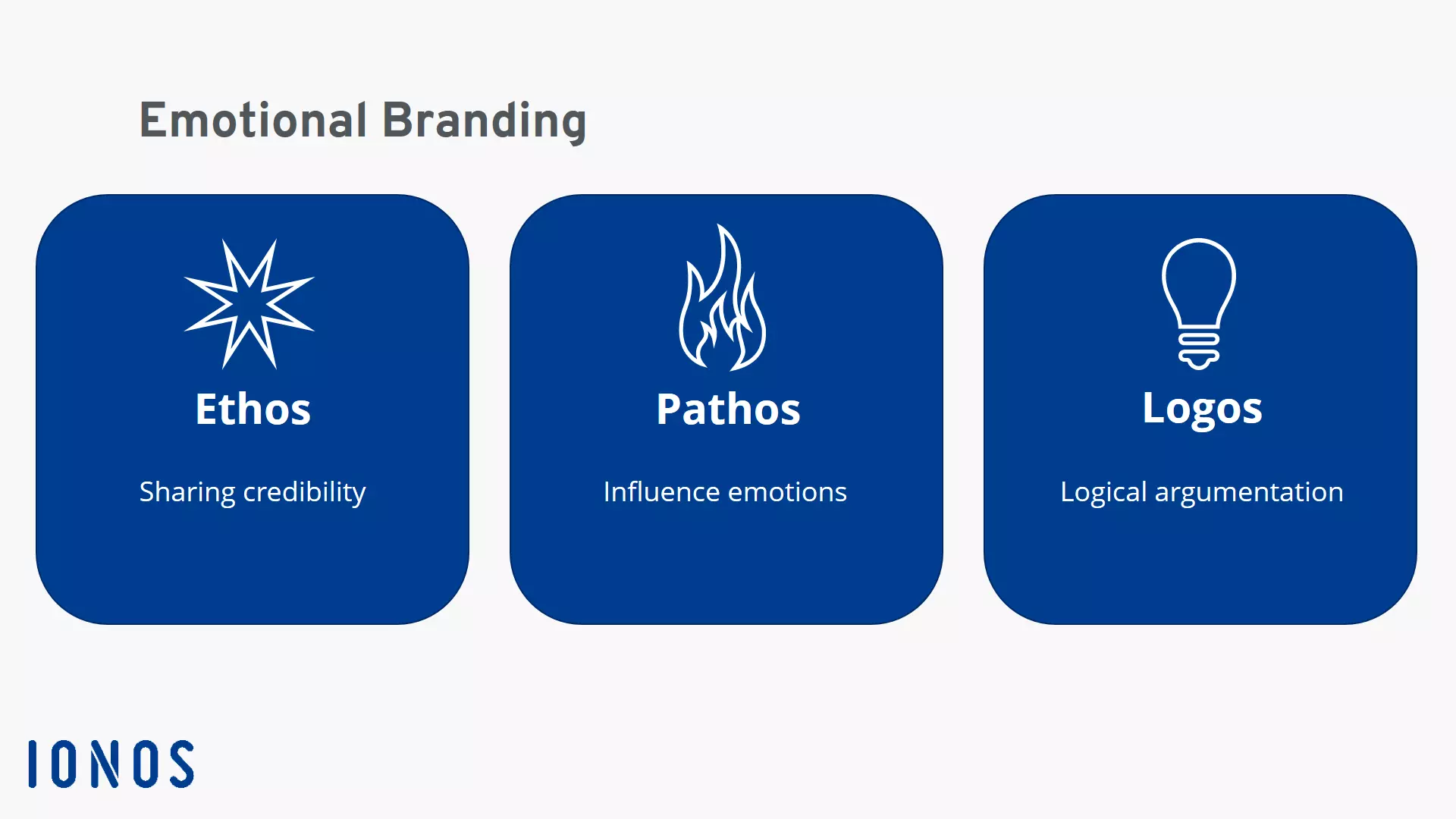
Emotional branding works best when it is focused on Greek philosopher Aristotle’s three pillars of rhetoric for persuasion: Ethos, Pathos, and Logos.
Ethos
In emotional branding, ethos represents sharing credibility and moral character. Customer-winning brands convince the target base not only that they have good quality products, but that they have ethical and moral values too. A brand’s ethos can be strengthened by political engagement, transparent company politics, reliability, fair working conditions, customer satisfaction, and environmental sustainability, and then made more visible by feedback in the form of reviews and social proof.
Pathos
Pathos drives customer attention through igniting targeted emotions and needs. This involves a sense of urgency when making the purchase – a fear of missing out (FOMO) – as well as a feeling of belonging and safety. A brand can use a visual and musical repertoire to awaken emotions such as surprise, curiosity, love, fear, hope or security right from the first impression, thereby creating a direct relationship. Emotions are behind 95% of all purchase decisions, making pathos one of the most important points in emotional branding.
Logos
Logos covers the logical and statistical side of marketing and should wrap up the customer’s emotional link in convincing, rational arguments. Once emotions have fostered receptiveness and interest, a product still has to win people over using quality and performance.
Emotional branding: Examples
The possibilities of emotional branding are endless. But two questions in particular are important: What target group do you want to reach, and which emotions would you like to be associated with your brand?
An experiment conducted by Facebook in collaboration with Cornell University and the University of California showed the effects of targeted emotional manipulation on users. In the study, 689,000 Facebook users’ newsfeeds were filtered to show primarily positive or negative posts from their friends. The users did not know that they were part of the experiment. However, their online behaviour did reflect the trend of negative or positive posts depending on which emotion they were shown. The name of this phenomenon is ‘emotional contagion’.
Nowadays, it’s actually quite difficult to not move in branded circles and not be exposed to forced emotions. This makes it even more important to be able to surprise and touch customers in their hectic daily lives, no matter whether you run marketing campaigns using traditional media like film, TV, radio, and sport and music events or rather via social media, sponsored ads, and influencers. Brand building can be both symmetrical and asymmetrical and you shouldn’t be scared to experiment.
The following emotional branding examples will show you which aspects are the most important when it comes to brand building.
Color psychology
Statements such as ‘Red is for passion’ or ‘Yellow is for happiness’ are basically meaningless without context, as colours speak above all to our subconscious. They strengthen the intensity of our senses and emotions. For instance, yellow can stand for both joy and sickness, or red for love and anger. Colours support the emotional power of the brand, if you work colour psychology into your logo or associate a particular colour or colour palette with your brand.
A famous example of colour psychology in emotional marketing comes from the charity organisation One Campaign and their licensed brand (Product)Red in 2006. Companies such as Apple, Coca Cola, Nike, and American Express supported the Red Campaign in its fight against HIV/AIDS in Africa by offering red products bearing the (Product)Red trademark. 50% of the proceeds were donated to the Global Fund and participating charity organisations.
 To display this video, third-party cookies are required. You can access and change your cookie settings here.
 Customer engagement
Actively interacting with customers increases brand attention and reach, and makes for a deeper emotional connection with customers. A brand should not just be a useful item or a background detail, but rather a true facet of a customer’s lifestyle, becoming part of their identity and their social life.
As an example, Coca Cola increased customer engagement with their Share a Coke campaign. Instead of the Coca Cola logo, personalised bottle labels showed common names from different countries. Coca Cola encouraged customers to post pictures to social media with their own personal coke bottle. This boosted global revenues and the brand’s reach across social media.
 To display this video, third-party cookies are required. You can access and change your cookie settings here.
 Customer loyalty
Customer loyalty has to be earned. More than anything else, it comes from feeling good. Customers who associate a brand with positive experiences are more likely to return to it.
Starbucks took this concept to heart in the most literal sense when they worked with dating app Match on the 2015 ‘Meet me at Starbucks’ campaign. Match users could use the app to set up their first date in Starbucks directly. The campaign targeted emotional connections between people and subconsciously extended this connection to the Starbucks brand. Ever since, Valentine’s deals have been one of the most popular and successful events Starbucks runs.
 To display this video, third-party cookies are required. You can access and change your cookie settings here.
 Ideals and values
Brands shouldn’t shy away from socio-political statements. In the era of social media, customers pay attention to a brand’s ideals and values. Fair trade, human rights, fair production line conditions, and environmental protection play a decisive role in a brand’s image. Brands can turn support for veganism, inclusiveness, human rights, and fair production into the heart of their emotional branding. Customers who feel that supporting a brand means supporting a better world vision will stay loyal to that brand.
Oatly, an oat milk company, always places its products in the context of environmental protection.
 To display this video, third-party cookies are required. You can access and change your cookie settings here.
 Flexibility and relevance
It is important for a brand to be recognisable and to adapt with the times. The best example for this is Apple. Apple began with chunky computer designs like the Apple II, which was the first Macintosh home computer, and then the Macintosh Portable, before changing its style with the bright iMac collection in 1998, the stylish iPod in 2001, and the first iPhone in 2007.
The history of Apple is one of game-changing product design and marketing, from the legendary 1984 Macintosh commercial to the U2 iPod campaign. Apple’s marketing strategy zones directly into customer needs, aesthetics and desires, and lovers of Apple products are driven to purchase because of the logo, not the price tag.
 To display this video, third-party cookies are required. You can access and change your cookie settings here.
 Apple managed to turn itself into a cultural, almost religious phenomenon by using new technology and emotional branding to work its way into consumers’ homes, ears, and pockets as well as every nook and cranny of social life. Apple’s success shows how important flexibility and openness to change are for a brand to ensure that it can meet the needs of new generations while still being seen as continuous and relevant.
Customer focus
Emotional connections between customers and brands are most likely to happen when customers feel like they’re centre stage. Unannounced changes in design, price or offer with no thought for customer desires can be deemed insulting by customers.
Think of the customer feedback to Ferrero in 2017 when they changed their famous Nutella recipe and risked losing the trust of their target group. The change wasn’t announced in time and the reasons for it were not made transparent, which visibly weakened customer trust. A similar thing happened with Toblerone chocolate bars. In 2016, the producer, Mondelēz International, decided to market a shorter bar with more space between each chunk in the UK. Customers had the feeling that they were receiving less for the same price, which resulted in outcry and Mondelēz backpedalling.
Customer focus and communication are essential if you want to avoid risking customer trust. For a more current example, the ridesharing company Uber brought customer focus to the forefront in the UK during the Covid-19 pandemic by offering free trips or food deliveries for medical professionals, seniors, and frontline workers and those most affected.
Emotional storytelling
Stories get through to us 22 times faster than dry facts. Our brain activity is increased by a factor of five when we hear a story. The most important thing is that stories incite feelings and inspiration.
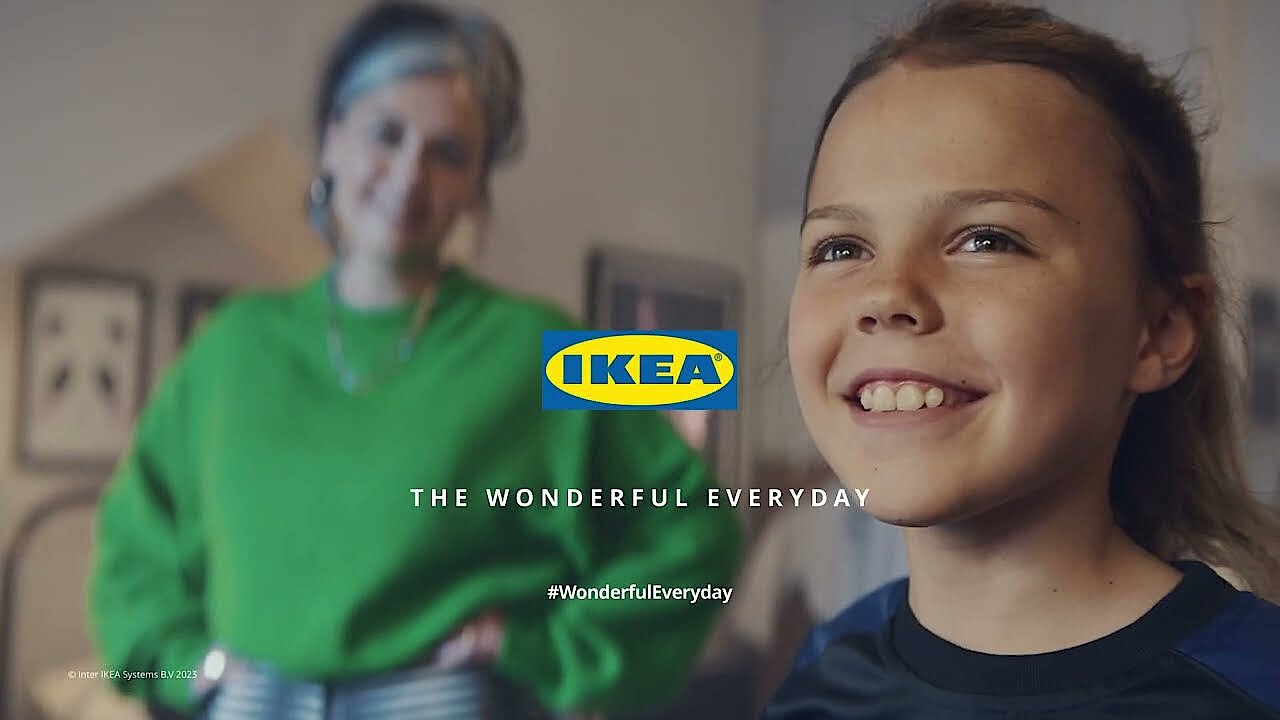
IKEA always surprises people with its original B2C storytelling. Slogans such as ‘We help you make it’ became part of a generation’s collective consciousness. IKEA’s emotional brand also developed through imaginative storytelling, and short ads full of humour and empathy became part of the brand’s identity. Their Christmas commercials or other situational clips stay with us. Who could forget the poor lamp abandoned by its owner on a rainy sidewalk?
 To display this video, third-party cookies are required. You can access and change your cookie settings here.
 What’s in store for emotional branding?
Emotional branding provides a brand with many advantages. It increases attention and encourages sales. Your customers will develop an emotional connection to your brand, building up trust, and staying loyal. Your brand will acquire a spot in their everyday lives, thereby increasing its reach.
If this is used correctly, a brand can follow in Apple’s footsteps and become bigger than the products it sells. Increasing digitalisation, wearable technology, 5G, and the influence of big data on the market opens up many new possibilities for emotional branding. In her bestselling book No Logo, the author and brand critic Naomi Klein warned of the ubiquity and monopoly of brands such as McDonald’s, Coca Cola, Apple, and Microsoft. As early as 1999, she pictured the brand-dominated world in which we live today.
Brands have even turned into political powers with an ever-stronger influence on people and social relations. The development of Amazon is a good example for this. Initially little more than a digital supermarket and bookstore, the company and brand ‘Amazon’ grew into a film producer, a self-publisher (Amazon Publishing), and space tourism agency Blue Origin with plans to go to the moon.
A similar thing happened with Elon Musk’s Tesla and SpaceX brands. Not only will Musk possibly be the first private space agency to make it to Mars, but he also wants astronauts to drive around the red planet in Tesla vehicles. You can't get more visionary and emotion-packed branding than that.
On the other hand, brands such as Facebook and Google are regularly criticised for reasons relating to data protection, political influence through neuromarketing, and selling user data.
Given the potential power of a brand, it's increasingly important to not lose sight of the strategic, emotion and value-oriented emotional branding required to make customers the protagonists of their brand. A brand doesn’t have to be big enough to be in every city in the world. However, it does have to be valued and relatable enough to find its way into its customers’ hearts.