

Pinterest and Instagram: comparing two image-sharing networks

Since their release in 2010, the image sharing platforms Pinterest and Instagram have taken the British market by storm. Their innovative features and capabilities present interesting new marketing opportunities, which have contributed to their growing success. The two platforms enable companies to present their brands or products through eye-catching images and profit from influential followers, making them attractive alternatives to Facebook and Twitter.
- Sell on social media in minutes
- Manage everything from one platform
- Works with any product or service
Similarities between Pinterest and Instagram
In principle, the networks share the same concept: registered users can upload images as well as view, share, and comment on other users’ images. As with other social media platforms, these interactions can help to build an extensive outreach. The more followers you collect, the more your content will be noticed and shared.
Both Pinterest and Instagram offer a huge number of influencers (users with a strong presence and good reputation in their network), including celebrities, sports personalities, and bloggers, whose opinions can strongly influence other users. When these influencers write and share photos about products, brands, and services, it has an enormous impact on those brands’ popularity.



Pinterest vs. Instagram: the biggest differences
Although the two services look very similar at first glance, there are several fundamental differences between Instagram and Pinterest, beginning with the number of registered users. Instagram has 400 million users around the world, around four times as many as Pinterest. It would be wrong to assume, however, that Instagram is a more effective platform in every instance. The choice between the two networks should be determined by your chosen marketing strategy. The following table illustrates the differences between Pinterest and Instagram:
| Outreach (worldwide) | 400 million | 100 million |
| Order of images | chronological | thematic |
| Type of images | private, professional, snapshots | professional, high quality images of products |
| Type of followers | More personal followers | Fewer personal followers |
| Linked images | Only as short links | ✓ |
| Embedding with other social media | Simple; code with every image | Complicated; code must be generated with a widget builder |
| Image filters | ✓ | ✗ |
| Video uploads | ✓ | ✗ |
| Upload via an app | ✓ | ✓ |
| Upload via a browser | ✗ | ✓ |
- Sell on social media in minutes
- Manage everything from one platform
- Works with any product or service
Instagram: increasing awareness of your brand
The table clearly shows Instagram’s main strengths; joining the network connects you to an enormous number of people and target groups. With Instagram, it’s easy to upload videos, edit images with different settings and filters, and publish new images on the go. Although the chronological layout of images is of course not ideal in every situation, it can have a positive effect on your position in the app’s search results; the use of hashtags makes your images more accessible to users searching for the same hashtags. Since Instagram has been bought by Facebook, the two platforms can be linked with minimal effort, and it is also easy to embed Instagram posts in other social media pages.
Another difference between Pinterest and Instagram is that Instagram centres on social interaction. On Instagram, there are a great deal of personal snapshots and users tend to gather a considerable amount of personal followers. Meanwhile, direct advertisements are quite rare and provide an unwelcome presence. Due to this lack of advertising, Instagram is not an ideal platform if your main goal is to generate traffic to your website. In terms of marketing, it is far better suited to improving a brand’s presentation. With the support of influencers and a continually growing follower base, Instagram is an ideal platform for establishing a budding business and raising brand awareness.
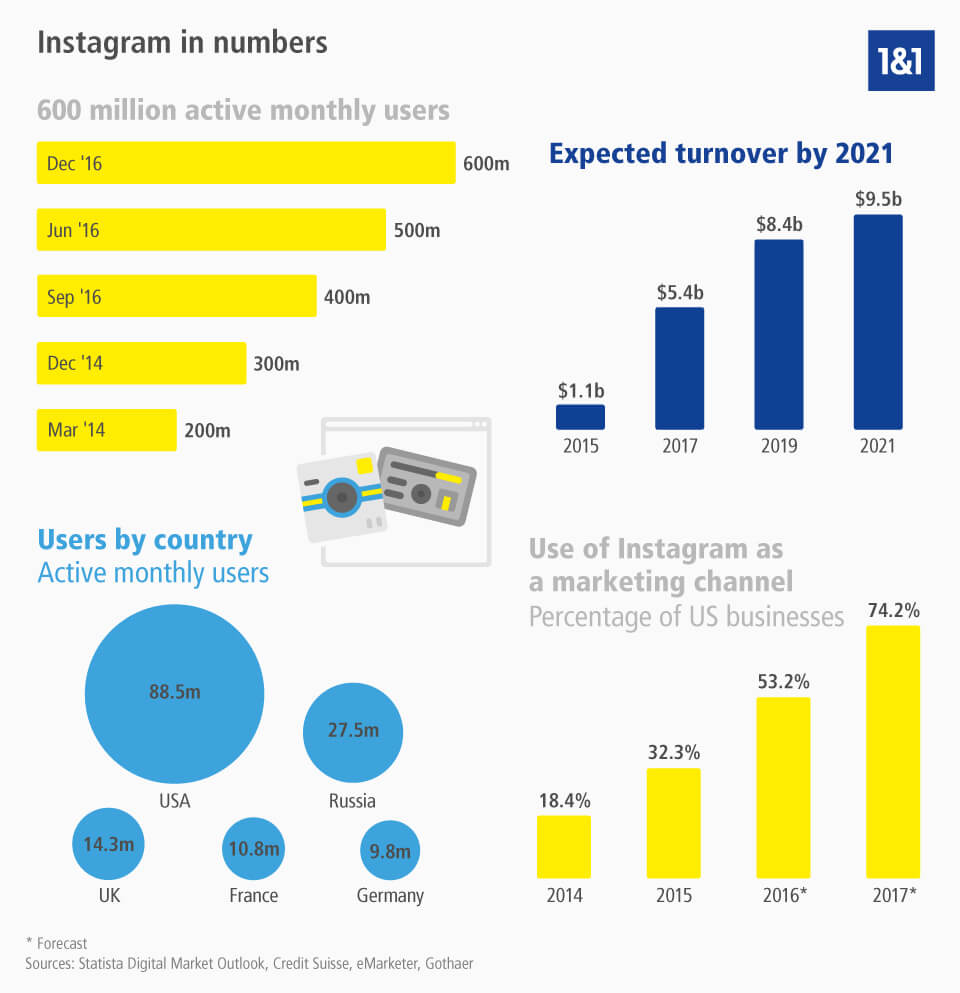
Click here to download the infographic about instagram facts.
Pinterest: leading customers to your store
Even though Pinterest cannot boast as many users as Instagram, the network has its own unique features that can provide irresistible marketing opportunities. Pinterest enables users to create unlimited folders or ‘pin boards’ and present images thematically to other users. The target group is something to bear in mind here; unlike Instagram, Pinterest followers tend to be people from outside of your personal network. There is also a big difference in the image quality. Although private photos are not completely discouraged, there is a strong emphasis on professional, high-quality images. Pinterest offers no filters or photo editing tools, demonstrating that photos should be of a high quality before they are uploaded. A further advantage is that you can upload images to your Pinterest both via an app and via a browser on a desktop or laptop.
Although it is not possible to upload videos directly to Pinterest, entries can contain links to outside sources. How you choose to use these links is up to you; whether they lead to informative or entertaining YouTube videos or directly to your website or online shop, they can be a great method of generating traffic. Unfortunately, embedding your Pinterest updates on other websites and social networks is not as easy as it is with Instagram; to create a link, you first have to generate an embed code using a widget builder. While this leaves Pinterest falling short of the mark in terms of compatibility, their advertising opportunities compensate for this drawback. Their ‘promoted pins’ feature offers the possibility to create paid advertisements aimed at other users, which, although useful, can prove relatively expensive. Overall, these differences between Instagram and Pinterest even out, presenting a level playing field in terms of marketing.
Why not Pinterest AND Instagram?
When it comes to Instagram vs. Pinterest, the various strengths and weaknesses they present mean that it is not necessary to choose between them. A combination of both services can be greatly beneficial for marketing campaigns, although this would unfortunately increase your workload.
The medium you choose should complement your brand’s image and marketing campaign, meaning that it is not always necessary to use Instagram or Pinterest. For example, maintaining a Pinterest account without high-quality images would be ineffective as there is strong competition on the site. On the other hand, finding success with Instagram is highly dependent on generating influential followers. Furthermore, it should go without saying that using either Pinterest or Instagram for your business is only advisable when you can market your products or services with images.