

What is an AI server?

AI servers are servers designed for training artificial intelligence. They tend to have more powerful software and hardware components than traditional server types.
- Get online faster with AI tools
- Fast-track growth with AI marketing
- Save time, maximise results
What does an AI server do?
AI servers are a special kind of server that are designed to run applications related to artificial intelligence (AI) and machine learning (ML). They are equipped with advanced hardware and software that can handle the high computing requirements of AI models. In contrast to typical servers, which are mostly used for basic computer tasks and hosting websites or databases, AI servers are optimised for processing larger datasets and performing complex calculations.
What are the hardware requirements for AI servers?
An AI server’s hardware is decisive for its performance and efficiency. AI applications involve a lot of computation and memory, meaning they need specific hardware. The most important components are:
- Graphic processing units (GPUs): GPUs are crucial for processing parallel data streams, which is necessary for training deep learning models.
- Central processors (CPUs): Powerful CPUs are important for general calculations and server management.
- RAM: AI servers need a lot of RAM so that even large datasets can be kept in memory and access times are kept to a minimum. At least 64 GB, but often 128 GB or more, are recommended.
- Memory: Working with artificial intelligence requires a lot of memory. AI models use a lot of datasets for training. That makes having sufficient HDD or SSD essential.
- Network cards: A high-performing network connection is necessary for communicating within the device network.
What are the software requirements for AI servers?
Having the right software for an AI server is just as important as the hardware, as you’ll need specific applications for training and running AI models.
-Operating system: You’ll need an operating system that manages hardware resources. Linux distributions like Ubuntu, CentOS, and Debian are common choices that natively support AI frameworks. -AI frameworks: Every AI server will need specific environments for working with artificial intelligence and machine learning. TensorFlow, PyTorch and Keras are especially popular. -Software libraries: Software libraries like NumPy and Pandas are necessary for programming AI models. -AI models: AI models are the programs that perform AI tasks. They are trained in a variety of ways to get the best possible results.
How do AI servers work?
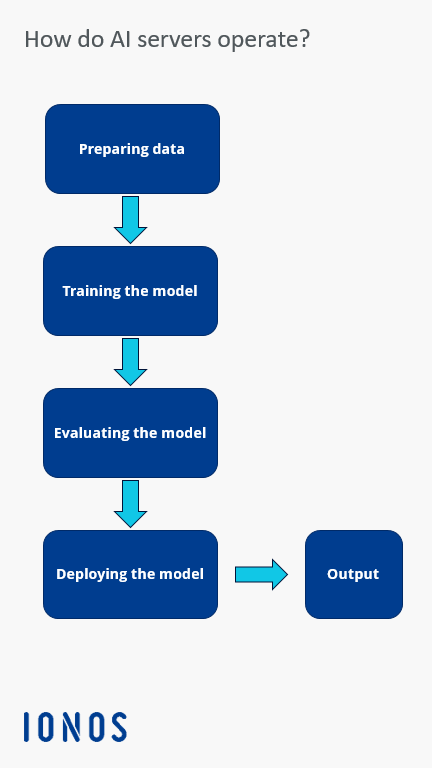
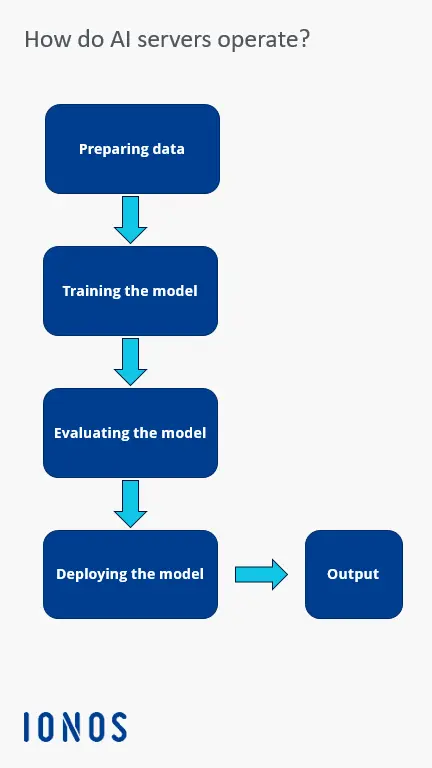
AI servers work by processing and analysing large amounts of data. The goal is to use machine learning or deep learning to train models that make predictions, make decisions based on new data or, in the case of generative AI, create output. The operation of an AI server can be broken down into the following steps:
- Preparing data: First, the data that are required for the AI model are collected, cleaned and saved in the appropriate format.
- Training the model: Next, you train the algorithm with the data you prepared or with training data. This step requires substantial computing resources, as the algorithm iterates through the data and adjusts its parameters in order to get the best possible results. Training can therefore take hours or even days.
- Evaluating the model: The trained model is then run on a separate dataset, the test data, in order to evaluate its performance and precision.
- Deploying the model: Finally, the model can be transferred to a production environment where it can be used to make predictions with new data.
What are the advantages of AI servers?
Using AI servers comes with a number of advantages for businesses. Especially if simple AI websites and tools, AIaaS and AI in the cloud aren’t enough in terms of performance and functionality, an AI server can be the right choice.
Scalability is one of the biggest arguments for using an AI server. They can be scaled based on your needs in order to provide more computing power or memory. They also use their resources with maximum efficiency. In contrast to conventional servers, AI servers use hardware that is designed to be used with AI. GPUs are a good example of that.
What are the most important uses for AI servers?
AI servers are suitable for any field in which using AI makes sense. That will mostly be areas that involve pattern recognition and processing and analysing very large datasets. A good example is self-driving cars, which process data from cameras and various sensors in order to navigate and make decisions. AI servers also make sense for language and image recognition and generation. Large language models and generative AI produce text and images based on learned data and probabilities.
- Enterprise hardware
- Configurable hardware equipment
- ISO-certified data centres
Reviewer

Christian Heldmaier
Christian Heldmaier is an experienced online marketing and SEO specialist from Karlsruhe. He has been working as an SEO Manager at IONOS since July 2020.