

What is random forest and how does it work?

Random forest is a machine learning algorithm based on a large number of decision trees. It is one of the most reliable methods for classification and regression. Especially for beginners, it offers a way to develop initial successful models.
What is random forest?
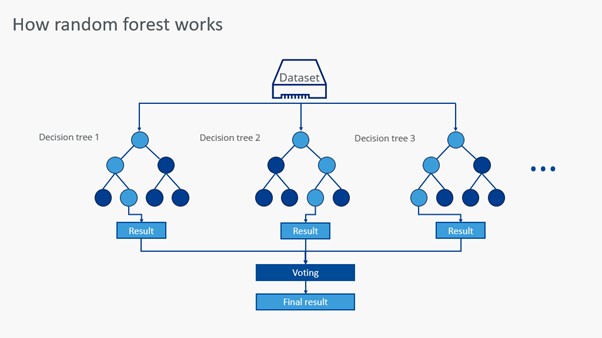
Random forest is a machine learning algorithm in which many individual decision trees work together to produce a result. Instead of depending on a single decision tree, the approach combines the predictions of many models to achieve higher accuracy. Each tree is trained on slightly different data samples or feature subsets, which increases diversity within the model. The key idea is that while individual decision trees may be unstable or error-prone on their own, their combined predictions form a robust and reliable overall model. As a result, a random decision forest is less susceptible to overfitting, since errors made by individual trees tend to cancel each other out. The algorithm can be applied to both classification and regression tasks and performs reliably even with high-dimensional data or incomplete information.
- Get online faster with AI tools
- Fast-track growth with AI marketing
- Save time, maximise results
How does random forest work?
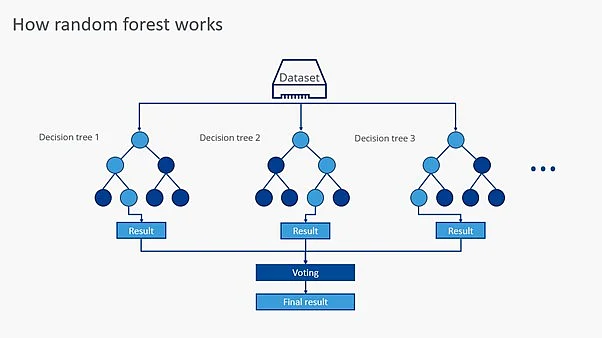
The random forest algorithm starts by generating multiple random samples from the original dataset. This process is known as bootstrapping. In a second step, a separate decision tree is trained for each of these samples. What matters here is that each tree considers only a random subset of the available features, which differentiates the models from one another. During training, each tree is created entirely independently of the others, so small differences in the data can strongly affect the tree’s structure. For classification problems, each tree outputs a class decision; for regression problems, it outputs a numerical value.
After training, the results of all trees are combined. For classification, the majority vote decides; for regression, the average is calculated. This voting reduces the likelihood that individual outliers will influence the overall prediction. In this way, random forest minimises overfitting because incorrect decisions by a single tree are averaged out. In addition, the algorithm measures how strongly each feature contributes to the prediction, which helps with model interpretation.
Advantages and disadvantages of a random decision forest
Random forest stands out for its high accuracy, flexibility, and stability, but like any algorithm, it also comes with challenges.
Advantages of random forest
Random forest typically delivers highly accurate results, even when datasets contain many variables or a significant amount of noise. By combining the predictions of multiple models, the algorithm is far less prone to overfitting than a single decision tree. It also handles missing values well and continues to perform reliably even when data quality is imperfect. Another key advantage is the ability to assess the importance of individual variables, which provides valuable insights into the underlying structure of the data. In addition, random forest is highly flexible and can be used effectively for both classification and regression tasks.
Disadvantages of random forest
Despite its advantages, random forest comes with some challenges. If the model contains a very large number of trees, computational effort increases significantly, which can lead to longer training times. Interpretability is also limited, since an entire forest of decision trees is not directly transparent. This makes it harder in areas where transparency matters to explain decisions in detail. Random forest can also hit its limits with real-time requirements, because predictions must pass through multiple trees. In particularly large datasets, the model may also require a lot of storage space.
Overview of the advantages and disadvantages of random forest
| Advantages | Disadvantages |
|---|---|
| ✓ High accuracy and robustness | ✗ Lower interpretability |
| ✓ Hardly any overfitting | ✗ High computational effort for large models |
| ✓ Works well with many features | ✗ Slower predictions with a very large number of trees |
| ✓ Handling missing values | ✗ Memory-intensive |
| ✗ Less suitable for strict real-time requirements |


What are typical use cases for random forest?
The random forest algorithm is used in many industries because it is reliable, robust, and versatile. The algorithm is especially beneficial when large datasets, many features, or complex patterns are present.
Credit and risk assessment
Banks use random forest as part of their AI systems to assess the likelihood of default. The algorithm combines data such as income, payment behaviour, length of employment, and credit history. Thanks to its robustness, it can identify patterns that humans—or even simple neural networks—might overlook. The large number of decision trees ensures that random outliers have little influence on the final outcome, which is especially important for making fair and stable decisions.
Medical diagnostics
In healthcare, random forest is also frequently used as part of AI-powered diagnostics. It can combine lab values, symptoms, or image features to make predictions about diseases. Because medical data is often incomplete or noisy, this field benefits greatly from the algorithm’s robust nature. In combination with other models—such as a neural network for image analysis—reliable end-to-end systems can be built.
Fraud detection
Companies use random forest, among other things, in AI-based fraud detection systems to identify fraudulent transactions. The random forest algorithm analyses patterns in historical data and compares them with current activity. Thanks to its ability to detect complex relationships, it is very effective at identifying unusual behaviour and performs very well even compared to simply structured neural networks. False alarm rates remain low because many trees work together. Even if some trees make incorrect decisions, the majority offsets them. This gives the system more reliable decisions than simple methods.
Random forest examples in practice
Random forest demonstrates its strengths in a wide range of application scenarios, both in smaller projects and in large enterprises. In e-commerce, for example, random forest can be used to predict which customers are likely to repurchase a specific product. To do this, the model analyses previous purchasing patterns, visit times, product categories, and user interactions.
In marketing, random forest models help companies segment target audiences more precisely. They analyse customer behaviour, demographic characteristics, and interests to enable personalised campaigns. This reduces wasted reach and allows marketing budgets to be used more efficiently.
The model is also widely used in cybersecurity. Random forest algorithms detect unusual network activity by comparing patterns from historical data with current events. In this way, they help identify potential attacks at an early stage and minimise security risks.
Reviewer

Christian Heldmaier
Christian Heldmaier is an experienced online marketing and SEO specialist from Karlsruhe. He has been working as an SEO Manager at IONOS since July 2020.