

How to achieve more by setting SMART goals

To be successful, you need to set goals. Every businessperson or manager knows this. Still, we often fall short of our goals in everyday life. The goals themselves are often the underlying cause. The type of goals you set and the way you set them significantly influences your likelihood of success. Goals have to meet certain criteria in order to be motivating, attainable and beneficial for the company. SMART goals incorporate all these criteria.
Why setting the right goals is the key to success
Sometimes goals are too fuzzy, and other times they’re too unrealistic. Sometimes a goal has no deadline, sometimes the deadline is too tight. You can make a lot of mistakes when setting goals. But you still need goals if you want to get anywhere. They provide a sense of direction. In a business context, goals keep employees engaged and ensure that they use their skills and creativity to deliver the desired results. Goals serve as a guide for measuring team progress. Last but not least, goals are what motivate the team to act in the first place.
However, goals won’t be effective if you simply set a vague direction and say “Give it your best shot!”. In 1990, after years of research studying goal-setting theory, Latham and Locke showed that goals work best when they meet five specific criteria. They used the acronym “SMART” to summarise these criteria. SMART is made up of the initial letters of the five criteria.
What are SMART goals?
According to Locke and Latham, all goals, whether personal or professional, work best if they are SMART. SMART goals are specific, measurable, attractive, realistic and timed. Alternative terms are occasionally used, but they always have similar meanings to these terms.
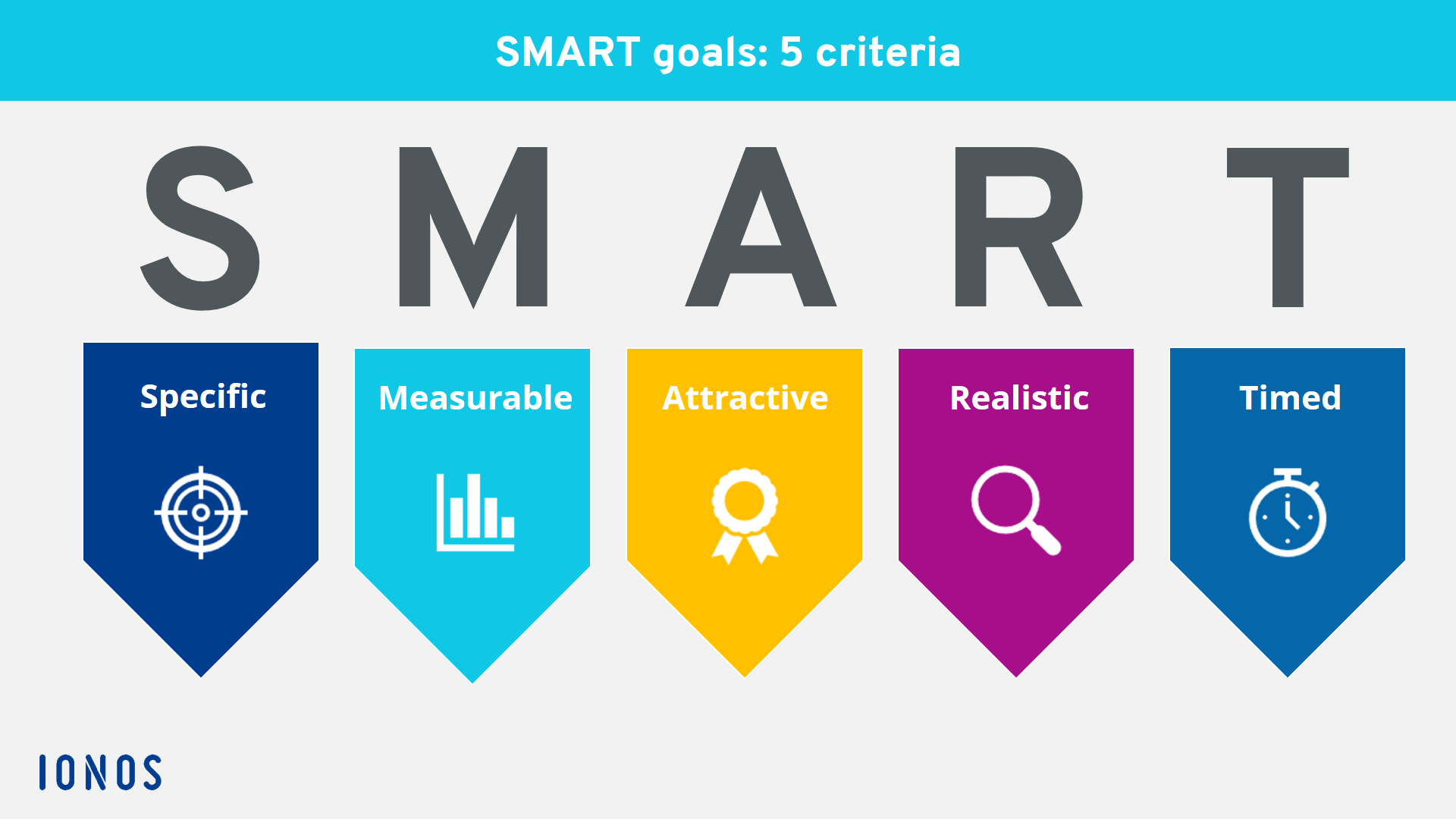

Specific: Objectives should be defined as precisely and specifically as possible. Business goals should be especially clear about the desired outcome and shouldn’t leave any room for interpretation. The goal should always be stated positively. (Positive statement: “We want to be profitable again.” Negative statement: “We want to get out of the red.”)
Measurable: The goal should be stated so that progress can be verified objectively. Define reliable metrics such as monthly sales, the number of conversions per month, or the number of sales per quarter. However, not every goal can be measured using quantitative indicators. In that case, use qualitative metrics such as customer or employee satisfaction and rank them on a graded scale.
Attractive: Everyone involved has to be “attracted” to the goal so they are motivated to reach it. The chances of success are slim without this commitment and an emotional connection to the goal.
Realistic: You should set realistic goals so that employees can achieve them and accept their responsibilities. Goals can be ambitious, but don’t set the bar too high for the team. A goal that seems unrealistic will kill all motivation right from the start. To define a realistic goal, you have to consider the resources and time available.
Timed: Every goal should have a clear deadline. Employees will be more motivated if there’s a clear timeline for milestones. A schedule also counteracts the tendency for team members to procrastinate and postpone tasks. Let colleagues know that progress will be checked on certain dates. That will give them extra motivation to perform.
Sample application for SMART goals
At first glance, SMART goals seem to make goal-setting more complicated. You have to consider so many variables. So much more work! But the extra mental effort pays off. With a little practice, you’ll quickly internalize the criteria as a mental checklist. Defining SMART goals will then become second nature to you.
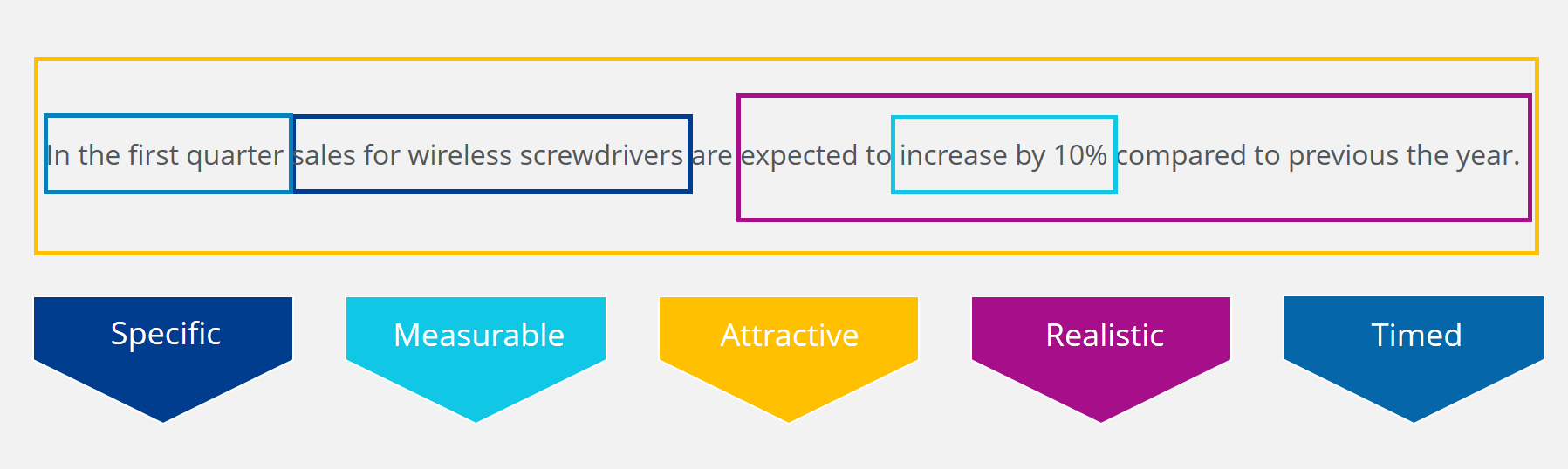
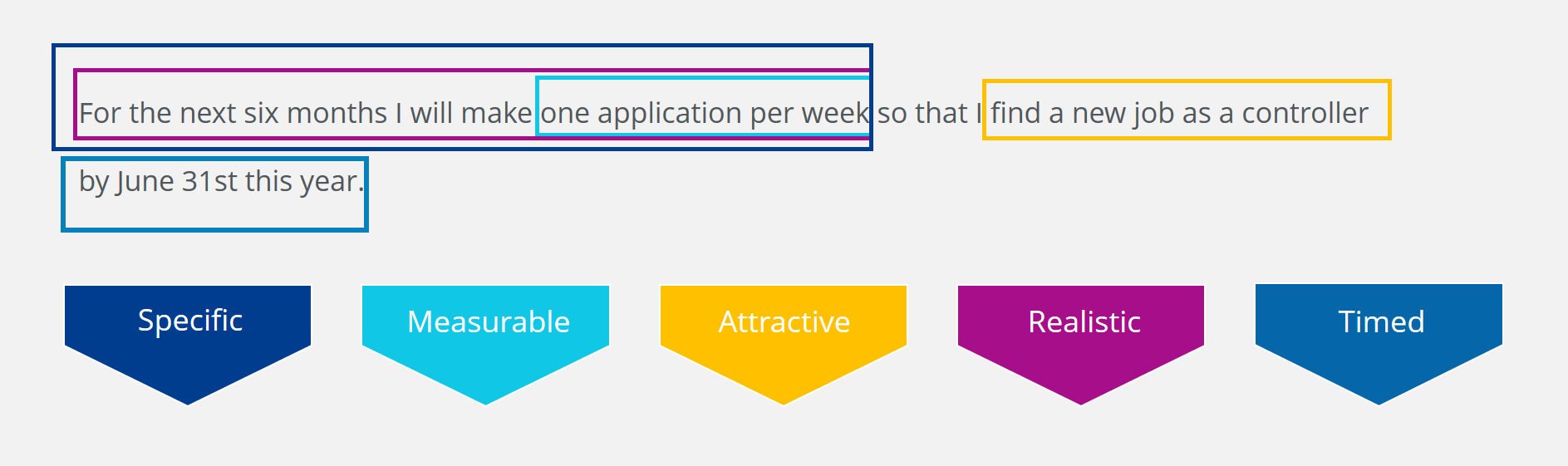
The three examples below show you can improve conventional goals by using SMART goals:
- We need to increase revenues.
2. I want to change jobs.
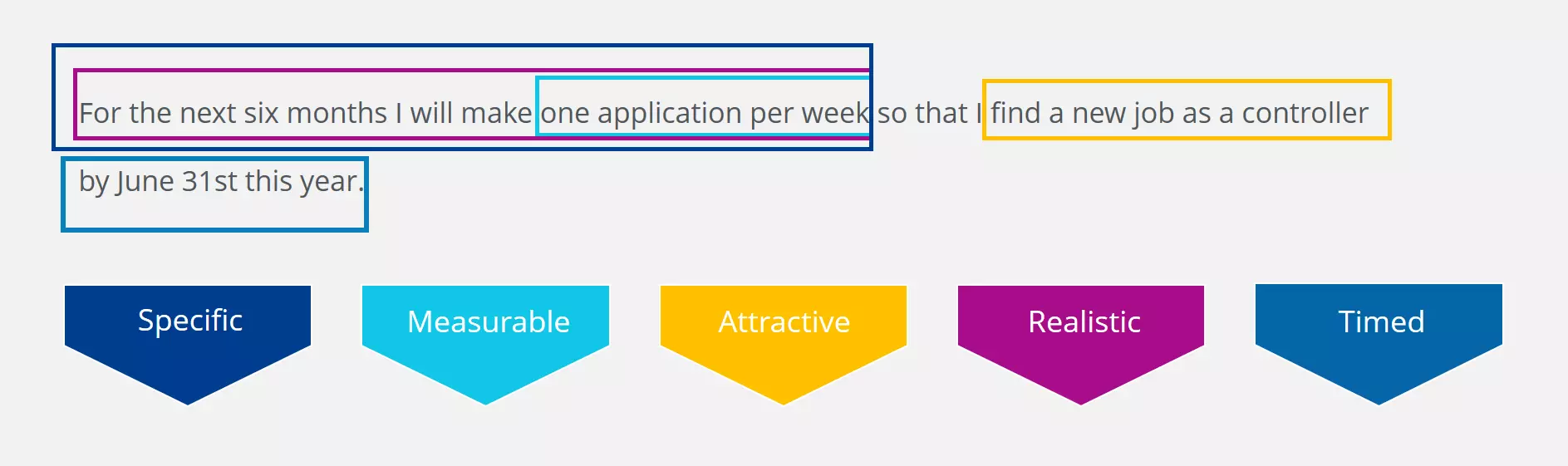
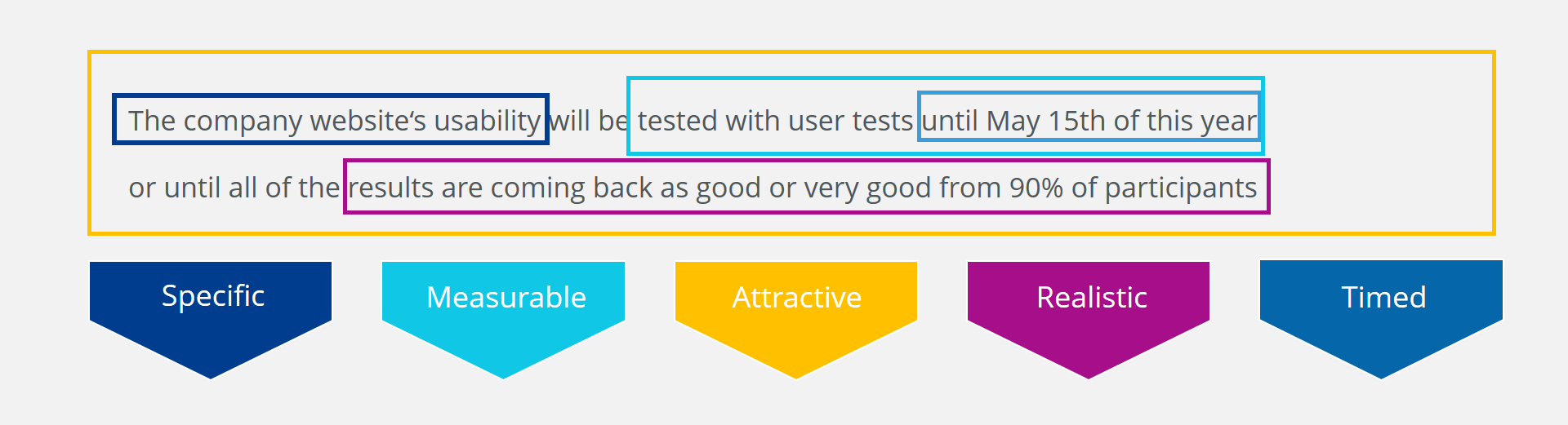
3. We need to improve the usability of the corporate website as quickly as possible.
Pros and cons of SMART goals
SMART criteria are one of the most popular tools for setting goals and have many strengths, but they also have some weaknesses.
Advantages
Setting goals, especially SMART goals, has many advantages. Here’s a summary of the main advantages:
- They make it easier to reach goals: Like packing for a trip, you’ll be better prepared if you know where you’re going. SMART goals are specific, so they’re a good starting point for detailed project planning.
- They create clarity about priorities: Clearly defined SMART goals are especially helpful if you find it difficult to set priorities and easily get bogged down in unimportant tasks without a clear objective.
- They boost the probability of success: If you set SMART goals, you can clearly verify whether and to what extent a goal has been achieved. Having this clear benchmark can increase employee motivation and engagement. In the study “Toward a Theory of Task Motivation and Incentives” of the American Institutes for Research employee motivation increased by 35% after teams agreed on clear objectives.
Disadvantages
For critics of SMART goals, the benefits are outweighed by some serious disadvantages.
- They encourage mediocrity: SMART goals require you to set realistic objectives. As a result, visionary business ideas might not be pursued and managers and teams may embrace mediocrity.
- They inhibit motivation: If SMART goals aren’t ambitious enough, they won’t have a motivating effect, as shown by a LeadershipIQ study.
- They increase the pressure to perform: This weakness is a drawback for any goal-setting practice, and not specific to SMART. However, SMART goals allow for a clear distinction between “achieved” and “not achieved”, so employees are less able to make excuses and cover up a failure. Whether this transparency actually leads to increased pressure to perform depends on the company’s culture of handling mistakes. When a goal isn’t met, does the company investigate the causes constructively or assign personal blame?
SMART goals: a good method, but not the only alternative
Goals are what drive businesses. But how you define goals is what determines their success. SMART goals are a proven tool for setting goals so that you and your employees have a clear target in view as well as a basis for defining specific milestones.
You’ll increase your chances for success if you define goals for you and your employees that are specific, measurable, attractive, realistic and timed. The devil is in the details, however. Smart goals can also be discouraging and limit creativity and commitment.
It’s important to use the individual SMART criteria with sensitivity and contextual awareness. Does the team need very tight guidelines or should the goal allow for some leeway to inspire creativity? Will a tight deadline boost productivity or should you strive for realistic deadlines to avoid counterproductive pressure to perform? These detailed questions will ultimately decide how effective your goals are. Even the best formula can’t make the decision for you. So you’ll still need to rely on your own judgment.
And don’t worry if you don’t warm to SMART goals. You have alternatives. Learn about other techniques such as the WOOP method, the KRAFT model, or the ALPEN method. These methods have a proven track record and are sometimes even better than SMART criteria when it comes to motivating teams to do their best work.
Please note the legal disclaimer relating to this article