

Petabyte – what is it?

Up until the turn of the millennium, the floppy disk drive was standard computer storage device. The disk had a storage capacity of less than 3 megabytes (MB) but that was a large amount of data in the late 1990s. Today, 3MB is hardly enough to back up a single photo.
It’s now common for computer users to save a multiple of that quantity of data onto their computers, smartphones, external hard drives, USB sticks, or cloud providers online. The capacity of these storage media often exceeds 1,000 MB. But to keep increasing quantities of data legible, units of information are required that denote larger quantities in simple figures. Petabytes are already being used by mainframes and server centres to denote their capacity and sooner or later it’s expected that they’ll reflect the capacity of common storage media.
What is a petabyte?
A byte refers to a quantity of data. However, the modern USB stick, computer, or other data carrier offers capacities well beyond 1,000 bytes. Therefore, information units that are multiples of a byte are in use. Gigabytes and terabytes are common measures of memory for data storage capacity. In the case of server centres and mainframes, the amount of data well exceeds that of private storage devices which is where petabytes come in. There are 1,024 terabytes in one petabyte.
Given rapid digitalisation, the increasing popularity of streaming services and continued technological developments, it’s only a matter of time before petabytes will become more relevant to the average user. There’s already a growing demand for larger storage capacities and data carriers continue to scale their volumes. An SSD in 2.5-inch format now stores up to 15 terabytes. For 1 petabyte of information, around 68 SSDs are required.
- Write perfect emails with optional AI features
- Includes domain, spam filter and email forwarding
- Best of all, it's ad-free
Petabytes and petabits – what’s the difference?
A single letter makes all the difference. Take internet providers who advertise their services with ‘up to 100 Mbit/s’ (which translates to 0.0125 GB/s) while a hard drive may be described as offering 512 gigabytes of storage space. Similarly, the unit petabyte can be distinguished from petabits. But what’s behind these near identical terms?
A bit can adopt one of two states: ‘1’ denotes ‘on’, ‘0’ stands for ‘off’. This binary system corresponds to the smallest unit of information in a computer. To represent a character that is readable by humans, 256 (28) possible states are necessary. Therefore 8 bits are combined to 1 byte. In practice, bytes are used to specify memory capacity and bits for data consumption and transmission speeds.
The following example calculation illustrates the difference between bits and bytes: 100 petabytes correspond to 8 times the amount in bits, i.e., 800 petabits. Conversely, 100 petabits is only 12.5 petabytes.
What are the multiples of a petabyte?
The term ‘petabyte’ denotes vast amounts of data, but we rarely encounter these in our daily life. When specifying the storage capacity of hard disks or other data carriers, megabytes, gigabytes, and terabytes are commonly used. The conversion factor between two consecutive quantities is always 1,024 (210). The designation according to the decimal system is therefore misleading; in fact, it is a common combination of decimal prefixes and binary numbers.
The following table is an overview of the conversion from petabytes to all common units of information:
| Data quantity | In petabyte | In byte |
| 1 Bit | 1/9,007,199,254,740,992 | 1/8 |
| 1 Nibble | ½,251,799,813,685,248 | 1/2 |
| 1 Byte (B) | 1/1,125,899,906,842,624 | 1 |
| 1 Kilobyte (KB) | 1/1,099,511,627,776 | 1,024 |
| 1 Megabyte (MB) | 1/1,073,741,824 | 1,0242 |
| 1 Gigabyte (GB) | 1/1,048,576 | 1,0243 |
| 1 Terabyte (TB) | 1/1,024 | 1,0244 |
| 1 Petabyte (PB) | 1 | 1,0245 |
| 1 Exabyte (GB) | 1,024 | 1,0246 |
| 1 Zettabyte (ZB) | 1,048,576 | 1,0247 |
| 1 Yottabyte (YB) | 1,073,741,824 | 1,0248 |
| 1 Brontobyte (BB) | 1,099,511,627,776 | 1,0249 |
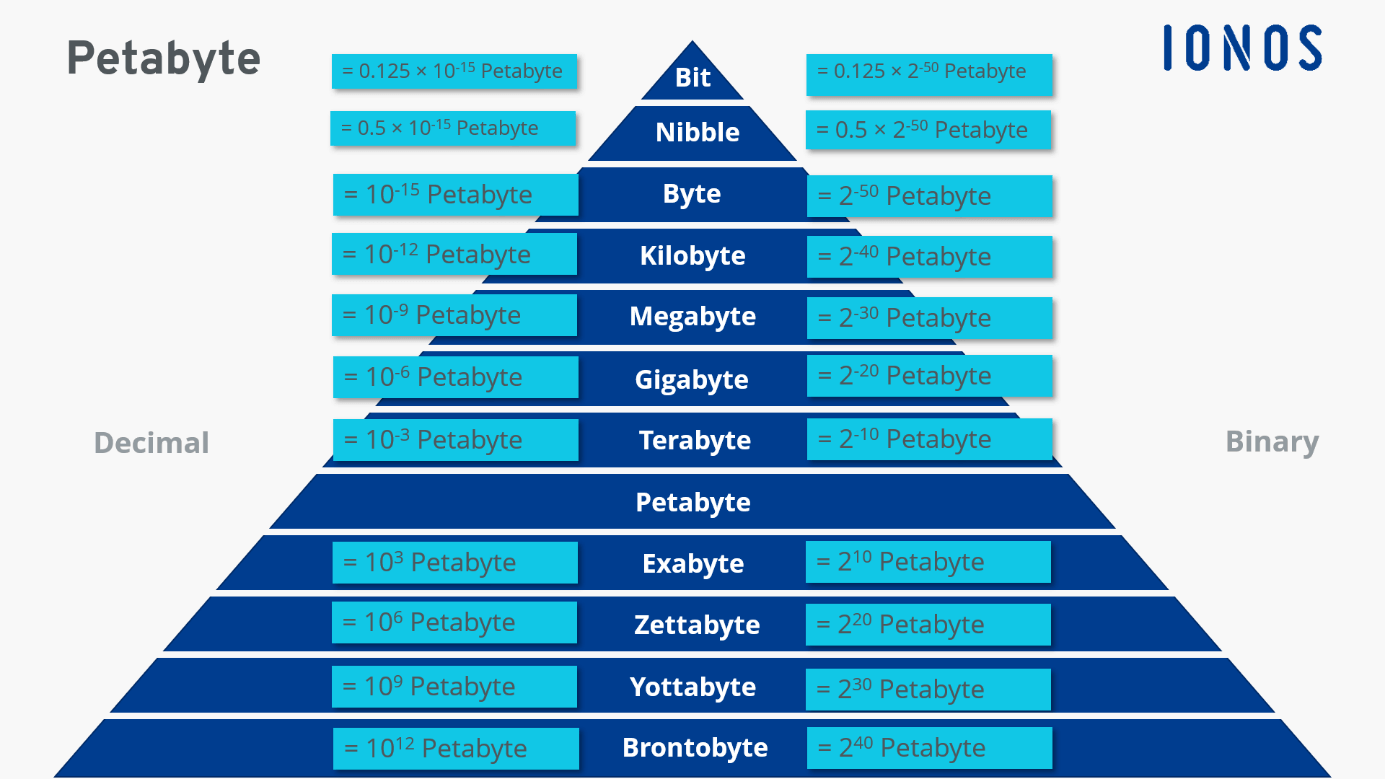
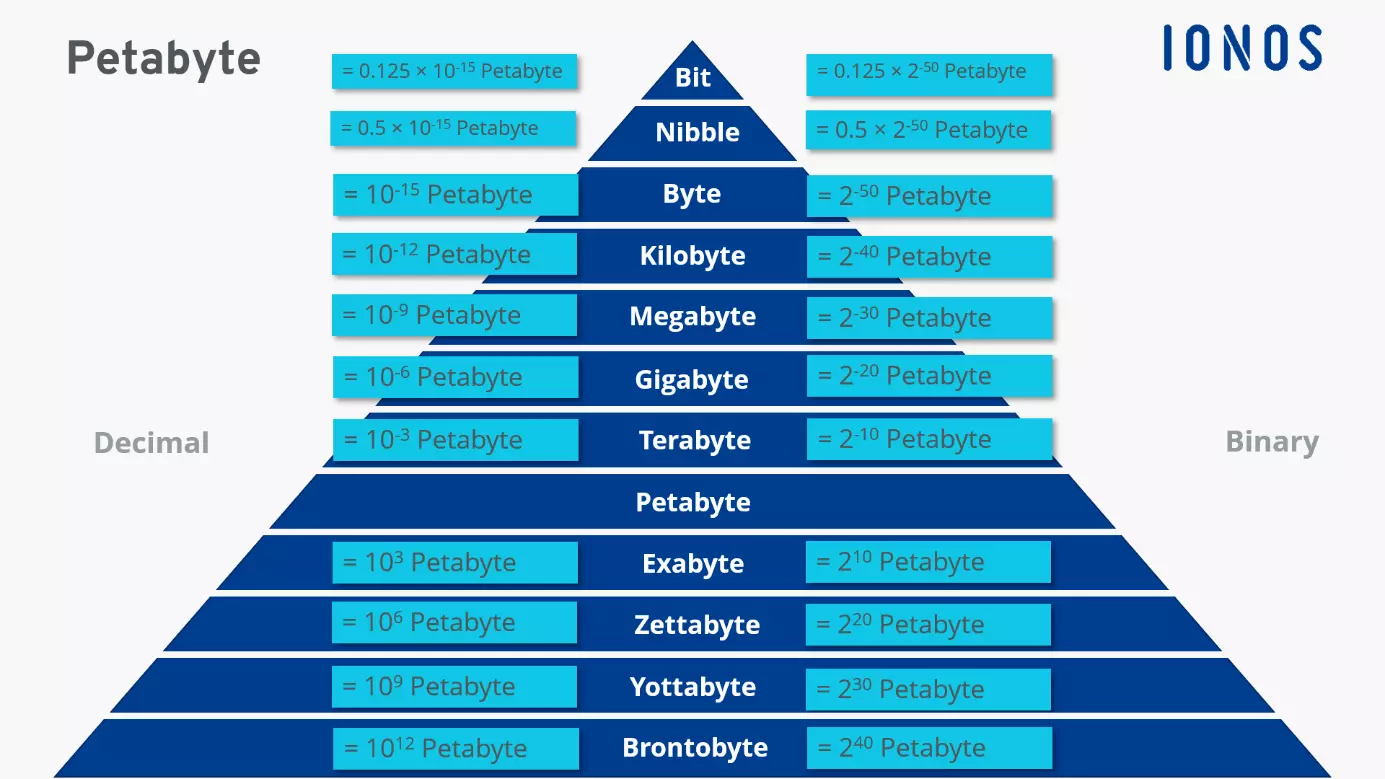
When it comes to units of measurement such as litres or meters, we often have a clear idea of their quantities. Digital units of measurement, on the other hand, are abstract. A comparison to physical sizes emphasises their actual capacities: a petabyte represents the content of around one billion books. In other words: this amount of data corresponds to roughly 500 billion pages of text.
Who uses petabytes?
It didn’t take long to come up with the term ‘petabyte’. As with megabytes, kilobytes, and gigabytes, the prefix is derived from the Greek. One petabyte currently comprises vast amounts of data found on mainframes and server centres. Since it’s widely speculated that the amount of data will continue to grow, these larger units will become increasingly important.
Use the HiDrive Cloud storage from IONOS to secure your data online – quick and easy thanks to the practical app. Access your data anytime, from anywhere, and on any device. Your data remains safe and secure against unwanted access.