

Zettabyte – the storage capacity unit explained

External hard drives, USB sticks, memory cards or CDs – the hardware for storing data is diverse. To make the right selection, compatibility with other devices and storage capacity are crucial. However, despite differences in the individual hardware, their development is similar. Although devices continue to decrease in size, their storage capacities are increasing. Compact, external hard drives now usually store one or more terabytes of data and have become more affordable for private users too. At the same time, the quantity of data used worldwide in the private and commercial sectors continues to grow.
The terabyte tends to be the highest storage capacity unit of common data carriers we encounter on a regular basis. It is followed by the petabyte, exabyte, and zettabyte, which remains largely unknown among the average users. Yet, understanding these data quantities is worth it. After all, the zettabyte now represents the quantity of all data in use globally. We explain what a zettabyte is and how it is converted into other units.
What is a zettabyte?
The zettabyte consists of two terms: zetta and byte. By defining these terms, the meaning of a zettabyte can be easily deduced. A byte consists of 8 bits. A bit describes the smallest possible information unit that can adopt one of two states: 0 or 1. This results in a total of 256 (28) different states for one byte. One byte can be used to store a character in binary form.
A text document requires very little storage space compared to other data. Due to the small amount of data, principally it’s possible to specify this in bytes. However, this unit is too small for external storage devices, videos, or music. For this reason, there are numerous multiples of a byte to indicate larger data quantities and storage capacities in a readable number.
‘Zetta’ is a so-called decimal prefix. The meaning of this prefix is defined in the international standard system. Zetta therefore always stands for 1021. A zettabyte corresponds to 1021 bytes. That’s 1,000,000,000,000,000,000,000 bytes (or one trillion bytes).
But computers don’t use the decimal system for their calculation. Instead, they use the binary system, which is based on 2. One zettabyte thus corresponds to 270 = 1,180,591,620,717,411,303,424 bytes. The binary prefix reserved for this size is ‘Zebi’, the correct designation is ‘Zebibyte’. However, binary prefixes are not yet well-established.
Zettabyte and zettabit – what’s the difference?
The unit byte and its multiples indicate storage capacities. For example, kilobytes are commonly used for text documents, megabytes for image files, and gigabytes for video files. But bits of information are also common in everyday life. Users know about internet speeds such as 100 Mbit/s (megabits per second). That’s because for transmission rates, the unit bit is commonly used. Basically, bytes can always be converted into bits. Zettabits are also calculable and indicate corresponding transfer rates. In contrast to zettabytes, the use of zettabits is currently neither necessary nor common.
What multiples of zettabytes exist?
The memory unit zettabyte is suitable to designate the capacity of data in use globally. Day to day, however, we only encounter smaller units of information. The following table shows the relation of different storage units and explains how they’re converted.
| Data quantity | In zettabyte | In byte |
| 1 Bit | 1/9,444,732,965,739,290,427,392 | 1/8 |
| 1 Nibble | 1/2,361,183,241,434,822,606,848 | 1/2 |
| 1 Byte (B) | 1/1,180,591,620,717,411,303,424 | 1 |
| 1 Kilobyte (KB) | 1/1,152,921,504,606,846,976 | 1,024 |
| 1 Megabyte (MB) | 1/1,125,899,906,842,624 | 1,0242 |
| 1 Gigabyte (GB) | 1/1,099,511,627,776 | 1,0243 |
| 1 Terabyte (TB) | 1/1,073,741,824 | 1,0244 |
| 1 Petabyte (PB) | 1/1,048,576 | 1,0245 |
| 1 Exabyte (GB) | 1/1,024 | 1,0246 |
| 1 Zettabyte (ZB) | 1 | 1,0247 |
| 1 Yottabyte (YB) | 1,024 | 1,0248 |
| 1 Brontobyte (BB) | 1,048,576 | 1,0249 |
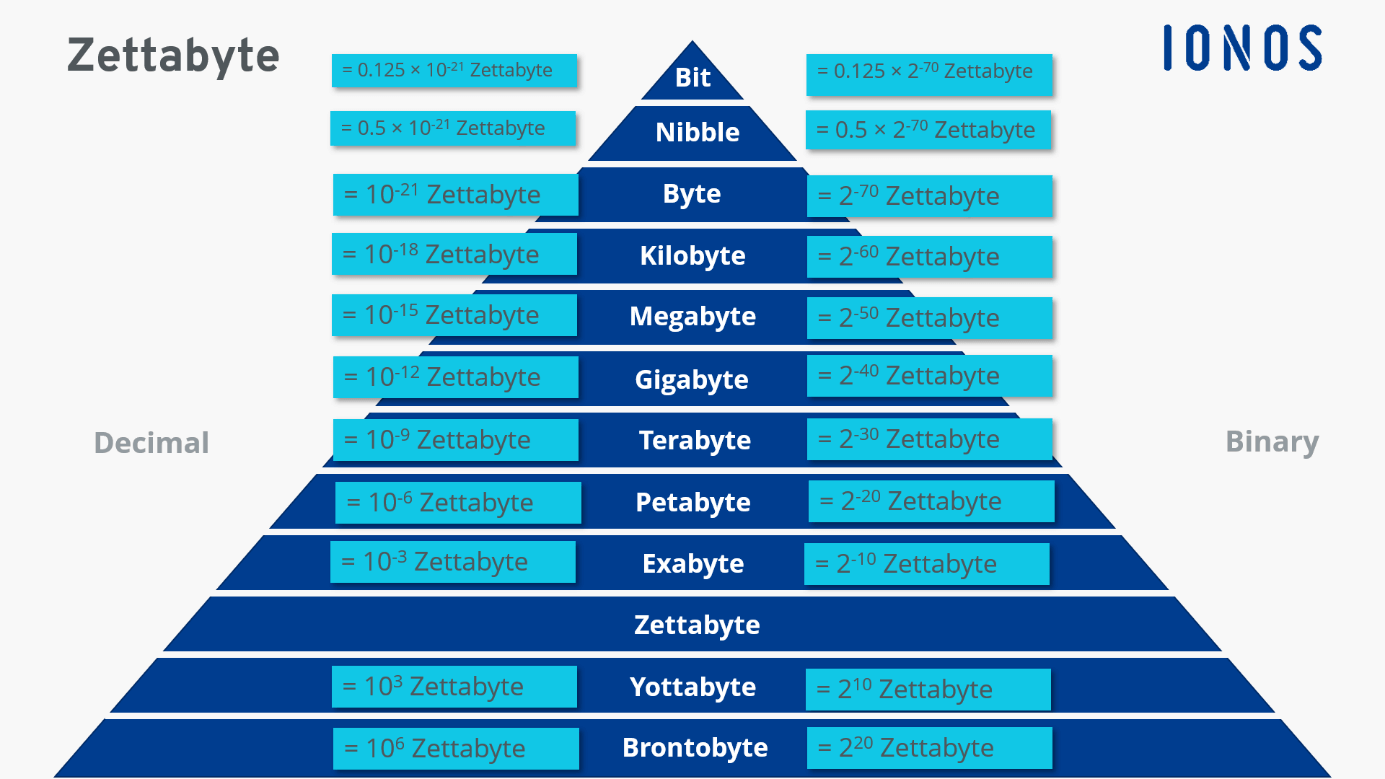
The larger the information unit, the more difficult it becomes to relate it to practical quantities. A comparison can help: One exabyte, for example, corresponds to 12 million 4K videos. Accordingly, a zettabyte offers enough space for 12,288 million 4K videos.
How and since when are zettabytes in use?
The term “‘zettabyte era”’ describes two different developments. On the one hand, it relates to the general rise in digital data used worldwide. On the other hand, the term indicates the point in time when global data usage reached the order of magnitude of zettabytes. This gives rise to two possible beginnings for the zettabyte era. As early as 2012, the total number of digitizsed data used worldwide exceeded one zettabyte. According to alternative definitions, this era didn’t actually start until 2016. This year, global data traffic via the Internet alone exceeded this data volume. It is estimated that the amount of data will grow to 175 zettabytes by 2025.
Want more storage space? The more data you store, the more important it is to protect it from data loss. Your data is safe with the IONOS HiDrive Cloud storage. You also benefit from device-independent access to your data, which allows you maximum flexibility. Our servers are ISO-certified and GDPR-compliant.