

Which is the best static site generator? A comparison of 10 top options

A static site generator (SSG) is an ideal development solution for many website types. Offering low complexity along with high performance and security, SSGs are widely favoured. In this article, we highlight the best static site generators and provide helpful tips for choosing and using them.
- Free WordPress with .co.uk
- Free website protection with one Wildcard SSL
- Free Domain Connect for easy DNS setup
What makes a good static site generator?
Compared to popular content management systems (CMS) like WordPress, Joomla!, and others, static site generators offer significantly lower complexity and enhanced security. Some SSGs even support running a content management system as a headless CMS.
The most compelling argument that distinguishes the best static site generators is the performance of the generated websites. Static websites can be hosted with minimal effort because no special server environment is needed to execute code. With SSGs, HTML and CSS elements are rendered directly when the code changes. Additionally, static sites are much easier to cache; popular options include so-called edge caches, which are provided globally via content delivery networks (CDN).
A comparison of the best static site generators
Due to the simple operating principle and widespread popularity, a thriving ecosystem of static site generators (SSG) has developed. The website jamstack.org lists over 360 SSGs and provides an overview of the technologies in use. In the following sections, you will find some of the best static site generators in direct comparison and brief portraits.
| Static Site Generator | GitHub Stars | Script Language | Template Language |
|---|---|---|---|
| Next.js | 131k | JavaScript | React |
| Hugo | 80k | Go | Go |
| Docusaurus | 59k | JavaScript | React, Markdown |
| Nuxt | 56k | JavaScript | Vue |
| Gatsby | 55k | JavaScript | React |
| Astro | 50k | JavaScript | Various |
| Jekyll | 49k | Ruby | Liquid |
| Hexo | 40k | JavaScript | Various |
| VuePress | 22k | JavaScript | Vue |
| Eleventy | 18k | JavaScript | Various |
Information correct as of May 2025
Next.js

Next is currently the most popular static site generator by numbers. Next is written in JavaScript. Locally, Node.js is used for compiling. Server-side rendering is also possible with Node.js. The JavaScript framework ‘React’ is used as the template language, and the TypeScript dialect is supported. This allows modular components to be created, containing the website’s content.
| Advantages | Disadvantages |
|---|---|
| ✓ Static site generation and server-side rendering are supported | ✗ Documentation is oriented towards Linux and macOS |
| ✓ Allows incremental regeneration of changed pages | ✗ Requires a good understanding of JavaScript and React |
Hugo

As reflected in its name, the static site generator (SSG) Hugo is written in the programming language Go. Unlike most of the best static site generators, Hugo is delivered as a single binary file. This results in high performance, allowing for the creation of static websites with thousands of pages. Conceptually, Hugo builds on many of the principles that made the SSG pioneer Jekyll famous.
| Advantages | Disadvantages |
|---|---|
| ✓ Very fast build speed | ✗ Programming and template language Go is not widely used |
| ✓ Suitable for generating large sites | |
| ✓ Delivered as a binary, therefore runs almost anywhere |
Docusaurus

Docusaurus is among the best static site generators for creating documentation and project websites. The open-source project is primarily supported by Meta. Content is written in Markdown and then enhanced with React components. Docusaurus offers integrated features like versioning, localisation, and a plugin architecture that is especially tailored to the needs of developers.
| Advantages | Disadvantages |
|---|---|
| ✓ Versioning and multilingual capabilities integrated | ✗ Designed for specific use cases |
| ✓ Pre-configured layout for technical documentation |
Nuxt
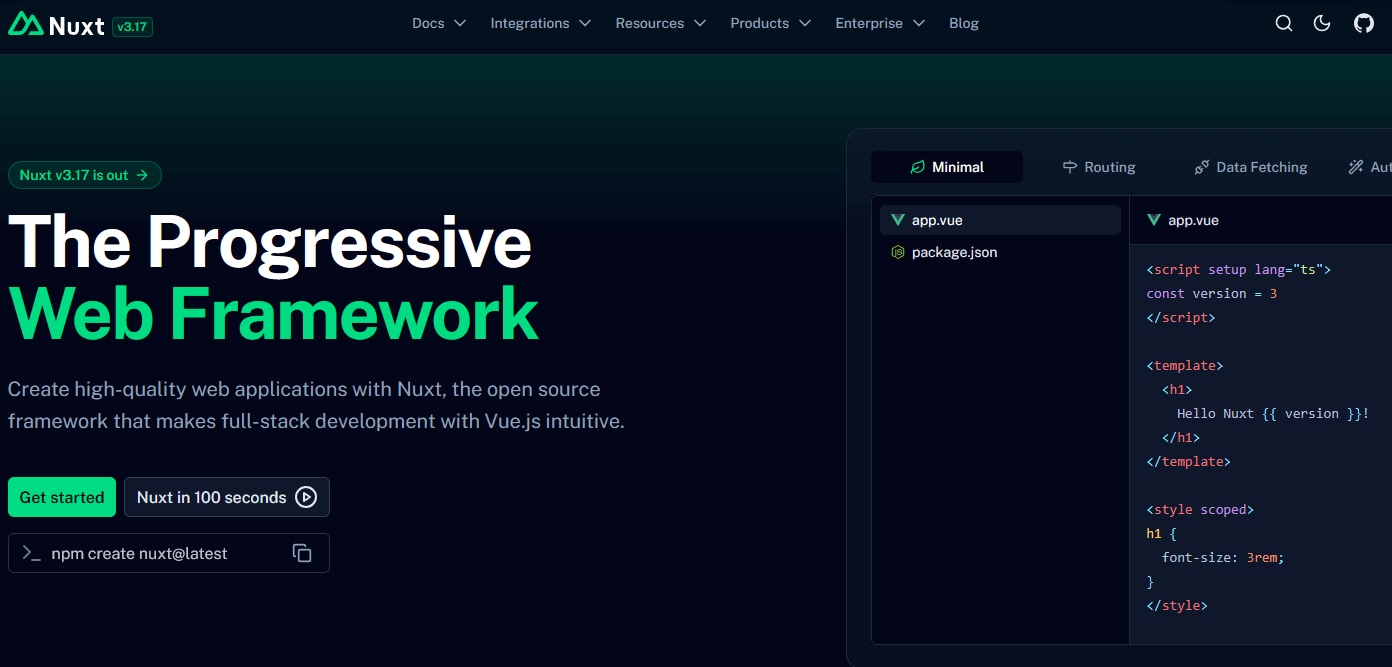
As the name suggests, Nuxt is a static site generator inspired by Next. However, instead of React, Vue is used as the component framework. Like Next, Nuxt also offers multiple deployment modes: both static site generation and server-side rendering are supported.
| Advantages | Disadvantages |
|---|---|
| ✓ Vue is easier to learn than React | ✗ Relatively small community |
| ✓ High degree of modularity | ✗ Dependency on the Vue ecosystem |
| ✓ Extendable via plugins |
Gatsby

Gatsby is a React-based development approach that enables rapid development using a GraphQL data pipeline. Gatsby is often used to enhance the performance of WordPress sites. The content is read via a GraphQL interface and packaged into a static website using React. By decoupling the front end and back end, WordPress becomes a ‘headless CMS’. Gatsby also allows for the creation of ‘Progressive Web Apps’ (PWA).
| Advantages | Disadvantages |
|---|---|
| ✓ Sophisticated image optimisations | ✗ Performance losses with growing sites |
| ✓ Hot reloading for immediate reflection of frontend changes | ✗ Strong dependency on plugins |
| ✓ Pre-fetching of content when scrolling the page |
Astro

Astro is one of the newer entrants among the best static site generators. The software is specifically designed to make websites as light and fast as possible. The ‘Islands Architecture’ approach allows interactive components to be loaded only when truly needed. Astro supports various template languages such as React, Vue, Svelte, or SolidJS and offers the ability to generate content completely statically or server-side. With a focus on HTML first development, Astro is particularly well-suited for content-driven websites and fast landing pages.
| Advantages | Disadvantages |
|---|---|
| ✓ Minimal JavaScript delivery | ✗ (Yet) small plugin ecosystem |
| ✓ Supports various template languages | ✗ Integrations can be quite complex |
Jekyll
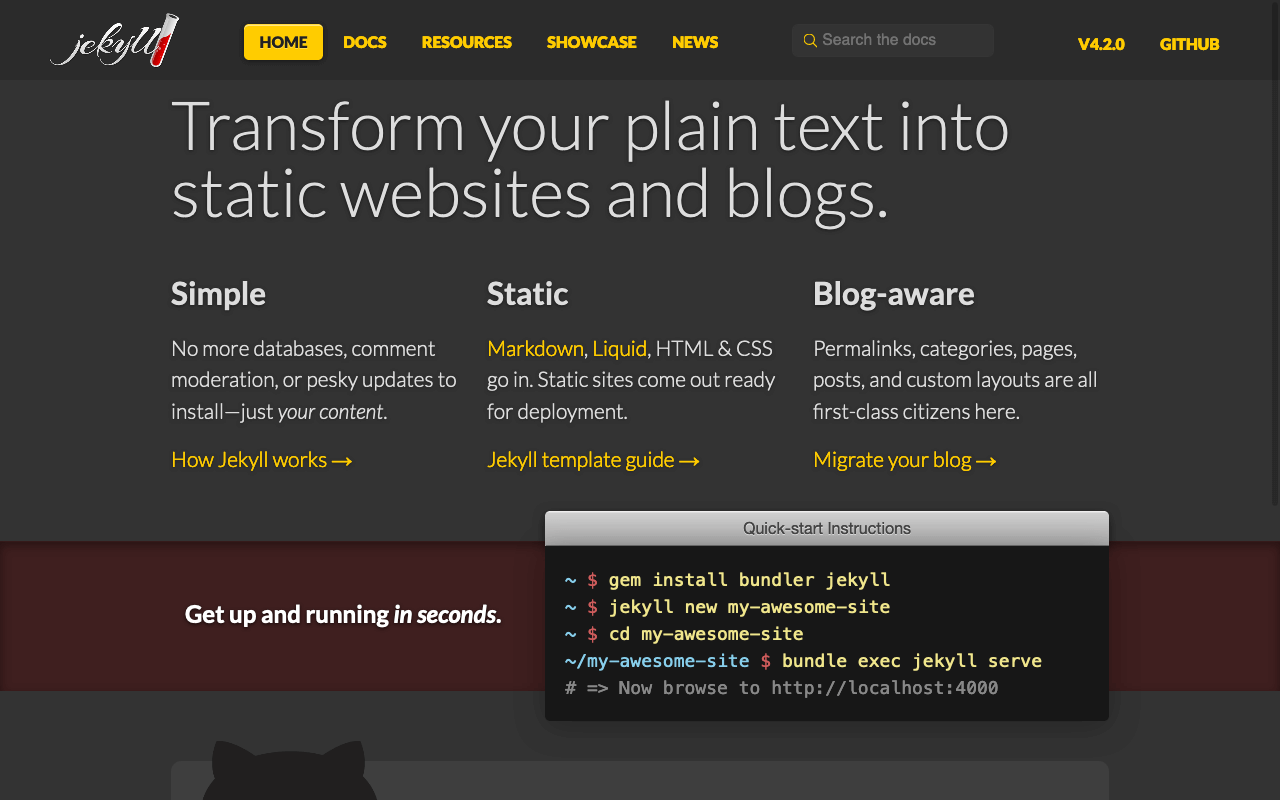
Jekyll is the cornerstone of the best static site generators. This software popularised the SSG concept, driving the widespread adoption of the technology. The concept behind a static site generator is simple: Content from markdown files is structured into templates and served as a static site. Jekyll is particularly well-suited for building blogs and documentation. Written in Ruby, it serves as the core framework for GitHub Pages, which is integrated into the GitHub code hosting service.
| Advantages | Disadvantages |
|---|---|
| ✓ Easy to use | ✗ Ruby is less common |
| ✓ No JavaScript framework needed | ✗ Complex setup on Windows |
| ✓ Full control over delivered JavaScript |
Hexo
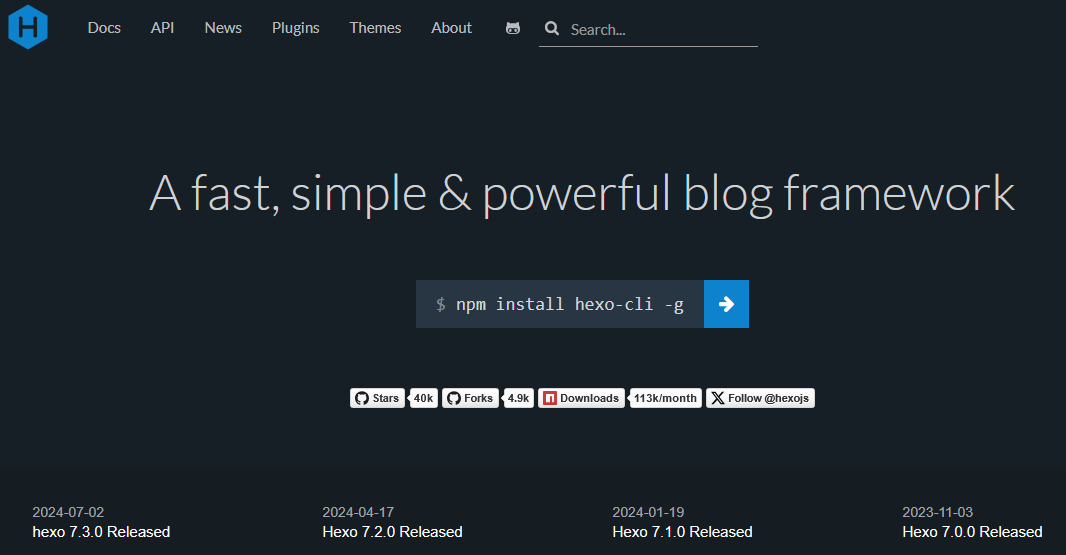
Hexo advertises itself as a fast, simple, and powerful blog framework. The focus is on generating blogs and other sites whose content can be maintained as a collection of markdown files. This places Hexo in the class of Jekyll-like static site generators. By using plugins, a variety of additional template languages can be utilised. To quickly set up a design, you can choose one of the pre-made themes.
| Advantages | Disadvantages |
|---|---|
| ✓ Wide selection of plugins and themes for easy expansion | ✗ Limited functionality |
| ✓ Fast generation of entire sites with hundreds of markdown pages |
VuePress

With VuePress, another static site generator is available that uses Vue as a template language. The software’s mantra is ‘Convention over Configuration’. This allows the SSG to be used with little effort; in the simplest case, placing Markdown files in a special folder and triggering the build process is sufficient. VuePress is particularly well-suited for quickly creating documentation.
| Advantages | Disadvantages |
|---|---|
| ✓ Minimal setup | ✗ Limited functionality |
| ✓ Supports Vue components in Markdown | ✗ Strong focus on documentation creation |
Eleventy

The Eleventy static site generator is often promoted as a Jekyll alternative or ‘Jekyll implemented in JavaScript’. Like the famous predecessor, Eleventy creates static sites without the need to incorporate a client-side JavaScript framework like React or Vue. This keeps the full control over the rendered pages with the developer. The most striking feature of Eleventy is its flexibility. Various languages and formats can be used, and the default behaviour of the SSG can be extensively adjusted through configuration.
| Advantages | Disadvantages |
|---|---|
| ✓ Simultaneous use of different template languages possible | ✗ Manual adjustments and technical understanding required |
| ✓ Static site contains no JavaScript framework | ✗ Small community |
How to find the right static site generator?
To choose the best static site generator for a project, it is crucial to answer the following two questions regarding the project type:
- Is it a blog or a collection of landing pages? In this case, a simple SSG that generates pages from a few markdown files would be ideal.
- Is a web app or an online store required? In that case, you may want to consider a component-based SSG using React or Vue. Alternatively, you could choose a generator that also supports server-side rendering.
Find out elsewhere in the Digital Guide about the differences between client-side and server-side rendering.
The experience of the developers involved should also be considered in the choice of the best static site generator (SSG):
- If only one template language is available, it is advantageous if the developers are familiar with the language.
- If you can choose from a variety of template languages, you are significantly more flexible.
- It is also relevant whether the template language is used only during the build process (Twig, Liquid) or is closely integrated with the frontend (React, Vue).
The next important point to clarify is where the content for the site comes from:
- If a site is built from scratch, the content can potentially be entirely stored in markdown.
- Is it an existing site that already contains large amounts of content? Then you should use a static site generator that can access content from different sources through defined interfaces like GraphQL.
Hosting is also an important factor when selecting the best static site generator. Depending on the server environment, certain languages or runtime environments may not be available. However, this issue is less relevant when hosting within a container. Finally, when choosing the best static site generator, it’s essential to consider the ecosystem. It’s important to differentiate between niche solutions and industry standards. A larger community typically offers a broader range of documentation, tutorials, and support for troubleshooting errors.
SSGs as part of the Jamstack
Like all tools of the industry, the best static site generators are part of the so-called Jamstack. Its name is derived from the initials of JavaScript, APIs, and Markup. Here’s an overview of the specific benefits of the individual components of the Jamstack:
| Jamstack Component | Benefit |
|---|---|
| JavaScript | interactive elements on the site, data exchange with APIs |
| APIs | Data sources, interfaces for data transfer |
| Markup | Structures and content on the page |
Websites based on the Jamstack are static websites. The individual pages are linked to each other. The content often exists in a simple markup format (like markdown). Any dynamic content, such as comment or search functions, is implemented in JavaScript. Data exchange runs via APIs that operate on remote systems. With Jamstack, websites are generated during their build time using SSGs, optimising their performance. In contrast, ‘traditional’ websites are generated during runtime, resulting in longer load times.
Build faster websites through prerendering and leaner hosting. Deploy them with IONOS.
How to deploy a static site generator via GitHub?
In a static site generator, unlike most content management systems, no database is used. Instead, all components are available as files. This includes the content and assets for the static website, as well as the code and configuration of the SSG. These can all be managed in a Git repository, enabling version control and collaboration.
To build a static website with a static site generator (SSG), HTML documents and asset files (images, scripts, stylesheets) are created during the build process. In the subsequent deploy step, the files are uploaded to a web server. With Deploy Now by IONOS, the entire process can be automated. Any change to the repository automatically triggers the build process and updates the files on the server. Deploy Now utilises GitHub Actions, allowing the build logs to be displayed directly in the GitHub dashboard.