

Why do we need market research?

The market is the place where supply and demand meet. This meeting of suppliers and buyers (customers) is about an economic asset, a product, or service. The basic principle of the market is the exchange of goods for a recognised equivalent, e.g. other goods or money. Market research is used to determine what a customer wants to buy and how much they would exchange it for.
With market research, a company can analyse which of its products are popular and which need improvement. Market research also uncovers information relevant to companies and target groups, such as prices and pricing range. This allows a company to make adjustments to the product, change advertising strategies, and make decisions for future business directions and products.
Market research is the systematic collection and analysis of data on the market are characteristics of an industry. In certain market situations, companies need this data in order to further develop their products or services and better adapt them to their customers. Market research thus serves as a marketing tool and is always used when a company wants to analyse the current market situation or assess market risks. It is also possible to determine in advance whether an offer is marketable at all through market research measures.
What is the purpose of market research?
Market research provides information on the situation of the market. This information is important for a company to make customer-oriented decisions and not lose sight of the target group. Furthermore, market research can identify trends and use them for the further development of products as well as for other business decisions.
Via a product clinic – an analysis concept developed by Horst Wildermann – companies can collect customer options on a particular product by having it independently tested. Using the collected results, they can revise the product and make it more customer-oriented. Companies even use this method to assess competing products. In addition, market research can be used to find indications of the successes and failures of a product and the company in general.
In the long run, regular market research will help your company to move forward and make profitable decisions.
The purposes of market research include, but are not limited to, the following:
| Early warning | Risks are more predictable and can be identified at an early stage |
| Innovation | Opportunites and developments can be anticipated and uncovered |
| Reduce uncertainty | Helps specify the facts during the decision-making process |
| Structuring | Promotes the understanding of the target and learning processes |
| Intelligence building | Supports the work of corporate management and contributes to intelligence-building processes |
| Information selection | Company-relevant information can be selected and processed amid the flood of information |
Types of market research
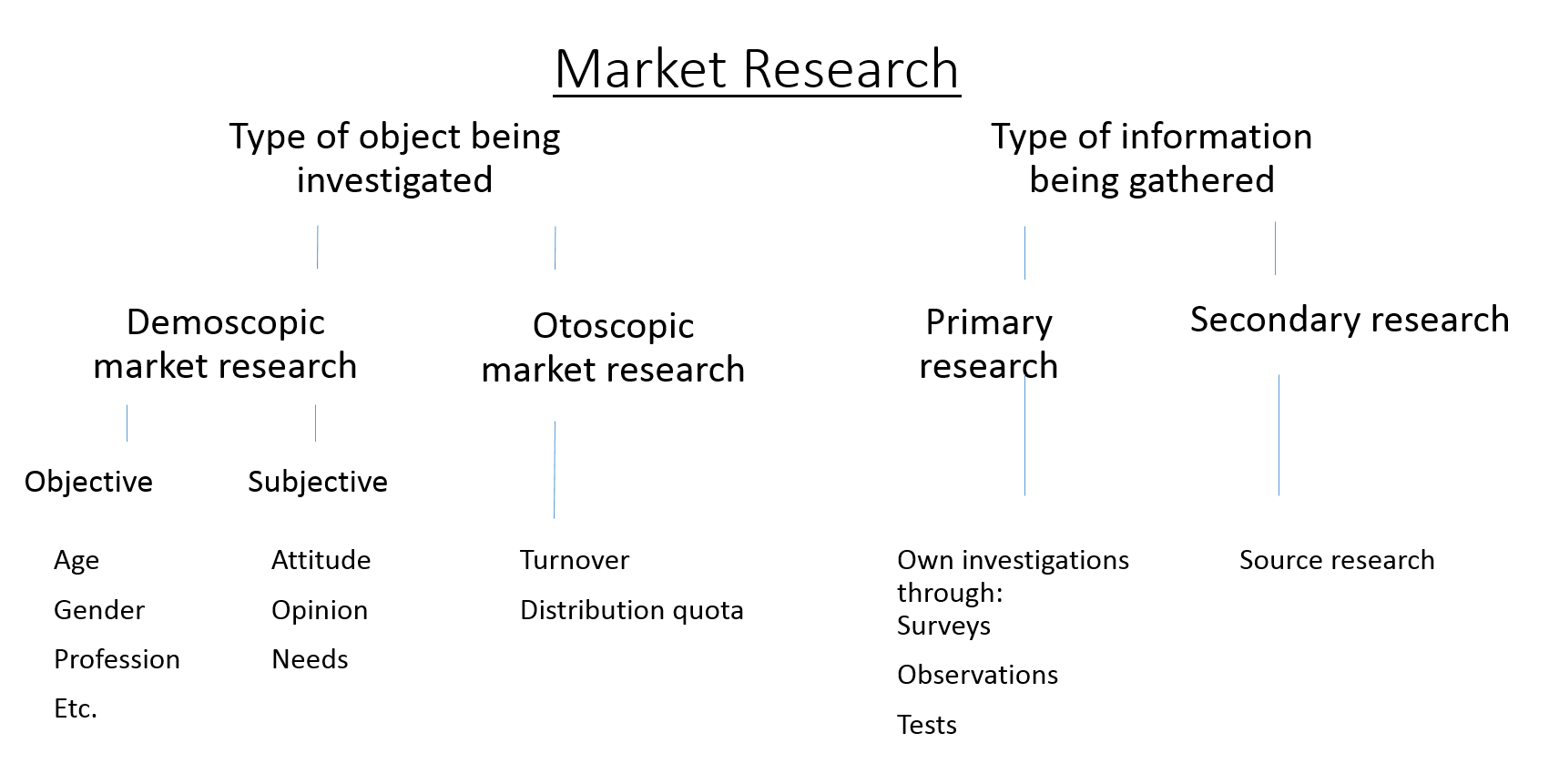
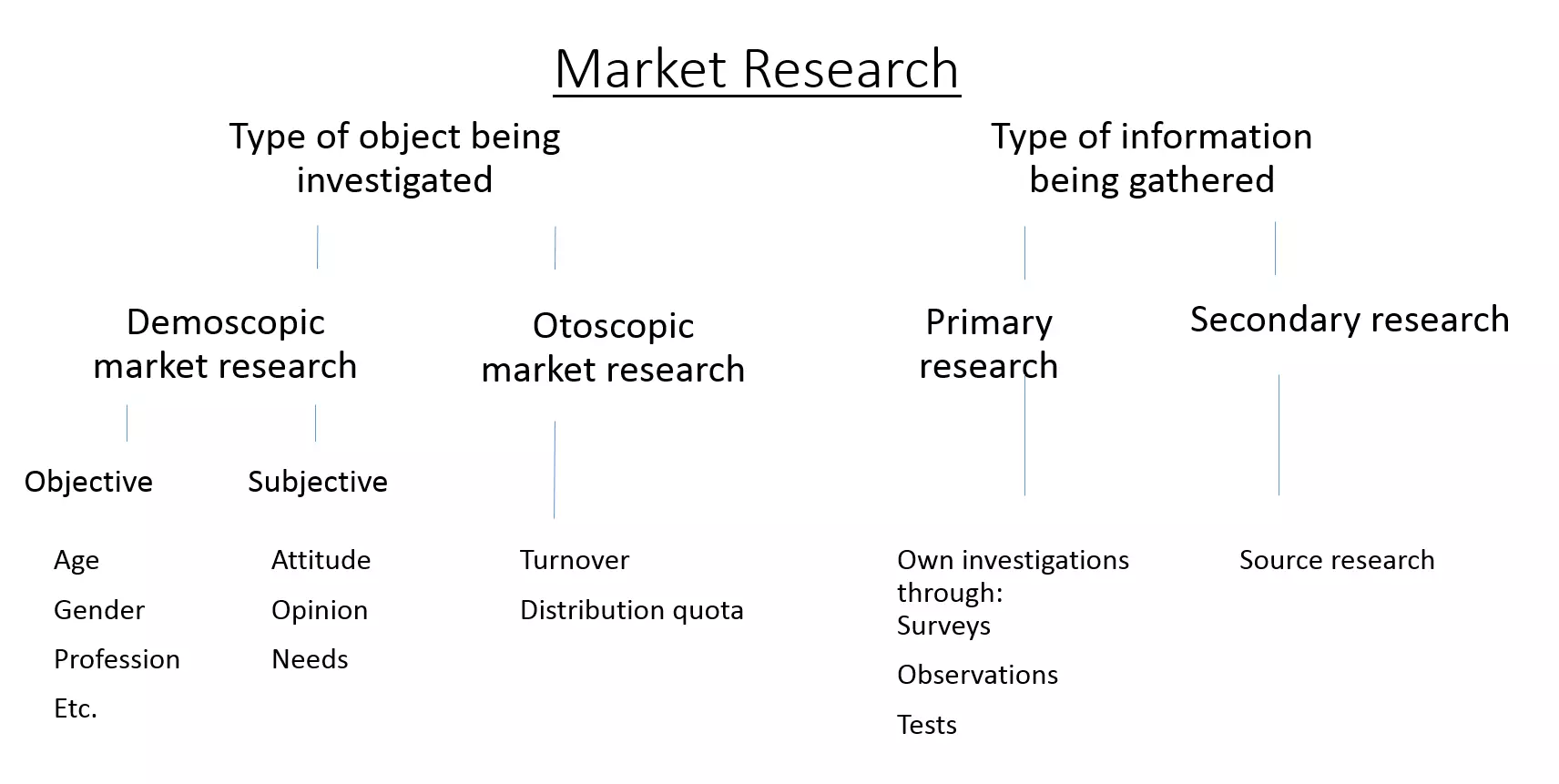
In market research, a distinction is made between the type of object studied and the type of information gathered. Both species can be divided into two further categories.
The type of object studied includes demoscopic market research and ecoscopic market research. The former examines subjective and objective information about a person, focusing on the individual consumer and collects demographic data. Ecoscopic market research, on the other hand, focuses on the industry’s objective market size. This includes the quality and quantity of goods or price of goods. Furthermore, procurements and sales market structures are examined, as well as buyer and supplier numbers.
Gathering information generally deals specifically with the collection of company-relevant data. There are two subcategories of this: primary and secondary research. With primary research, you conduct your own surveys according to self-chosen criteria in order to collect data about customers. With secondary research, surveys are carried out and evaluated using criteria and tests determined by third parties.
In addition, there is a fundamental differentiation between quantitative and qualitative market research:
- Quantitative market research: Measurable values about a market are statistically evaluated using experience. This can meet objective or subjective factors.
- Qualitative market research: With this method a customer’s opinions, expectations, and motives are considered. A frequently used method here is opinion research.
What does market research consist of?
The need for information is normally derived from a decision-making problem: a company faces a problem and wants the help of market research to resolve it. The research can be seen as a structured process. This goes through many phases, with data collected in each.
The process of market research can be divided into six phases. The first phase decides what information is important for the company and what is not: from this, an object of investigation is defined. In the second phase, a method of use is decided upon. In the third, survey documents are drawn up to be used for further work. The fourth phase consists of the data being collected via surveys or tests.
During the fifth phase, data is processed and evaluated, before finally being presented by the market researchers in the sixth and final phase. Reasons for the results of the findings and ideas for changes to be made are then also worked out. Subsequently, any decision for further actions to be made by the company are based on the information obtained.
Overview of the phases of market research:
| Phase 1 | Choose what information field to investigate |
| Phase 2 | Determine the methods you will use |
| Phase 3 | Create surveys |
| Phase 4 | Collect data from surveys |
| Phase 5 | Process and evaluate the data |
| Phase 6 | Present your findings |
Why is market research important?
Market research insights build a secure foundation for the diagnosis and prognosis for a future market entry or product development. With this information, a company can plan and steer its business in the right direction and find and correct mistakes. Market research also helps a company to set prices: how much are customers willing to pay for certain items?
Market research is indispensable for product development. Customers can directly test the products and offer their free opinions. This is how you determine the needs and wishes of potential customers: having the product tested by the consumer themselves shows precisely what they want.
Without market research it’s difficult to make important company decisions. Through the collection of information and resulting evaluations, company executives are able to make decisions about products, services, and pricing with more certainty.
Please note the legal disclaimer relating to this article.
Reviewers

Anne-Laure Wolber
Anne-Laure has been part of the IONOS Digital Guide since its inception in 2016. As an expert in the startup category, she focuses primarily on the strategic integration of SEO, GEO and conversion rate optimisation. Over the years, she has also gained extensive experience in related performance disciplines such as lead generation and native advertising. As a polyglot, she leverages her multilingual background to develop content strategies with precision and impact for international audiences.

Christian Heldmaier
Christian Heldmaier is an experienced online marketing and SEO specialist from Karlsruhe. He has been working as an SEO Manager at IONOS since July 2020.