

gTLDs: what you should know about generic top-level domains

An internet address (domain) consists of several parts, one of which is the domain extension, also referred to as a top-level domain (TLD). There are different types of TLDs, for example, .co.uk is a country-specific domain. A gTLD, on the other hand, is an international extension. An example of this is, .com, which stands for, commercial, and is the most common gTLD. All TLDs are part of the Domain Name System, which is like an internet address book. But what differentiates gTLDs from other top-level domains and how are they classified?
- Free website protection with SSL Wildcard included
- Free private registration for greater privacy
- Free Domain Connect for easy DNS setup
Country-specific and generic top-level domains
Domain extensions are divided into two categories: gTLDs and ccTLDs. Known examples of generic TLDs besides .com are .net, .org, and .info. The ccTLDs (cc = ‘country code’), however, are used as country-specific top-level domains (e.g. .us for the USA and .uk for the UK). A generic top-level domain covers a thematic field rather than a geographical field: for example, .org stands for ‘organisation’ and generally refers to nonprofit organisations. The .info gTLD lets you know that the website is of an informative nature. Unlike ccTLDs, gTLDs always consist of at least three letters. In the early days of the internet, there were only a handful of generic top-level domains. In January 1985 .com, .org, .net, .edu, .gov, .int and .mil as well as .arpa were introduced as the first gTLDs with the first ccTLDs following in the same year. There are now hundreds of generic domain extensions due to the gradual introduction of new gTLDs.
Looking for an alternative to the traditional .co.uk extension, or want to grow your online presence? Give .uk a try today.
£1 for 1 year!
Sponsored vs. non-sponsored gTLDs
Generic TLDs can be divided into two categories: sponsored and non-sponsored top-level domains. To obtain an internet address with a sponsored TLD, certain requirements must be fulfilled. These conditions are determined by the sponsors (companies or organisations) that are also responsible for monitoring guidelines and general management of their TLD. Some examples of sponsored domain extensions are .gov (for US government institutions), .int (for international organisations), and .jobs (for company job offers). The non-sponsored TLDs, on the other hand, are monitored and managed centrally. ICANN Internet Corporation for Assigned Names and Numbers) is primarily responsible for these and works together with various partners. When the first non-sponsored TLDs were introduced, it was originally planned for them only to be purchased under certain conditions. Like sponsored gTLDs, they should denote a clear frame of reference for websites: .com was initially only available for companies, .net was intended for internet service providers, and .pro for professional use in various occupations. These plans, however, were gradually dropped and now almost every non-sponsored gTLD is available for individuals, businesses, organisations, etc. to use.
Overview of traditional gTLDs
Due to the mass approval of new TLDs, there is now a large amount of generic domain extensions that is hard to overlook. For additional information about TLDs that have been registered recently, see our article on the new gTLDs. The two tables below provide an overview of classic generic top-level domains, divided into sponsored and non-sponsored categories.
.arpa isn’t listed as a domain extension because it’s an exception. It was introduced in the Domain Name System as a first TLD in 1985. At the beginning it served to transmit hostname conventions of the ARPANET (the internet’s predecessor) in the Domain Name System. Nowadays .arpa is exclusively used for technical infrastructure purposes, which is why the TLD is not available to the public and you can’t register domains using it.
Non-sponsored generic top-level domains
| Top-level domain | Year of introduction | (originally) intended for |
| .com (commercial) | 1985 | (US) Businesses |
| .org (organization) | 1985 | Nonprofit organizations |
| .net (network) | 1985 | Internet providers |
| .info | 2001 | Information services (but available to all) |
| .biz (business) | 2001 | Businesses |
| .name | 2001 | Private individuals |
| .pro (professional) | 2004 | Specific professions |
With IONOS you can register your domain today. Simply use the domain finder to check whether your desired address is available! You can also benefit from additional services such as a personal email address and a free SSL/TLS wildcard certificate.
Sponsored generic top-level domains
| Top-level domain | Year of introduction | Authorised users/ intended for |
| .gov (government) | 1985 | US Government authorities |
| .edu (educational) | 1985 | Organisations of the educational system (limited to US educational institutions since 2001) |
| .mil (military) | 1985 | US Military |
| .int (international) | 1988 | International organisations |
| .aero (aeronautics) | 2001 | Aviation industry |
| .coop (cooperatives) | 2001 | Cooperatives |
| .museum | 2001 | Museums |
| .cat (catalan) | 2005 | Supporters/Users of the Catalan language and culture |
| .jobs | 2005 | Company job advertisements |
| .mobi (mobile) | 2005 | For mobile-optimised websites |
| .tel (telecommunication) | 2005 | Presentation of the domain owner’s contact details |
| .travel | 2005 | People, companies, and organisations in the travel industry |
| .asia | 2007 | People, companies, and organisations from the Asian/Pacific region |
| .xxx | 2011 | Erotic/pornographic content |
| .post | 2012 | Members of the Universal Postal Union |
gTLDs: domain extensions with a history and a future
Generic top-level domains represent an important technical cornerstone for the internet and have existed since the beginning of the web. They will continue to play a major role in domain allocation in the future. It can be assumed that generic TLDs that have established themselves in the last few decades, will also still be relevant in the future.
The amount of remaining site addresses that end in popular TLDs such as .com, .org, and .net is continually decreasing. The same applies to country-specific TLDs, as can be seen from the following infographics about the .com domain. Given the massive popularity of top-level domains like .com, .info, and .uk, these new alternatives have now become unavoidable.
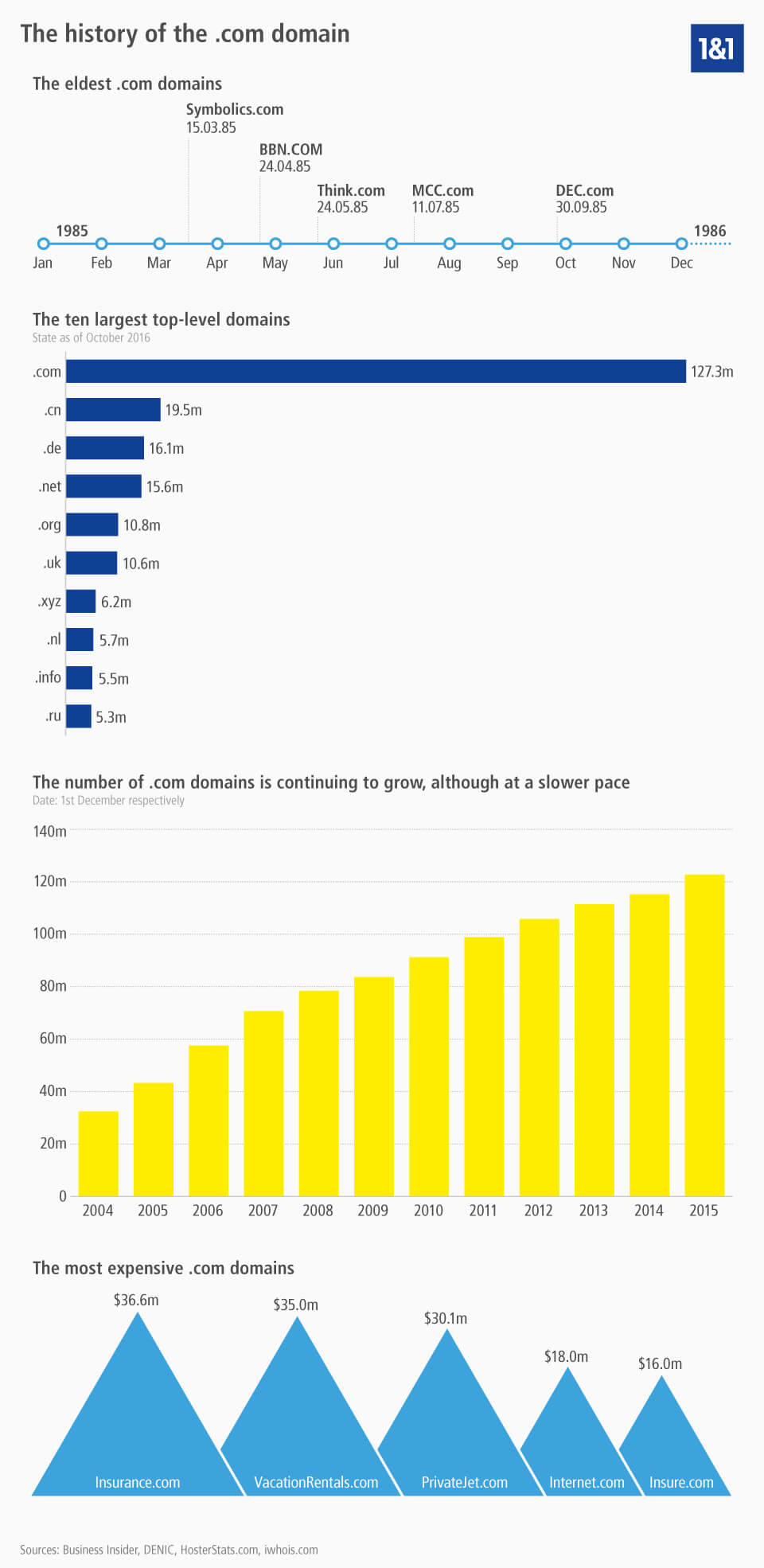
Click here to download the infographic on the history of the .com domain. Thanks to these new gTLDs, the most sought-after domains are now available with an alternative ending.
For many website operators, this allows them to get one step closer to their perfect domain.