

Lead scoring

Lead scoring is the term used to describe evaluating leads. The quality of the collected information is compared. Both the amount of information per lead (explicit scoring) and the reaction of the lead to the communication (implicit scoring) play a role in the evaluation. Using this you can figure out how high the probability is that a prospective customer will become a real customer.
What is lead scoring?
Lead scoring is all about evaluating how valuable each lead is. Not only the quality and status of the contacts are assessed, but also the likelihood of the company making a sale.
Objectively evaluating a contact for the sales department is usually only possible if they are compared to other contacts. There are two main criteria used for this purpose: On the one hand, you check how complete the contact information is on the user’s profile – this is referred to as explicit information. On the other hand, you assess the lead’s response to the contact attempts made during the lead nurturing process – thereby gaining implicit information.
The goal of lead scoring is to facilitate the coordination and cooperation between marketing and sales. This is all done at the beginning of the lead management process by pre-sorting the leads received, and later on more thoroughly, according to clear guidelines, which determine when a lead is ready to be passed to sales and how high its priority is. These rules and guidelines are summarised in a lead scoring model, which is implemented in B2B and B2C marketing and sales areas especially. The model helps determine whether a contact should be followed up by the sales representative i.e. passed to lead routing, or whether it needs to be further managed in lead nurturing.
The lead scoring model
The distinction between implicit and explicit information has been mentioned above, but implicit and explicit scoring is also carried out – both of which are part of the scoring model.
Explicit scoring: evaluating the user’s profile
Explicit scoring deals with the lead’s contact information or profile. Relevant information in the B2C area is sociodemographic data, such as age, gender, and location. In the B2B area, for example, the position of the contact within their company, the industry in which the company operates, its number of employees, and the expected turnover, all play a role here. Each company decides for itself which explicit data it would like to use for the profile analysis. It’s important to work closely with sales and marketing. Together, both departments can determine the factors that make the optimal customer.
Define and weight categories
A general user profile emerges from these observations after the most important factors have been selected. In the following example, the individual categories position, industry, and number of employees are weighted differently depending on individual requirements. The position of the employee is the factor that is weighted the most for the company in this example:
| Category | Weighting |
| Position | 50 % |
| Industry | 30 % |
| Number of employees |
Assign score points within the category
Different data, same idea: implicit data is also weighted within the categories. In this example we use landing page visits. The evaluation is based on how up to date things are, and frequency. The maximum number of score points is again 10.
| Landing page visits | Score points |
| 2 within the last 7 days | 10 |
| 2 within the last 30 days | 5 |
| 1 in the last quarter | 1 |
Determine the rating in accordance with the idea profile
Just like with explicit scoring, the individual prospective profiles are then compared with the ideal profile to see how well they match.
A very active prospective customer, who regularly visits the website, has already requested an offer, and has downloaded an e-book, matches the ideal profile well and therefore receives the rating '1'.
| Match with the ideal profile | Rating |
| > 75 % | 1 |
| 50–75 % | 2 |
| 25–50 % | 3 |
| < 25 % | 4 |
Lead scoring model from explicit and implicit data
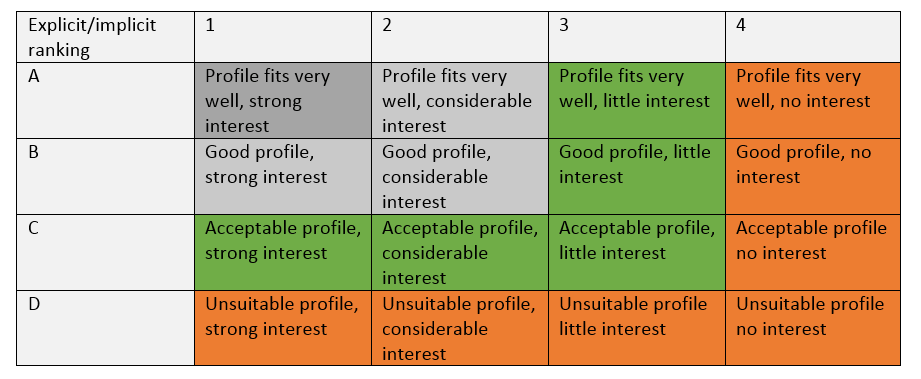
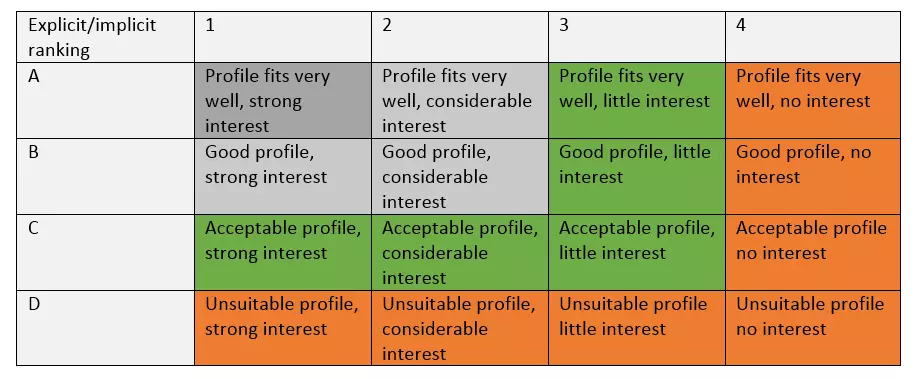
In the end, the explicit scoring is combined with the implicit scoring or both the established ratings. Both are important, but are only relevant in relation to one another. Contacts, whose profiles fit well and have received an A rating, are of no use to a company if they aren’t interested in the products and services. If your lead is a managing director, department manager, or even the person responsible for purchasing, it doesn’t automatically guarantee success. Despite the A rating in the case of explicit data, the rating for implicit scoring may be very bad, for example, if the lead hasn’t responded to any of the measures in the lead nurturing process.
On the other hand, the contact having a great interest in the products is worthless if the profile doesn’t correspond to the ideal profile. A classic example in the B2B sector is a contact person who doesn’t have any decision-making power. In the B2C area, demographic data (e.g. income) can often suggest that the person is not able to buy the product. Despite receiving a high rating for implicit scoring, the contact is less valuable.
Both ratings are relevant if the data is interpreted correctly. This results in a general grading, which is of course more detailed in individual cases:
Summary: Lead scoring saves precious time and resources
If you plan to use efficient lead nurturing and later build a solid bridge to lead routing, you need lead scoring. A professional and well thought-out lead scoring model focuses on the leads who have the highest likelihood of purchasing something or completing a transaction. This is how marketers and sales representatives organise and make the most of their time and resources. To do this, you first need to categorise your requests and prioritise them at the same time.
By identifying the 20 to 30 percent of your contacts who are most likely to make a purchase, you can then put more effort into this lead segment. The remaining contacts shouldn’t be neglected because even a lead with a B3 score can be converted into a customer if the right measures are taken. A rather low-rated lead, however, has a lower priority in lead routing. This group is easily integrated into automated lead nurturing campaigns that help capture further potential customers.
Is the lead scoring now complete? It’s now time for the next step in the lead management process, the final lead routing.