

A marketing mix: the right strategies for success

In today’s competitive industry, marketing professionals are pursuing more concrete strategies to efficiently market their products or services. All decisions and actions that contribute to a marketing campaign are called a marketing mix. The instruments and steps taken help the company create a structured marketing concept (such as 4P marketing).
But what is a marketing mix and what is it typically made up of? Here, we provide a comprehensive definition.
- Free website protection with SSL Wildcard included
- Free private registration for greater privacy
- Free Domain Connect for easy DNS setup
Definition: what is a marketing mix?
The term marketing mix incorporates all actions and decisions that are important to successfully launch a company and its products and/or services into a market. The classic marketing mix model (4P marketing) covers four different key areas. These are: product policy, pricing policy, distribution policy, and communication policy. Successfully implementing these 4 P’s is considered essential in running a successful business.
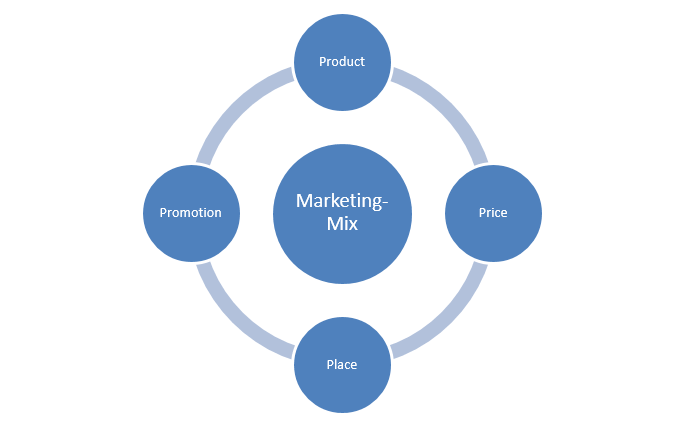
Classic 4P marketing: the four pillars of marketing
The four marketing mix pillars are:
- Product
- Price
- Place
- Promotion
Together, they form a unified marketing concept that has proven itself time and time again when it comes to marketing products. However, with regards to marketing a service, the 4P model does have some weaknesses – but it is still a basic model that every marketer should be aware of. The need-to-know basics are explained below:
Product
The product is at the heart of any marketing mix and influences all other marketing processes. It covers all areas concerning the design of the product, like the material, design, brand name, and services offered around the product.
Good product strategy requires detailed planning. First of all, you need to consider which target group you want to address and their specific requirements. Answering the following questions is important: How old is the target group, and what are the characteristics and needs of that age group? Is the product being aimed more toward women, men, or both genders? Is it possible to offer product variants (like different versions in different price ranges, or gender-specific versions)?
As part of your product strategy, you need to determine what qualities the product should have and what features it will offer its customers. In addition to benefits and specific characteristics, the product strategy also covers other topics too. Here are some examples.
Design and packaging
Both the design and packaging of a product play a central role. They contribute significantly to the product image and differentiate it from competing products.
Product design considers both function and aesthetic. For example, a coffee maker should have buttons that are self-explanatory and easy to use, as well as have a classic or extravagant look. In addition to the design, the name of the product or the corresponding brand should be well considered.
The design not only affects the product as such, but also the packaging: is the quality of your product reflected in cheap film, or high-quality cardboard? Does a striking colourful packaging appeal to the target group, or would muted colors be more suitable? These kind of considerations are important for food, drinks, toiletries, and other products that need to stand out among other competing products on the store shelf.
Product service
Another important part of product strategy is the service you provide to your customers before and after you buy a product. You should strive to have a good, readily available customer service for your customers, a warranty with a decent length, and even free delivery of your products. Inexpensive installation of home furnishings, supply technology, and other similar aspects are other things to consider in this area.
Marketing mix example: product strategy for a fashion company
Any fledgling company in the fashion industry who is striving to produce quality clothing should pay attention to the following steps:
- Products: Which garments does your product range include? For example, if you are selling trousers, the company has to decide how many models will be produced, what materials they will be made from, what cut they will be, and whether they are aimed towards men, women and/or children.
- Material: What fabrics will you need to source for your planned garments? In addition to the fundamentally required material (like denim for jeans), the quality of the textiles (high-quality, durable denim) also plays a role.
- Garment Design: What are the current fashion trends? What shapes, colors, and patterns will your trousers feature?
- Product Variants: What sizes, colours, and designs will be offered in your range? Are you selling jeans in just light blue, or other colours as well? Do you only produce standard clothing sizes, or do you offer a wider range than usual?
- Production: Who makes the clothes, and what will your working conditions be like for those making your clothing?
Whether a product becomes a success or failure can already be assessed during the development phase.
Create a detailed personal profile of your customers with the help of buyer personas. Personality profiles help you thoroughly engage with your target audience and to better understand their decision-making process.
Price: how much should your product cost?
The pricing strategy is also an integral part of the marketing mix and is about setting product prices. The strategy should also include any price adjustments or variants, as well as short-term discount campaigns.
The basic price of a product should give you the highest possible return, while also keeping the product competitive. To determine the ideal price, you need to calculate the production and distribution costs correctly and consider the purchasing power and buying habits of your target group.
Prime Costs
Make sure that you know what the total expenditure costs of each of your products will be. To do this, you need to calculate all costs incurred for the manufacturing process. In addition to production costs (e.g. the hourly wages of your employees) and the material costs, it also includes factors like energy consumption for production and fixed costs (like room rental for staff and storage rooms).
Once you know how much money (and time) you are investing in the production and distribution of each product, you can set the price to optimise the profit margin of each product sold.
Pricing based on your target groups and competition
When determining the final price, you also need to consider the previous target group analyses and the current market situation: how much do your potential customers spend on similar products? What is your target groups’ average purchasing power?
In terms of pricing, you should also keep an eye on your competition. Find out how expensive competing products are. If your potential customers find a similar product at lower prices from competitors, they often opt for the cheaper one. Prices far above the market average can usually only be justified by your product having a special added value over the competition.
Marketing mix example: pricing strategy for a fashion company
Our example fashion company takes a number of elements when pricing a pair of jeans into account:
- All expenses incurred for producing the jeans: What is the real cost of purchasing the necessary materials and production (personnel costs, costs for the purchase and operation of production facilities, space costs, storage costs, etc.)? These cost centers inevitably affect the pricing strategy – they need to be low enough to be able to sell trousers at a profit in the targeted price range.
- Competition’s prices: In order to estimate how expensive the trousers will be, you can research prices of comparable jeans already on the market. This determines a price segment, and helps you know what price range you should place your jeans in.
- Target group’s purchasing power: If the target group analyses show that there are numerous potential customers with higher purchasing power, then you can adjust your prices accordingly. You can justify a higher price for your jeans if they display good workmanship, and/or make use of high-quality, durable denim.
Place: how will my product reach my customers?
Distribution strategy (also called distribution policy) is the aspect of a marketing mix that determines how your product reaches the customer. It includes all activities related to the different distribution channels your product may take. There are a few important questions you need to ask yourself: Is my product being distributed through intermediaries or direct sales? Should the company offer just one or both options? The selection of distribution service providers also falls into this area.
Distribution channels
When choosing your distribution methods, you can choose between direct sales, indirect sales, and a mixture of both (franchising). With direct sales, you directly sell your product to your customers and are directly in contact with them. However, setting up your own direct sales can be costly. Only a few companies have the resources and infrastructures to ensure long-term distribution of their mass products which are in demand all over the world. For direct sales, the profit margin per product is usually higher because you work without middlemen.
You can achieve a further customer range by choosing indirect sales. This means that you cooperate with an intermediary (usually a wholesale or retail company or a commercial agency), which brings your product to the end consumer. The hardest part is convincing the distributor that your product is worth selling. Once you have done this, the broker will seek out suitable customers for your product (you can then contact these customers directly) and will receive compensation (usually a small commission) from you for each successful sale. This reduces the profit margin, but you will benefit from an existing distribution network.
Point of sale
In addition to your distribution process, your strategy also needs to take into account where exactly your customers will be able to purchase your product. Should it be offered in its own store or should it be sold alongside competing products from the same industry? Is it sold online (though an online shop) or offline (in a physical store)? Different distribution channels are often used in parallel.
Marketing mix example: distribution policy for a fashion company
When distributing clothing, our hypothetical fashion label needs to weigh in on the following aspects:
- The clothing should initially be sold through their own stores. To do this, both an online store is created, and a physical store in opened in a city, which also serves as the company headquarters. The goods are sold by direct sales and online purchases are posted.
- Since it is a newly founded and still largely unknown fashion label, it will be difficult to integrate into a range of larger retail chains. Therefore, they should only seek contact with retailers when their own brand has gained some popularity. If this is successful and the clothing is distributed throughout the US, they can begin considering cooperating with a sales partner. Although this would eliminate direct contact with your customers, the company would then benefit from a networked sales force. In addition, storage costs could also be saved as the goods will leave the warehouse faster and can even be stored directly with the sales partner.
Promotion: making customers aware of the product
Making customers aware of your product is one of the most important aspects of a marketing mix, so investing in promotion is extremely important. Communication policy refers to all measures taken to boost sales of a product and build a positive brand or corporate image. Typically, this is achieved through advertising, PR, and marketing campaigns that draw your attention to products and encourage your target group to buy them. Without a coherent, functional promotion strategy, you will hardly make any sales.
Promotion is an umbrella term covering all communication measures taken to get information about the product and its target group of customers.
Communication channels and content
The promotion must be designed to reach potential customers while being well received. The choice of communication platform is crucial and should take into account the preferences of the target group. Possible channels for promoting your product may include:
- Offline advertising: television, radio, newspaper, magazines, posters, etc.
- Online advertising: display marketing, video advertising (on YouTube, Facebook or as videos embedded on websites), social media advertising, search engine advertising etc.
- Personal communication: face-to-face conversations between seller and customers
- Public relations: contact with public institutions and opinion leaders (parties, associations, newspaper publishers) to present your company positively to the world
- Internet communication: e-mail, newsletters, social media marketing
Many of the above platforms and channels are particularly affected by how you choose to draw attention to your product. If you run a TV ad, your time slot should be during the break of a show that your target audience are most likely watching. If you decide to go to a trade fair, it should be one that is directly related to your company or product. The communication strategy also includes sales promotion. This refers to temporary actions that you use to promote your product specifically (short-term discounts, competitions, tasting stands, etc.).
You should calculate a fixed budget for promoting products. Maintaining a low price and still promising a unique product are important elements that make online marketing campaigns particularly successful. E-mail marketing, newsletters and social media marketing can reach a large number of customers for a low price. However, not every product is suitable for marketing campaigns through these channels.
Marketing mix example: a communication policy for a fashion company
A newly-founded clothing company plans to reach its target group through the following marketing campaigns:
- Posters are put up in the city where the company is based, close to the newly-opened store and in the busy squares of the city. In addition, the company has leaflets printed and distributed in shopping centres with lots of fashion stores, as these are likely places where your message will reach the target group. Both advertising materials also refer to the company’s online shop.
- Online advertising should also be featured on social media like Facebook and Instagram. Users who have fashion interests shown on their profiles should be targeted with these ads.
- Users can register for a newsletter on the company’s website or web shop.
- As soon as the company has made the first big gains, ads in fashion magazines and fashion websites will follow.
The 4P marketing mix using the fashion industry example
Below, we have summarised the individual areas of 4P marketing clearly in a table for you:
- Product
- Main product: women’s, men’s and children’s fashion
- Secondary products: accessories
- Spectrum: from low-cost, mass-produced no-name products to custom-made, luxurious, haute couture fashion
- Expensive packaging is usually unnecessary
- Price
- From very low prices for no-name products to extremely high prices for tailor-made designer pieces
- Sale/end of line products
- Discounts and promotions
- Place
- Point of sale: own branch(es)/own online shop and/or branches and retail partners’ online shops
- Warehouses
- Transport to the point of sale through direct shipping/indirect shipping via intermediary/mixed method between direct and indirect shipping
- Promotion
- Classic advertising channels: print media (advertising posters, advertising in magazines, flyers for certain discount campaigns, etc.), radio advertising, television advertising
- Videos posted to YouTube and various websites
- Blog
- Social media marketing and advertising (like Facebook, Instagram, Twitter)
- Word of mouth
Criticism of the 4P model and developing the marketing mix
For many companies, the 4P model is very suitable and helps create effective marketing campaigns. However, the model does not fit all companies. This is especially true of those who primarily market services rather than products. Because 4P marketing is very much focused on marketing physical products, companies offering services rather than goods may not find it helpful. Meanwhile, there are marketing models that expand the 4P model. For example, three more P’s are introduced for the services sector. The 7P model marketing mix includes these three new aspects, in addition to the four well-known ones:
- People: This marketing tool focuses on the employees of a company and involves recruiting qualified personnel and developing tactics to attract suitable professionals. The long-term commitment of employees to your company plays a role in this.
- Process: This includes all measures to optimise the services offered and increase customer satisfaction. Ideally, communication and interaction with customers will run smoothly, because only satisfied customers will use the same service again.
- Physical facilities/physical environment: The visible environment in which a service is offered, and the associated equipment, influences marketing success. Therefore, it makes a difference for the customer, whether a consultation is offered in a comfortable meeting room where you can visualise content on the PC, or in a dusty back room. Providing sufficient parking spaces in front of the shop also plays a part.
Which marketing model is best for a company cannot be universally defined, since not all models are all-inclusive. The 4P or 7P marketing mix model do not work equally well for every business plan. However, these two models form the basis for comprehensive campaigns which involve several marketing tools being coordinated. More up-to-date models usually deviate from the original two only in detail. Anyone who studies the components of these models in detail will be focusing on the most important aspects of a marketing campaign and benefit from more plan security by outlining all procedures in advance and developing a suitable strategy for each marketing field.