

Everything you need to know about multichannel marketing

You buy a used car from a dealer in the city center, bread from the bakery, kitchen gadgets from a shopping channel when you phone in to place an order – companies used to concentrate on a single distribution channel when selling their goods or offering their services, an approach that today is called “single channel.” The supplier, not the customer, decides where, when, and how products and services can be purchased. Then came the digital revolution: existing channels changed and new ones were invented – first e-commerce, then mobile shopping.
Consumer behavior also continued to change and develop along with new information and communication technologies. In addition to a wide range of products and 24-hour service, buyers demanded a wide selection of sales channels so they could choose their personal favorites. To stay competitive, companies and dealers could soon no longer afford to market their goods with just one channel. This led to the birth of multichannel marketing, but what exactly does this term mean?
What is multichannel marketing? The definition
Multichannel marketing is a strategic way of communicating and selling products, since potential customers can be reached on several channels. It’s also beneficial from the customer’s point of view, as the multichannel approach enables companies to be contacted in various ways. On top of this, the customer is better informed about the products and services offered, and can acquire them more easily.
Here is a rough list of the various distribution channels:
- Manufacturer sales branches
- Stationary trade (stores, malls)
- Ambulant trade (mobile outlets, street vendors, sales representatives)
- Catalog/mail-order business
- Teleshopping
- Internet/online shopping
- Mobile shopping (has become the driving force behind multichannel marketing)
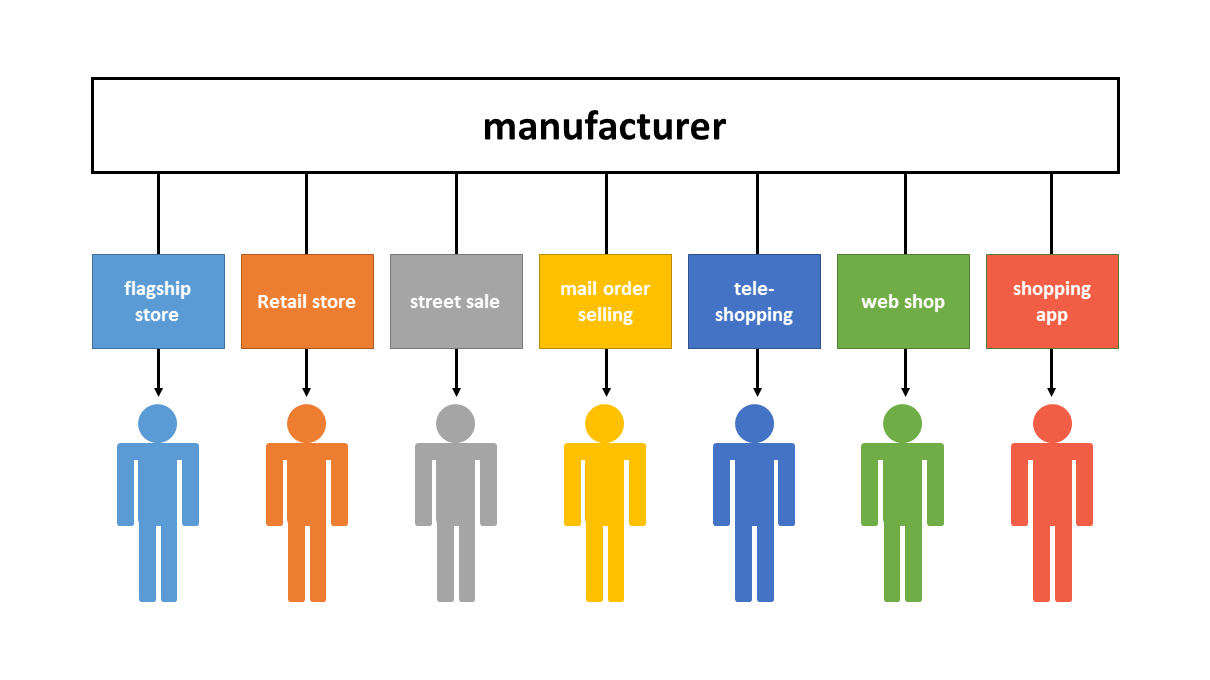
Having a multi-track sales approach means that your company is responding to consumer demand by allowing them to choose certain channels depending on what suits them best (e.g. for convenience or information needs). The main aim of multichannel is then to maximize the performance of each individual channel offered i.e. to tailor it specifically to the needs of the respective target group. When a customer goes to a brick and mortar store, they would expect personal advice from a specialist, whereas online shopping focuses on time efficiency and attractive prices.
Multichannel marketing is a communication approach that companies use with the aim of reaching potential customers on several communication channels simultaneously (with advertising, information, products, and services). As a result, customers can choose their preferred channel to find out about a company’s offerings, buy goods, and communicate with the company.
Advantages of a multichannel strategy
The multichannel approach means that the company is flexible, improves customer satisfaction, and consequently strengthens customer loyalty. Additional sales channels make it possible to reach target groups that couldn’t previously be reached by a single-channel strategy. At the same time, this allows the development of completely new business fields, with which a company can offer new products and services and reposition itself on the market. In the long term, a multichannel strategy should increase a company’s sales.
Multi-track sales approaches of this kind have become standard in the economy. Even small and medium-sized businesses usually have at least one webstore in addition to their brick and mortar business. After all, being present on as many channels as possible can prevent potential customers from migrating to the competition if you aren’t present on their preferred channel.
Disadvantages of a multichannel strategy
Communication, advertising, distribution, and sales over several channels instead of just one requires more complex logistics and a greater control effort. If the different channels are not presented in a homogeneous corporate image, this could confuse potential customers and they may not realize that the product and/or service belongs to the same company.
Another disadvantage of a multichannel strategy is that the individual sales channels merely exist side by side, but are not connected in terms of organization and technology. The lack of ability to switch back and forth between favorite channels within the same transaction at will (e.g. with practical click and collect) isn’t so inviting for some consumers and it may cause them to switch to a competitor that offers a more holistic buying experience (see crosschannel and omnichannel marketing below).
Then there is the issue of “cannibalization.” For example, a customer signs a Verizon contract either by telephone, online, or in one of the provider’s branches. In a multichannel strategy, each of these channels operates on its own. In other words, the advisor won’t directly benefit if a potential customer is advised in a store and then signs the contract via the company’s website. This is what’s known as the cannibalization effect: the partial or complete sales shift from one channel to another. Many store owners, for example, worry that customers will move from offline to online shopping. However, this can only be calculated to a limited extent.
A study by GE Capital Retail Bank revealed that 81% of shoppers research online before making a purchase which is known as “ROPO” (research online, purchase offline).
Overview: advantages and disadvantages of multichannel marketing
| Advantages | Disadvantages |
|---|---|
| ✓ More flexibility for the company | ✗ Complex logistics, higher control effort |
| ✓ Improves customer satisfaction and customer loyalty | ✗ Risk that the individual channels are not perceived as part of the same company |
| ✓ Better market coverage, development of new target groups | ✗ Possibility of a “cannibalization effect“ |
| ✓ Business risk is distributed further | ✗ Individual sales channels aren’t connected |
| ✓ Opportunity to reposition a company on the market | ✗ Information can’t be transferred across channels |
Multichannel marketing – examples of strategies
Multichannel strategies are mostly, but not exclusively, found in retail or in the B2C area. In this context, the focus is usually on the link between online and offline measures. Many retailers set up a webstore in addition to their physical points of sale, which usually offer a larger, even more complete product selection, which would not be logistically possible in stationary retail. This means that even goods that are rarely in demand can be offered for sale anywhere and at any time.
Both channels have their own cost structure and prices due to their inherent characteristics. This could be inconvenient for the customer, since they want the shopping experience to be as homogenous as possible. One solution is to offer the same prices on all channels, but to advertise online with special promotions. Synergistic effects should also be used: e-mail newsletters can, for example, be used to inform customers of any sales in stationary retail, and store operators can display flyers containing information about the online store.
The department store, JCPenney, is a good example of a business that uses a multichannel strategy. It was the first department store to sell merchandise online by making its entire product inventory available to buy on Facebook. Customers can make their purchase without having to leave Facebook. With over 5 million likes, the store uses the social media platform as a necessary tool to interact with its customers.
Multichannel marketing – differentiating between crossmarketing and omnichannel marketing
There are different terms for sales that take place over several distribution channels. “Multichannel” is certainly the traditional channel since it is the most widely used and has been around the longest. In addition to the terms: “no-line commerce” and “everywhere commerce,” “crosschannel” and “omnichannel” were also established, which differ from multichannel. Basically, the multichannel strategy is the evolutionary predecessor of the crosschannel and omnichannel concepts – and is therefore gradually seen as outdated.
Difference to crosschannel marketing
While multichannel refers to several channels operating separately, the crosschannel approach refers to channels that are closely linked (integrated), enabling a crosschannel shopping experience. For example, the customer might find out about a product in the brick and mortar store, order it in the webstore, and then pick it up from the actual store via click and collect or in-store pickup. The same range of goods or at least part of them can be found in all available distribution channels. A requirement for this integrative aspect of crosschannel marketing is a consistent, centrally managed, and always accessible database consisting of information about the customer and the inventory.
Difference to omnichannel marketing
A multichannel strategy should cover as many distributions channels as possible in order to reach all relevant target groups. The omnichannel approach, in turn, claims to be present on all existing channels with marketing measures at least according to its name (“omni” means “everything” or “everywhere”). At the same time, the channels should be closely interlinked so that the customer can use them in parallel and at will. Omnichannel combines the advantages of multichannel and crosschannel marketing in a single concept.
Although some retailers are still a little skeptical about multichannel marketing (or crosschannel marketing and omnichannel marketing), one thing seems quite obvious: If you don’t reach the customer on their preferred channel, they might move on over to the competition which would then increase their power in the distribution network. For some industries, products, and companies it’s almost imperative then to be omnipresent when it comes to communication, advertising, and sales efforts. Small and medium-sized companies, which lack the technical possibilities for a consistent and centralized customer database, should at least pursue one selective multichannel strategy – the absolute minimum for this is a combination of stationary trade and online store.