

Netflix alternatives: the best online streaming portals

Netflix has become synonymous with online streaming in many languages today. The US company has long-since turned their hand to in-house productions across many genres, helping to solidify their position as the number one streaming format – strides ahead of other services in pursuit. But these alternatives to Netflix are making efforts to close the gap through their own original programmes and unique payment models. And with some big players like Amazon entering the market, things have become a little confusing for the consumer. So which streaming services are actually alternatives to Netflix? Which is the most expensive and which is the best value for money? We’ll assess all the options for you in our guide to Netflix alternatives.
Streaming online: where to start?
The streaming market is sometimes very confusing and the number of different services out there is really incomplete thanks to differing broadcasting rights and a growing trend towards original programming. This is further complicated by the fact that new platforms are constantly joining the competitive market, often just to disappear again a few months later. The abundance of different providers means that it’s important to look into the differences between them. We’ll compare the four big platforms: Amazon Prime, Netflix, Google Play Movies & TV, and iTunes. But we’ve decided not to include any free portals like YouTube – even though it offers a number of legally uploaded films and series. In fact, we’ve dedicated an entire article to discussing the best alternative video platforms to YouTube. Our comparison of Netflix alternatives will of course look at the films and TV shows that each platform has to offer, but will also include other aspects like the availability of a mobile app, added features, and the terms and conditions of a subscription package. We’ll also make the distinction between original content and general, third-party content.
Netflix: what does the market leader really offer?
One look at the market share demonstrates the strong position that Netflix holds. Recent figures show that almost a quarter of all UK households owned a Netflix subscription in 2016, with roughly 500,000 people subscribing to Amazon Video, the highest competitor.
Although Netflix might have quite a limited movie collection, missing many classics, cult films, and independents, the platform more than makes up for this with its many high quality series and exciting original programming. Some of the most notable ‘Netflix Originals’ include high-budget smash hits like ‘Stranger Things’, ‘Orange is the New Black’, ‘Narcos’, ‘House of Cards’, and when you throw the Marvel series ‘Jessica Jones’, ‘Luke Cage’, and ‘Daredevil’ into the mix, there’s hundreds of hours of top draw entertainment to enjoy. Such is the success of Netflix’s original content that the label ‘Netflix Original’ has almost come to be considered as a quality guarantee. But there’s more to Netflix than just its original TV shows. Popular series like ‘The Walking Dead’, ‘Modern Family’, ‘The Big Bang Theory’, and ‘Breaking Bad’ are also available for viewing. But the wait can often be a few months after their original airing on US TV that the latest season of shows like this are available on the online streaming service. The same is true for the latest blockbusters. And some big-hitting series like ‘True Detective’ or ‘Game of Thrones’ are nowhere to be found. But new content is added regularly: Netflix updates its back catalogue with both classic series and Netflix Originals several times every month. Lastly, there are plenty of other types of show available, including documentaries like Planet Earth and cartoons. One of the best things about Netflix is its flexible customer subscription model and many extra bonus features: the initial trial month is free and an online subscription package can be cancelled at any time, meaning signing up is basically risk-free. And if you decide you’re not enjoying Netflix during your trial month, you can just switch to another provider once it’s over – meaning it doesn’t cost you a penny! Netflix is also popular among many commuters: along with its native apps for smart TVs, computer consoles, Apple TV, Chromecast, and the classic browser website, Netflix offers mobile apps for iOS, Android, and Windows Phone. And better still, the iOS and Android versions of the app feature a practical download function that allows you to store your favourite programmes for offline viewing, meaning it won’t cost you your data package in streaming. The volume and subtitle controls are also easy to operate. Netflix offers HD and ultra-HD content, but only at the more expensive Standard and Premium subscription packages. This wouldn’t be such a disadvantage, but for the fact that there’s quite a large gap between price and extra features with the more expensive tariffs. The additions offered for the extra pounds per month are often not worth it for many users. HD is a bonus that many users can enjoy with the Standard package compared to the Basic package, but the only other benefit of the extra price per month jump to Standard is the advantage of being able to stream Netflix on two different devices at the same time. The Premium package offers ultra HD on 4 devices, but this is only worth it for families who have the appropriate 4K/UHD devices and superfast internet speeds.
| Advantages | Disadvantages |
|---|---|
| Superb original programming | Missing several key films and TV shows |
| Very flexible subscription model… | … but with precious little incentive to upgrade to the Standard and Premium packages |
| Apps for many devices and operating systems | No single download option for additional films or series |
| Download function for mobile devices | HD only available with pricier subscription upgrade |
| Original versions and subtitles for foreign language programming |
The best Netflix alternatives: what about the competition?
Amazon Prime Video
The Netflix alternative with the next biggest market share by a distance is Amazon Prime Video.
The films and series platform Amazon Prime Video can do everything that the market leader, Netflix, can: along with high-quality original programming like ‘The Man in the High Castle’, ‘Goliath’, ‘Transparent’, and ‘Red Oaks’, it also offers new and often exclusive third party content regularly too. In fact, Amazon Prime Video actually has a broader selection on offer: It’s diverse range includes exclusive blockbusters like the ‘Hunger Games’ movies with Jennifer Lawrence, successful series like ‘Downton Abbey’, and beloved children’s programmes like the popular ‘Bibi & Tina’ films. Amazon Prime Video also generally keeps up with Netflix when it comes to broadcasting new seasons of huge TV shows like ‘The Big Bang Theory’ or ‘The Walking Dead’. And it’s also possible to buy or rent content as you please with ‘Amazon Video’, a slightly different service that doesn’t require a subscription. The subscription model for Amazon Prime Video differs slightly from Netflix: there’s still a regular trial month, but along with the monthly access through the regular monthly subscription, there’s the option to purchase the full Prime package for an entire year. This annual package may be a more considerable outlay to make, but over the course of the year it means that Amazon Prime Video is a more financially viable Netflix alternative: When you calculate the cost of a yearly subscription to Netflix, Amazon Prime Video works out as about two-thirds of the price. There are no noticeable differences in quality and range of features between the two platforms, with both offering programs in SD, HD, and 4K, with subtitles and good sound quality. Apps are available for iOS and Android as well as for all current gaming consoles and the in-house set-top boxes Amazon Fire TV and Amazon Fire TV Stick. Another advantage is the download function for many mobile devices that enables viewing playback without a direct internet connection. Unfortunately, Amazon Prime Video is less common on Smart TVs, Blu-ray players, and home cinema systems, while parallel viewing is only available on a maximum of two devices at present. The Premium package from Netflix, by comparison, offers simultaneous playback on up to four devices – but it’s significantly more expensive.
| Advantages | Disadvantages |
|---|---|
| High quality original shows and classics | Occasionally confusing distinction between Amazon Video (loan and purchase of content) and Amazon Prime Video (flat rate content) |
| Multiple options for subscribing, renting, and purchasing | Comparatively fewer original language versions of movies and series in foreign languages |
| Apps for iOS, Android, consoles, Amazon’s in-house set-top-boxes, and more … | … but less common to find on Smart TVs, Blu-ray players, and home cinema systems |
| HD available for subscribers | |
| Download function for mobile devices | |
| Subtitles | |
Google Play Movies & TV
Google Play also offers films and TV shows to download – but not via a subscription model. Instead, this alternative to Netflix focuses on one-time visitors, meaning it’s particularly useful for beginners. Movies, series, and individual episodes of programmes can be rented or bought – meaning that you can keep your monthly expenses in your own hands, just like with Amazon Video. The downside to this is that people often end up spending considerably more.
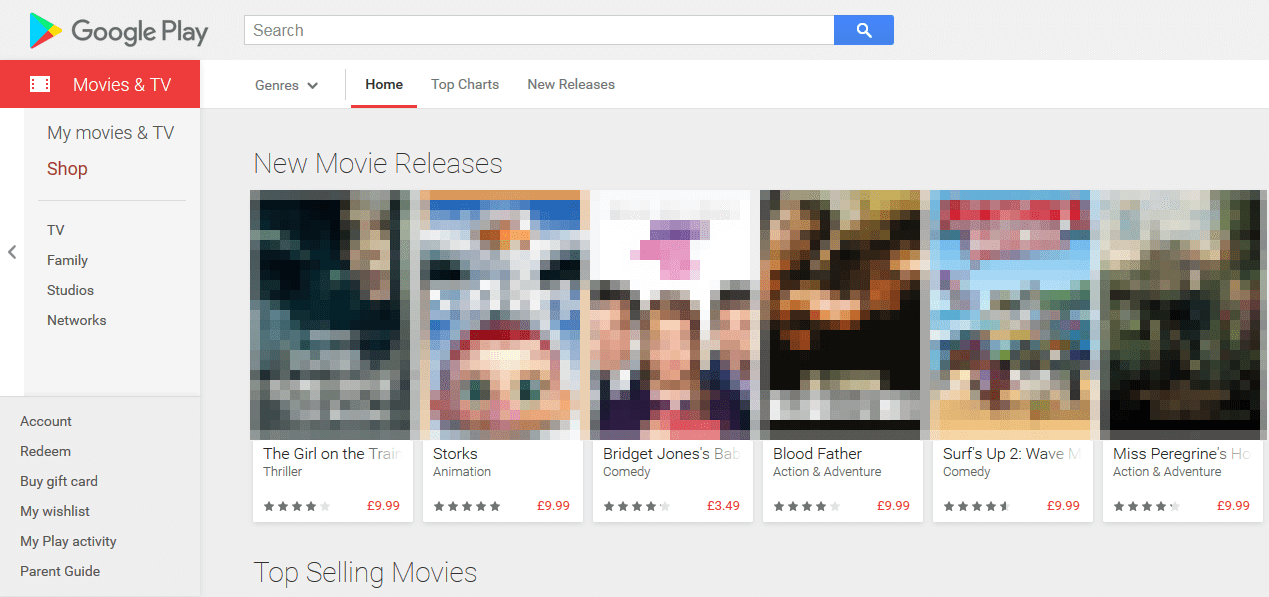
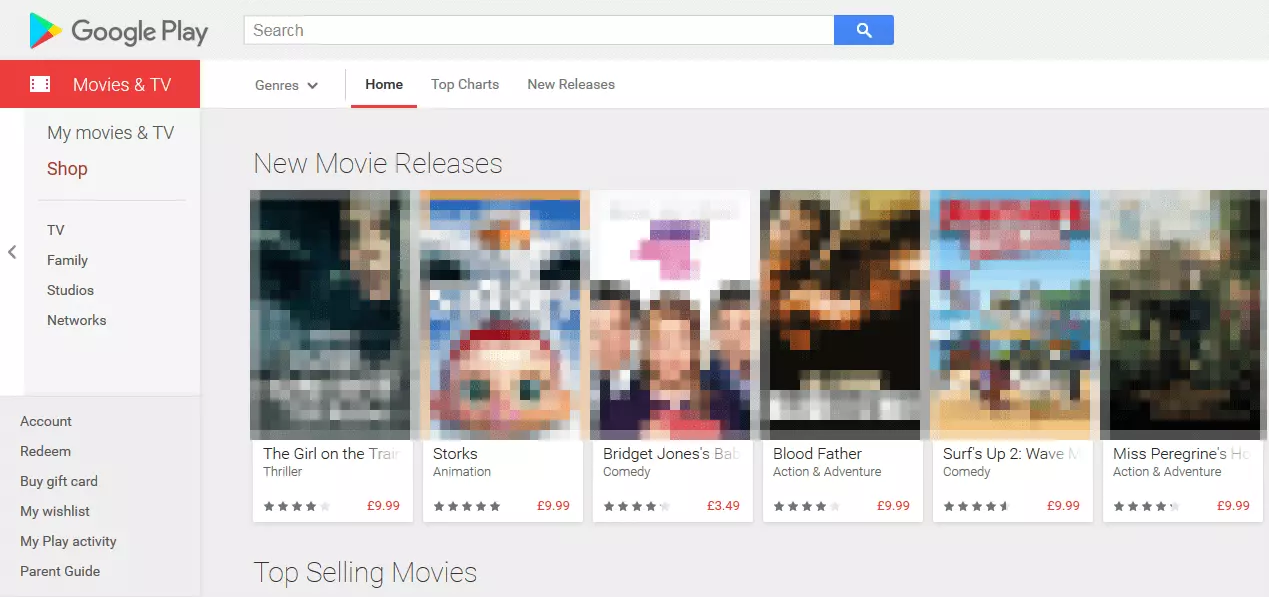
The pricing model for Google Play means it doesn’t compete directly with Netflix in many ways. But one field where it can compete is for selected blockbuster highlights. While the film selection is remarkable, offering almost all new releases and many selected classics, the collection of current TV shows lags a little behind. Admittedly, big highlights like ‘Game of Thrones’, ‘The Walking Dead’, ‘Sherlock’, and ‘The Big Bang Theory’ are available, but there’s nothing in the way of exciting original programming or exclusive content. And when you factor in the pricing structure, series junkies who regularly watch the latest shows all weekend and sit down on the sofa throughout the week probably don’t want to have to pay individually for every season or episode they want to watch. To put it simply, catch-up TV show marathons are difficult and expensive with Google Play Movies & TV.
When it comes to extras, user comfort and technology with Google Play are just as good as you’d expect from such a big name. If you have a Google environment at home, then you can take advantage of the offline mode and download your purchases or rentals to your Android and Chromebook apps. Google Play Movies & TV does also offer an app with a download function for Apple iOS devices too.
Unfortunately, Google Play’s streaming service doesn’t work on other mobile devices. Additionally, the app is rare to find in other places too: the technology is only supported by the in-house streaming stick ‘Chromecast’, Android TV, Roku, and a handful of selected Smart TVs from LG and Samsung (though it’s always possible to connect the browser version on your laptop to a TV screen using an HDMI cable). Users of other Smart TVs, consoles, and Blu-ray players have to settle for this option.
If your device and content is compatible, you can enjoy the huge 5.1 sound offered by Google Play. And when it comes to image quality, there’s both standard definition and high definition versions of many films and shows – plus the recent addition of 4K/UHD as well. To take advantage of the 4K/UHD, you’ll need a bandwidth of 15Mbit/s, Chromecast Ultra, and a corresponding 4K screen.
| Advantages | Disadvantages |
|---|---|
| Huge selection of movies | No flat rate content available … |
| All the latest blockbusters | … and no original programming or exclusive content … |
| Mobile Apps for Android, iOS, Chromebooks | … which makes Google Play Movies & TV an unattractive prospect for binge watchers |
| Downloads possible with offline mode for mobile apps | Very few consoles or devices with a native Google Play Movies & TV app |
| HD- and 4K/UHD content |
iTunes Video
The Apple equivalent to Google Play Movies & TV is known as iTunes Video. Like the other platforms we’ve already discussed, iTunes Video offers plenty of films and TV shows for one-time viewing – but there’s no option for a flat rate subscription. This structural similarity to Google Play Movies & TV suggests similar strengths and weaknesses to the service, but this isn’t entirely true.
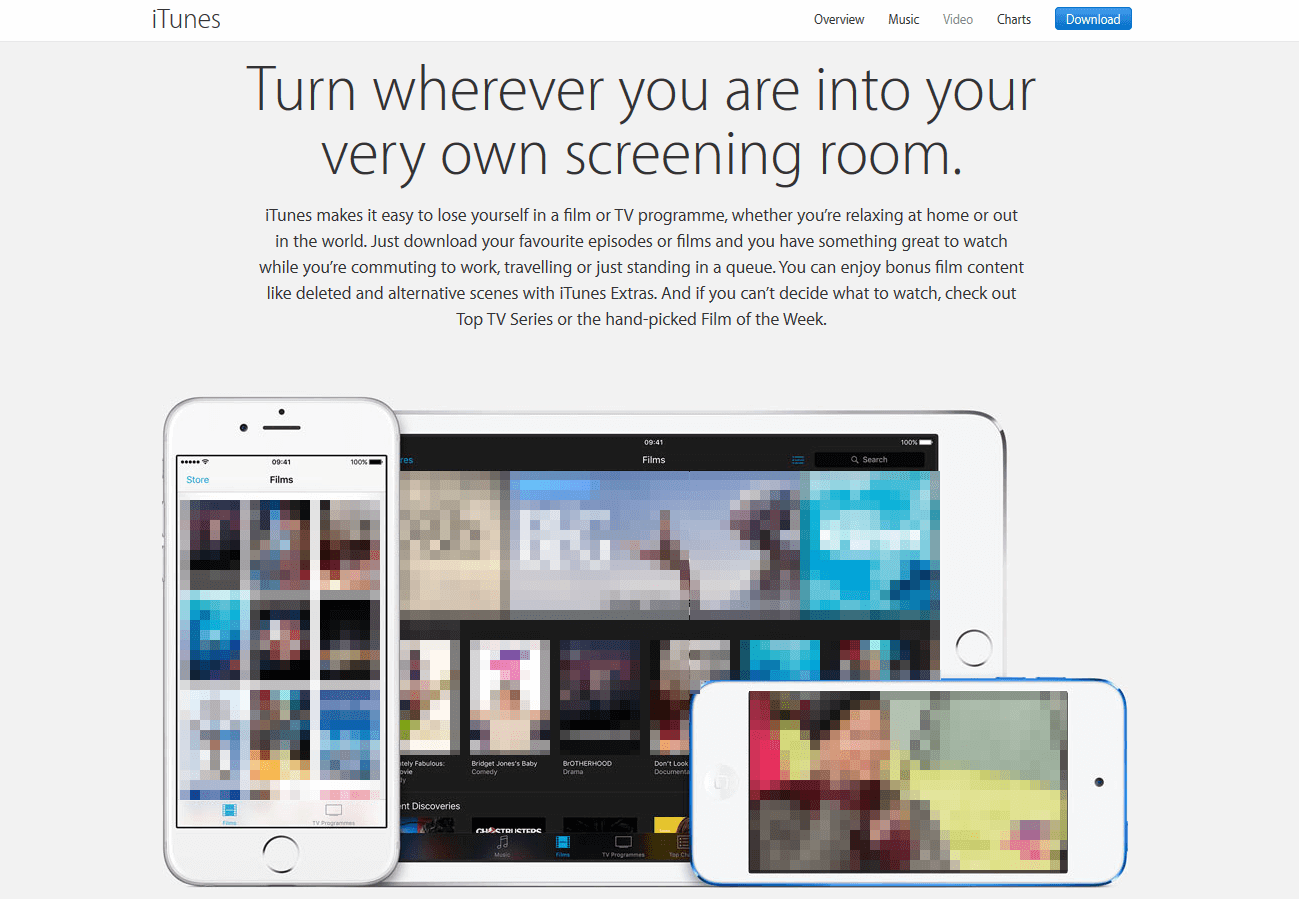
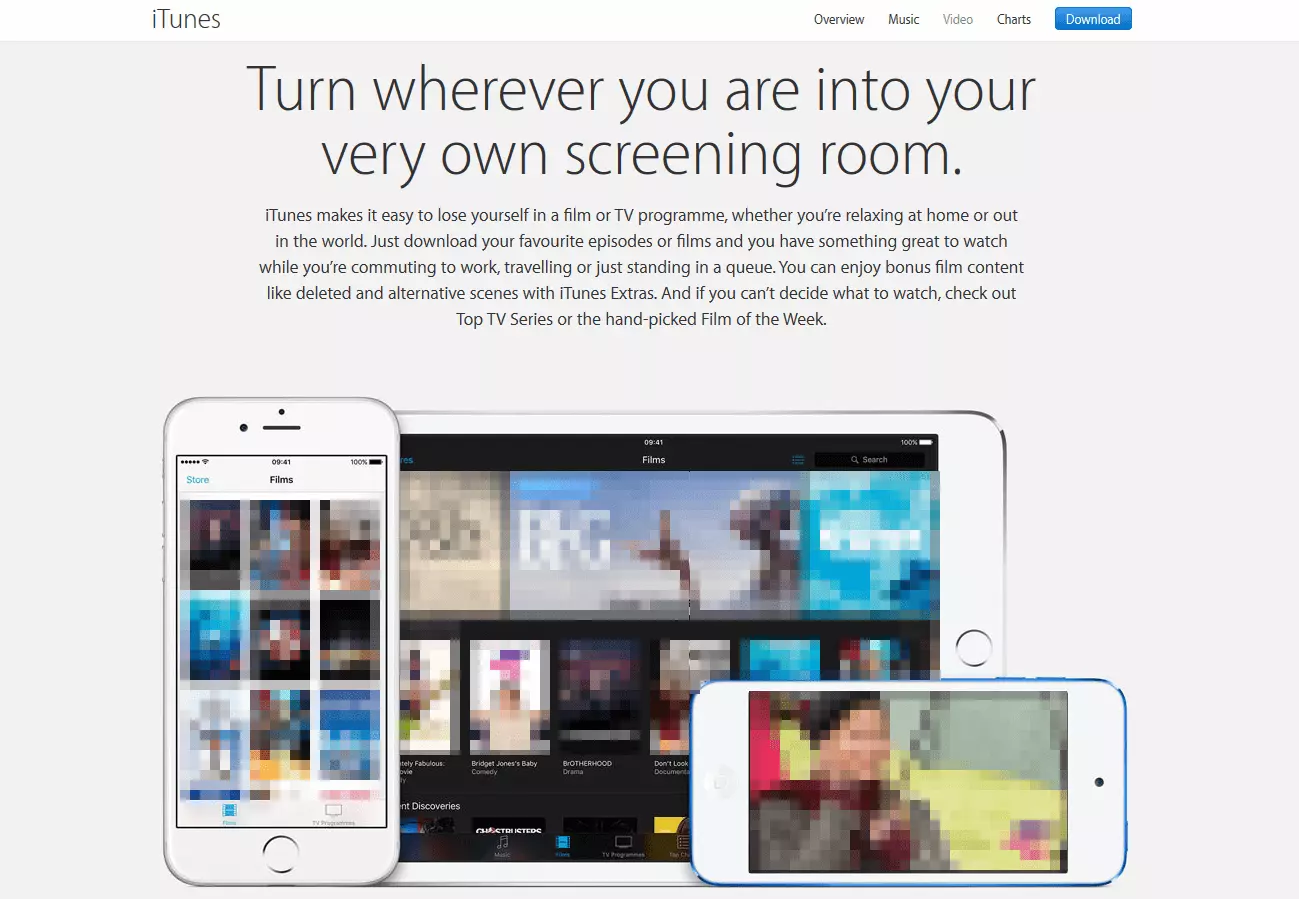
Those who have tried iTunes Video will all agree that there’s one big difference between the Apple service and the other Netflix alternatives we’ve introduced: There’s currently no web player for viewing programmes in your browser with iTunes Video. Instead, you’ll need to download and install the iTunes client on your device of choice. But your efforts will be immediately rewarded with a huge collection of films that’s really second to none – from classics to blockbusters, Apple has every genre fully stocked with content. iTunes Video also offers big-hitting series too: ‘Game of Thrones’, ‘House of Cards’, ‘The Big Bang Theory’, and many other popular shows can be downloaded season by season or as individual episodes.
One-time viewing of course will always offer the same pros and cons: users who want the latest releases or a number of different things to watch will usually end up paying a higher price for less content than they would with a subscription package deal for another provider. The Apple service does offer a great selection of bonus material for movies and series though, in a similar way to DVDs or Blu-rays – perfect for anyone who’s interested in interviews, ‘making-of’s, and other background information on various programmes. The image and sound quality of the movies on iTunes Video are also very respectable: HD is available and some films come with 5.1 sound – provided that you can meet the necessary speaker requirements for your home cinema system. Unfortunately, 4K movies are not presently available.
Similarly to Google, iTunes Video makes a great Netflix alternative for users who already have an Apple environment at home. This is because iTunes is only available on a limited number of apps and supported platforms: At present, you can use iTunes Video on the iPhone, iPad, and iPod Touch as well as on Mac, PC, and the in-house set-top box ‘Apple TV’. So as long as you’re not planning to watch your shows on a Smart TV, a Blu-ray player, a games console, or any other of the devices that aren’t currently supported, then you can also enjoy the benefits of offline viewing with Apple’s alternative to Netflix. This works intuitively: You can simply download your chosen film, or wait until its fully streamed and then enjoy it offline on the iTunes media library. The user interface is also intuitive and practical, making iTunes Video easy to use. Lastly, the service offers numerous different language and subtitle options, allowing you to enjoy content from around the world.
| Advantages | Disadvantages |
|---|---|
| Huge selection of movies and series | Download and installation of software required (no in-browser player) |
| The latest blockbusters and thousands of classics | No flatrate subscription package |
| Bonus material for many movies | No original programming |
| HD content available for many movies | No app outside of Apple devices, except for on laptops |
| 5.1 sound for some movies | Currently no 4K/UHD available |
| Offline mode |
Now TV
Now TV is a telecommunications firm which provides, amongst other services, contract-free Internet TV, and is a popular Netflix alternative. Founded in 2012, Now TV has a video-on-demand library, as well as a live streaming feature available to customers in the UK and Ireland. Now TV is a subsidiary of Sky, and subsequently provides subscribers with access to Sky Cinema, Sky Sport, and a selection of children’s channels. Their service also includes the ‘Entertainment’ section, featuring a selection of TV shows, including Sky Atlantic exclusive content.
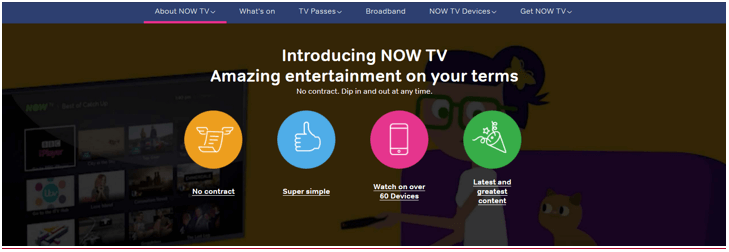
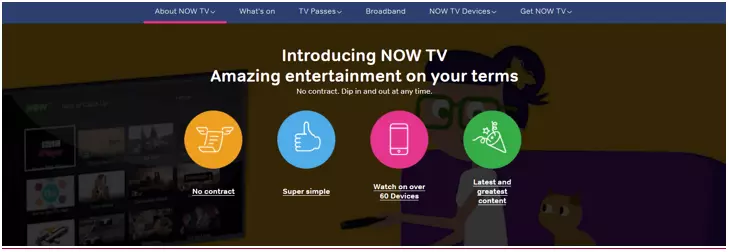
Now TV is a paid internet television service, offering a variety of bundles with different prices to suit user needs. A subscription to Now TV Entertainment will set you back £7.99 per month, Sky Cinema comes in at £9.99 per month, Kids TV costs £2.99, and you can also get Sky Sports for £7.98. Now TV offer a 3-month free trial and frequent offers and deals when you select channel subscriptions in bundles. The appealing aspect of Now TV, however, is that there is no contract. This makes the service appealing to customers who are trying to move away from getting stuck in television subscription contracts, but still want access to the same great content they are accustomed to. Now TV does not offer pay-per-view or rentals through their platform. Now TV has apps available for Android an iOS, which can be downloaded from Google Play or the app store. Their platform is compatible with over 60 devices, ranging from mobiles, tablets, computers, consoles, and smart TVs (or TVs fitted with a smart TV stick). For a full range of device compatibility options, please refer to their device list. Now TV do not currently offer offline viewing on their apps. The maximum image quality for Now TV streaming currently stands at 720p. They also offer subtitles on some films and TV shows on the Sky Cinema and Entertainment monthly passes, and viewers will be able to identify subtitled films by the ‘S’ symbol in the information description. This alternative to Netflix does feature an impressive range of films and TV shows, but is considerably pricier than the competition, and is a little lacking in some technical aspects.
| Advantages | Disadvantages |
|---|---|
| Excellent range of films and television | Paid-only video platform |
| Regularly updates | Limited subtitle and foreign language options |
| Numerous apps | Lackluster image quality |
| Extensive device capability | No offline mode |
| Subtitles and foreign language options |
Pluto TV
An increasingly popular Netflix alternative in the UK is the free online TV streaming service Pluto. As well as having a catalogue of content online, what makes Pluto TV special is its cable TV channel style. Rather than searching out what TV shows or films you would like to watch, Pluto TV’s interface looks similar to the Sky TV (or other cable TV) provider interfaces. In short, using the Pluto TV app allows you to flick through channels. This alternative to Netflix is sourced from a number of streaming sites, including YouTube and Hulu. Viewers peruse over 100 channels on Pluto TV’s interface, covering countless topics and themes. Films and TV show episodes can be saved for later viewings, just like ‘recording’ a program on your home cable box. Whilst Pluto TV’s interesting interface may be popular amongst those who are tired of having to curate their own viewing material with apps like Netflix, another appealing aspect of Pluto TV is the price: it is free of charge. Pluto TV instead generates revenue through advertisements.
Pluto TV has an extensive catalogue of over 2,000 films on its database, including classics and blockbusters like ‘Silence of the Lambs’ and ‘The Usual Suspects’, thanks to some lucrative licensing deals with film and TV studios like MGM, Lionsgate, and Warner Brothers. They are somewhat lacking in TV shows by comparison, but there are still some good offerings. Content is regularly updated, with the service claiming to upload weekly. Whilst Pluto TV does not create its own original content at this time, considerable funding has been set aside to pursue this, and they do have exclusive contracts with a number of external websites and production companies to stream their content. This alternative to Netflix does not include an option to rent or purchase content. Pluto TV’s content also varies depending on the viewing platform you are using, however, iOS and Android (the most popular) still feature a full channel catalogue. Pluto TV has two apps for Android and iOS, available through Google Play and iTunes. Pluto TV is compatible with numerous devices such as mobiles, desktops and smart TVs. For a full list of all devices compatible with Pluto TV, please see their website. Pluto TV does not have an offline mode, nor can you download and save content for offline viewing. In terms of streaming quality and maximum image quality, it varies wildly depending on the source of the content. This can make for disjointed viewing when switching channels if you are going from a high-quality picture source to something filmed on a mobile phone. Pluto TV also does not offer subtitles for foreign language content, nor does it offer closed captioning for the hard of hearing. Whilst Pluto TV cannot be beaten in terms of price, it’s lack of functionality means that it’s probably not the best alternative to Netflix.
| Advantages | Disadvantages |
|---|---|
| Excellent range of films | Unimpressive TV selection |
| Free of charge | Advertisements |
| Accessible apps | Lackluster image quality |
| Extensive device capability | No subtitles or foreign language content |
| Interesting channel-hopping interface |
MUBI
MUBI is an interesting alternative to Netflix that is a variation of the typical streaming-on-demand services that are saturating the current marketplace. Rather than just a streaming service, MUBI offers you a curated website that includes a video on demand option, a large film database, and an online magazine called The Notebook. Started in 2007, MUBI was originally named ‘The Auters’, and was intended to be a social network site for cinema fans. They rolled out a subscription service in 2010, along with a name change to their current MUBI.


You will not find any TV shows available to view on MUBI. It is a curated film-only platform, focusing on arthouse cinema. Their catalogue is limited: 30 films are available for 30 days at a time, before the platform is updated with a new 30 film catalogue to choose from. This ever-changing selection of films means that you are constantly gaining access to fresh content, but it also means that you have just a finite amount of time to watch the films you are interested in. MUBI do not have much in the way of original programming, but they do have exclusive access to a wide variety of films, and they have produced their own short film Ashes. This alternative to Netflix is available at a flat rate of £8.99 per month/£71.99 per year. MUBI also offers the option to rent films from its permanent catalogue at a price of £3.99. You can create a new profile on their website which does not grant you access to films, but allows you to rate and review films and participate in discussions. MUBI is available to watch on desktops, smart TVs, game consoles, mobile devices, and tablets. For a full list of all compatible devices, please visit their ways to watch page. They offer apps for Android and iOS through Google Play and the app store, both of which offer an offline viewing function. Many of the films on MUBI’s database are available to watch in HD, however due to recording quality, some older films may not exist in HD quality. The image definition is, as usual, dependent on your internet connection. As MUBI specialises in arthouse film, it has an extensive international catalogue with films in dozens of languages. They include comprehensive subtitling options, as well as closed captions. MUBI is available to users in over 250 countries. In terms of a unique platform, and an extensive film catalogue, MUBI could certainly be categorised as one of the best alternatives to Netflix. However, die hard TV fans will not be impressed, nor will fans of big Hollywood blockbusters.
| Advantages | Disadvantages |
|---|---|
| Unique service, including video on demand, film database and a magazine | Paid-only video platform |
| Impressive film catalogue | Non-existent TV show catalogue |
| Constantly updated content | Variation in image quality |
| Apps available for numerous devices | |
| Subtitles and foreign language options | |
| Offline mode |
The most popular streaming services compared
| Netflix | Amazon Prime Video | Google Play Movies & TV | iTunes Video | Now TV | Pluto TV | MUBI | |
| Selection of films | + | ++ | +++ | +++ | ++ | + | +++ |
| Selection of series | ++ | +++ | ++ | +++ | ++ | + | None |
| Original programming | Lots | Lots | None | None | Lots | None | None |
| Speed of latest releases | Average | Average | High | High | High | Low | High |
| Flat rate subscription | ✓ | ✓ | ✗ | ✗ | ✓ | ✗ | ✓ |
| Rentals & purchases | ✗ | ✓ | ✓ | ✓ | ✓ | ✗ | ✓ |
| Apps and availability | High | High | Low | Low | High | Low | ✓ |
| Downloads or offline mode for mobile apps | ✓ | ✓ | ✓ | ✓ | ✗ | ✗ | ✓ |
| Maximum image quality | HD/UHD with upgrade | HD UHD | HD UHD | HD | 720p | HD | HD |
| Multiple languages | ✓ | ✓ | ✓ | ✓ | ✗ | ✗ | ✓ |
| Subtitles | ✓ | ✓ | Sometimes | ✓ | Sometimes | ✗ | ✓ |
Conclusion
Each of the different Netflix alternatives that we’ve looked at have their own separate advantages. They’re aimed at different user groups and have different strengths and weaknesses: binge watchers will be able to keep themselves entertained for the whole month long with Amazon Prime Video, thanks to the fabulous original programming and organised subscription model. But if you’re more of a film buff and care most of all about seeing the latest releases in the best quality rather than settling for what the subscription platforms have to offer, then Google Play Movies & TV or iTunes Video will be perfect for your needs. And for those who are really into the extra bonus features that come with DVDs and Blu-rays, iTunes Video also offers a full range of additional delights.
So while Netflix remains the undisputed queen of the online streaming market at present, some of these alternatives to Netflix match or even exceed the standards set by the market leader. Which streaming service is the right one for you? This decision will ultimately come down to your personal preferences and what it is that you want from your streaming portal, whether it’s Netflix or an alternative.