

How can you improve your YouTube ranking with video SEO?

YouTube may be best known as a video platform, but it also ranks as the world’s second-largest search engine. By applying a range of YouTube SEO techniques, you can boost your video rankings and expand your reach. The following five steps outline the most effective ways to optimise your channel.
Step 1: Publish high-quality content
Improving the visibility of your YouTube videos through SEO doesn’t diminish the importance of strong content. Think of YouTube SEO as a way to amplify the reach of your videos and gain a competitive edge—not as a replacement for quality. Just as great content needs proper promotion to succeed, effective SEO alone won’t deliver results if the video itself fails to engage or provide value.
First, focus on creating interesting, unique, and high-resolution videos that entertain, educate, or help viewers solve problems. Regularly check which content resonates best with your users to respond to user needs. Ensure your content aligns well with the chosen video titles and descriptions to meet expectations.
- Our experts run your campaign
- Increase your online visibility
- Save money thanks to greater efficiency
Step 2: Optimise keywords, metadata, and other key elements
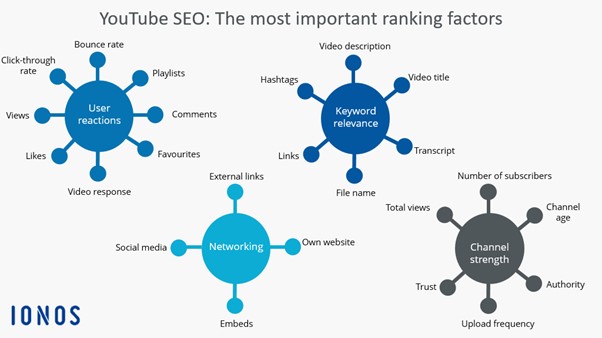
As mentioned earlier, YouTube functions as a search engine in its own right. That’s why on-page video SEO—like choosing and applying the right keywords—is just as crucial for your YouTube channel as it is for optimising a website. Your keyword research should follow a similar process and rely on trusted tools, such as Google’s Keyword Planner. YouTube’s autocomplete feature—which works like Google Suggest—also offers valuable ideas for long-tail keywords. Be sure to place your chosen keywords in the following four areas:
- Filename: While it may not be a major ranking factor, it is at least advisable to include keywords in the name of your video file.
- Title: The title is perhaps the most important element of SEO-based video optimisation. It’s crucial to find a phrase that includes the main keyword and is also appealing to viewers.
- Description: The description is also a very important ranking factor. Invest enough time in crafting a meaningful text that informs users and YouTube about what your video is about. Additionally, include your keyword set and add external links to your website or social media accounts. Remember that the first 100 to 150 characters are most crucial as they appear in the YouTube preview or, for example, in snippets on Google, X, or Facebook.
- Tags: Tags act as search terms that help users discover your video on YouTube. Ideally, your researched keywords should also be included here. However, keep in mind that tags no longer carry as much weight in the ranking algorithm as they did in YouTube’s early days.
Additional factors of on-page YouTube SEO that influence ranking are as follows:
- setting up a transcript file to add subtitles to your video
- the video quality (SD or HD)
- the age of the video
- annotations, such as pop-ups, text overlays, or speech bubbles, that add interactivity to your video
- the thumbnail, which along with the title, forms the main criterion for a good click rate or a high viewer count
Step 3: Optimise channel
Equally important for ranking as the on-page video seo is the strength of your YouTube channel. A well-structured channel that presents your clips in playlists and with substantial texts signals to the video platform and potential viewers what they can expect from your videos. With the absolute numbers that distinguish your channel, you further build trust, confirming you as an expert in your field. This includes, for example, the number of video and channel views, the age of your channel, and the number of subscribers.
Maintaining the channel is a valuable tool that you should use throughout the duration of your activities on the video platform. You positively influence the ranking by regularly uploading new videos that contain meaningful annotations and fit well thematically into your overall concept.
Step 4: Network content
YouTube SEO optimisation is also possible in the traditional off-page area since YouTube content can be distributed on the web like any other type of content outside the platform. You should therefore try to generate external links that lead to your channel or specific videos. In this context, embeds also play an important role. The more influential the websites are that embed or link to your clips, the more positively it affects your YouTube ranking.
In addition to traditional link building, distributing the content on social networks is also part of your tasks in YouTube video SEO. By making your YouTube clips public on social media channels like X, Facebook, or Pinterest, you not only gain additional links but also attract viewers outside of YouTube.
Step 5: Promote user engagement
User signals are the only way for YouTube to derive information about the quality of video content. For this purpose, the video service evaluates the number of views as well as the attention and reactions of viewers and compares these factors to similar videos uploaded on the platform. Your YouTube ranking will improve if users watch your video frequently and for as long as possible. Conversely, having only a few views and a high bounce rate negatively affects your ranking, much like the evaluation of a webpage.
Regarding user reactions, there are, among others, the following evaluation criteria:
- Number of comments
- Used keywords in comments
- Reactions to comments
- Number of positive ratings (‘thumbs up’)
- Ratio of positive to negative ratings (‘thumbs down’)
- Number of video responses
- Number of users who added clips to a playlist
To influence viewers’ reactions, you should actively participate in discussions about your videos: Respond to constructive criticism and positive feedback by writing your own comment replies.
