

IANA: admins of the internet

Each web page has its own name: if you have your own website or blog, you’ll know that you cannot use a website name – otherwise called a domain – that has already been taken. If you enter the name of a certain website into a browser search bar, the name is routed to a server, which translates it into an IP address and brings you to the website. These names and numbers, known as unique identifiers, are compared with a standardised set of internet protocol parameters, and enable communication between computers. One of the tasks of the Internet Assigned Numbers Authority (IANA) is to manage these unique identifiers.
What is IANA?
The Internet Assigned Numbers Authority has an important administrative role. It is responsible for assigning the unique names and numbering systems that are used according to the technical standards of the internet and form the basis for addressing websites. Although the internet is not a centrally managed network, some core elements do need to be coordinated globally. IANA took on this task with the predecessor of what we now know as the internet.This makes IANA one of the oldest institutions on the internet.
IANA’s history
IANA's tasks were originally done by a single person: Jon Postel. In 1972, Postel, a student at the University of California at Los Angeles (UCLA), proposed to establish an administration to manage socket numbers for the newly developed ARPANET. Although ARPANET was comparatively manageable, it was still important that the same socket numbers were not used for different applications. Postel himself took over the task and produced a corresponding catalogue.
A “socket” is the combination of IP address and port number. It is used to address a specific application on a specific computer. The IP address determines the network and computer, the port number the respective application.
From 1976 onwards, Postel pursued his appointment as “Czar of Socket Numbers” at the Information Sciences Institute (ISI) at the University of Southern California (USC). Officially, however, responsibility for the IANA function lay with the Defense Advanced Research Projects Agency (DARPA), an agency of the United States Department of Defense. The federal authority financed the ISI project to support the development of ARPANET. The term “IANA” was coined during the transition phase from ARPANET to today's internet, and was first used in 1988.
From 1988 to 1998, IANA was jointly funded by DARPA and ISI. With the publication of the National Telecommunications and Information Administration (NTIA) white paper “Management of Internet Names and Addresses” by the US Department of Commerce, a draft for a new administrative structure was presented. A private and non-profit organisation was to be set up to take over the IANA function and other administrative tasks. The Internet Corporation for Assigned Names and Numbers (ICANN) was founded at the end of 1998.
Until October 2016, IANA remained under the supervision of the US government. However, this government supervision has since been abolished, and ICANN has sole control over the functions of IANA.
IANAs tasks explained
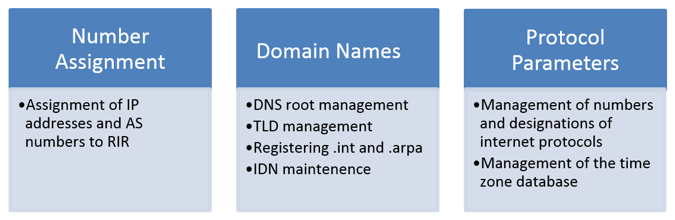
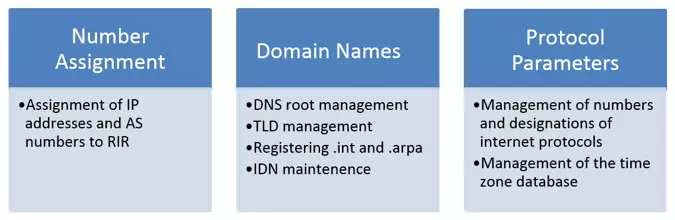
What IANA does is very important for the internet to work smoothly. The tasks can be divided into three main categories:
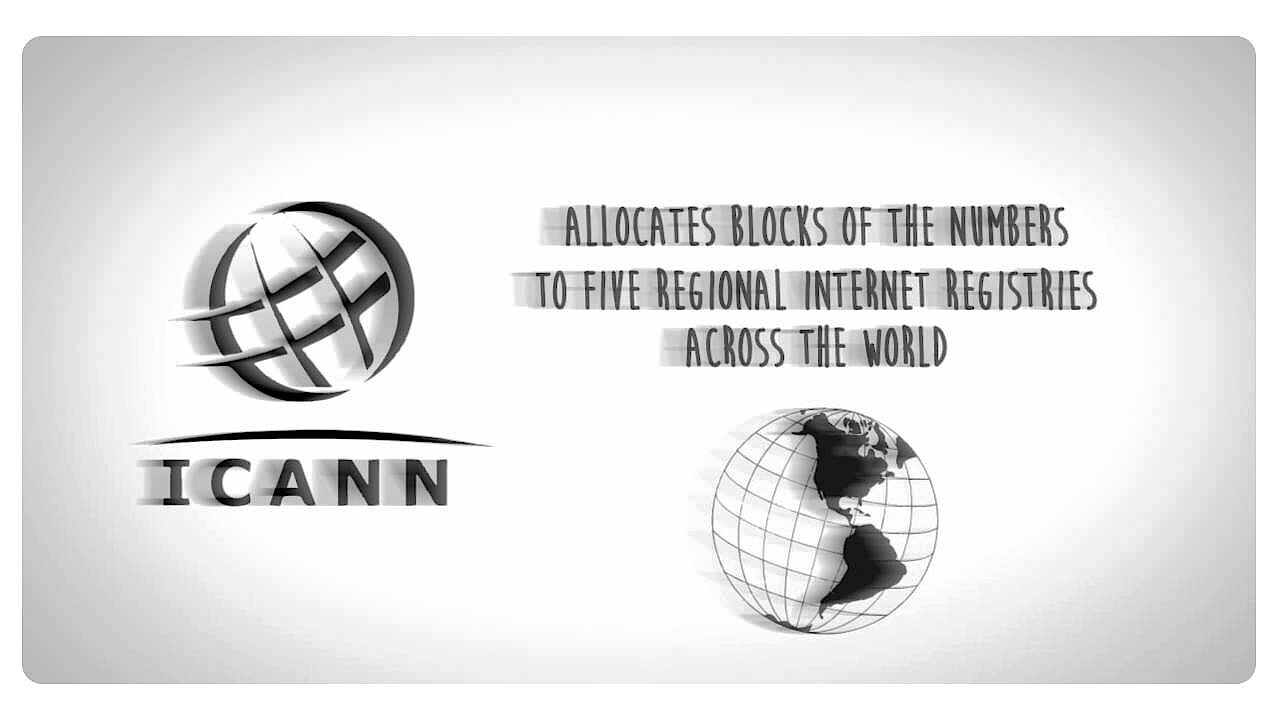 To display this video, third-party cookies are required. You can access and change your cookie settings here.
 IP addresses – number assignment
IANA coordinates the global pool of IP numbers and AS numbers (autonomous system numbers or just ASN), which are assigned in address blocks to the five regional internet registries (RIR). RIRs in turn make smaller address blocks available to the respective local internet registries (LIR) and the national internet registries (NIR), which then pass them on to the internet service providers. The table below shows the regions of each RIR:
| RIR | Area |
|---|---|
| AFRINIC | Africa |
| APNIC | Asia, Australia, and Oceania |
| ARIN | Canada, USA, and several Caribbean islands |
| LACNIC | Latin America and several Caribbean islands |
| RIPE NCC | Europe, the Middle East, parts of Central Asia |
There are currently two types of IP addresses: IPv4 and IPv6. The new IPv6 standard allows significantly more unique IP addresses to be generated. IPv4 addresses are still used more frequently, though.
Domain names
IANA operates and coordinates the central root zone of the domain name system (DNS), whose levels (top-level domain, second-level domain, and subdomain) make up the complete domain names. In this context, IANA also manages the database with all top-level domains (TLDs), the last part of the complete domain name. It also coordinates the .int and .arpa TLDs. The TLD “int” is reserved for intergovernmental contract organisations, while the TLD “arpa” is used only for technical infrastructure purposes. In addition, IANA maintains the central collection of permissible internationalised domain names. IDNs, also colloquially referred to as special character domains, allow umlauts, diacritic characters (small characters attached to letters that indicate pronunciation or tone), or letters from alphabets other than Latin to be integrated into the domain name. Originally, this kind of character was not provided for in the DNS. To cope with the growth and the resulting globalisation of the internet, the use of special characters was subsequently made possible by the internet standard “Internationalizing Domain Names in Applications” (IDNA).
Protocol parameters
In cooperation with the Internet Engineering Task Force (IETF) – an organisation dealing with the technical development of the internet – IANA manages the numbers and designations for internet protocols. The network protocols and their parameters define a common language through which computers and other devices can communicate with each other. Common parameters include:
- Port numbers: The use of ports makes it possible to assign data packages on the internet to an appropriate application. It is used for all data exchange via the user datagram protocol (UDP) or the transmission control protocol (TCP). Each computer has 65,536 ports. The ports assigned by IANA are numbered 0 to 65535 and can be divided into different categories, with the first ports (0 to 1023) reserved for certain services and purposes. For example, if you receive a mail, it will always be forwarded via port 25 reserved for mails. Port 80 is always used for surfing the internet.
IANA also manages the registered ports (1024 to 49151), which can be used freely by programs and applications without needing special rights. For example, a company can obtain a port for a specific service to ensure that the sent data packets arrive safely.
The remaining ports (49152 to 65535) are dynamic. They are not set to a fixed application. Like all ports over 1023, they pose a potential security risk because malware can also use them to gain access to your computer. - HTTP status codes: These are sent from a server to every client request. With the three-digit status code, the server informs the client whether the request has been processed successfully, an error has occurred, or authentication is required. For example, the HTTP status code 404 (Not Found) means that the requested web page data was not found on the server. Code 403 (Forbidden) indicates that the requested data is access-protected.
- Language attributes: The language abbreviations mark content according to the language in which it is output. For example, the language attribute “cy” stands for Welsh, the attribute “en” for English.
- Private enterprise numbers (PEN): Private companies can be identified in network systems via the PEN. They will be compiled in a public register, which also lists an associated contact name and an e-mail address. Any company is eligible for a free PEN from IANA.
- Media types: These are used to identify the format of data sent over the internet. The attribute “video/h264” is used for video streaming, for example.
IANA also maintains the time zone database (tz), which contains information on the world's time zones. The database is primarily intended for use in application programs and operating systems. It is periodically updated to take changes such as summer and winter time into account.
What roles does ICANN take on?
Since 1998, IANA has been a division of ICANN. ICANN is made up of different groups representing different databases, and making sure that the communication between these databases is smooth and efficient. They are divided into supporting organisations and advisory committees.
Supporting organisations
- Organisations that work with IP addresses
- Organisations that work with domain names
- Manager of country-specific top-level domains
In addition, the Technical Liaison Group works with the various organisations responsible for drawing up the basic internet protocols.
Advisory committees
- Governments and international organisations
- Root server operators
- Organisations concerned with internet security
- Traditional internet users (ICANN-at-large membership)
The final decisions are made by the board of directors consisting of 21 internet experts, which is appointed by several bodies. The articles of association provide for the greatest possible geographical and cultural diversity in the selection of members.
In addition to the IANA functions, ICANN also coordinates the operation of the so-called root servers. There are 13 of these servers worldwide. The central server is called “Root Server A,” the twelve other servers serve as a backup. The IP addresses for all TLDs are stored on each root server and are essential for the function of the internet. ICANN itself operates one of the root servers.
How to get involved yourself
ICANN is a grassroots organisation, and offers opportunities for all internet users to become involved:
- Three times a year, ICANN holds public meetings, which are open to all interested parties free of charge and held at different locations. At meetings, ICANN stakeholders determine what tasks will need to be completed in the future and who will take responsibility for them. Criticism and suggestions can be made during ICANN meetings.
- Alternatively, you can comment on ICANN's proposals and contribute your own ideas online at any time via the public comments.
- ICANN-at-large membership also offers the opportunity to become more involved. The members are organised in local sub-groups and work in different working groups on different topics.