
IaaS vs. PaaS vs. SaaS - What's the Difference?

Cloud computing service models offer developers many advantages in everyday life: Depending on the preferred model, developers can work with clearly defined areas of application, helping them map web developments in a scalable and, at the same time, cost-accurate manner with a pay-per-use model. In addition to specific services such as Backend as a Service and Function as a Service, you’ll find Infrastructure, Platform, and Software as a Service (IaaS, PaaS, SaaS). These comprehensive solutions let self-employed individuals, agencies, and companies of different sizes focus on cloud computing in a tailored way.
In this article, we introduce the different cloud computing service models and explain the differences between Software as a Service, Platform as a Service, and Infrastructure as a Service.
Ask, create and research with the European alternative to ChatGPT. Robust security and unlimited chats give you peace of mind.
Which cloud computing service models exist?
In the field of cloud computing services, a number of models have established themselves for the development of web applications. These so-called XaaS models share a number of common features, such as location-independent usage options, so that development teams from different countries can fall back on an existing structure. As the name suggests, the services are hosted in the cloud by the respective provider, making maintenance and update routines a thing of the past. With IaaS, PaaS, and SaaS, users receive different XaaS services, which involve little to very little administrative effort.
Software as a Service
Probably the best-known and most frequently used cloud computing service is Software as a Service (SaaS). This model provides users and developers with the greatest scope, while also providing the greatest overall assistance. The service usually refers to centrally provided web applications with a wide range of functions and areas of application. The applications don’t run on their own computer, but via a cloud. Examples of SaaS applications can be found in content management systems (CMS), in customer relationship management (CRM), or in eCommerce.
SaaS applications often replace several programs at once, so users only need one license, which greatly minimises administrative efforts and saves costs. Another advantage is that, despite the extensive functions, SaaS applications don’t require any maintenance or resources to operate. Regular updates, for example security patches, are automatically distributed by the providers.
Platform as a Service
Platform as a Service (PaaS) refers to a cloud computing service that provides developers with a development environment and the tools they need to develop new applications. This service is particularly suitable when web applications need to be deployed quickly and easily. The advantage is that developers don’t have to worry about configuring and maintaining the necessary infrastructure.
The platform gives developers access to pre-programmed application components, so that they can quickly develop cloud-based apps, for example. Testing of the developed applications is also possible via PaaS when the provider makes the necessary resources available via the cloud.
Infrastructure as a Service
Infrastructure as a Service (IaaS) is the smallest of the three cloud computing service models in terms of scope. With this model, users receive an IT infrastructure that is provided via the Internet. The data centres required for this are operated and managed by the cloud provider. Storage and administration are the responsibility of the provider, from whom users book the required computing power and the scope of the network structures according to their individual needs.
Other common cloud service models are Backend as a Service (BaaS) and Function as a Service (FaaS), which are more specialised than SaaS, PaaS, and IaaS in their scope and areas of application. What all cloud computing services have in common is that they can be scaled up and down. With the associated pay-as-you-use payment models, costs are only incurred for what users and developers actually use. This makes XaaS models genuine alternatives to conventional structures.
What are the differences between IaaS, PaaS, and SaaS?
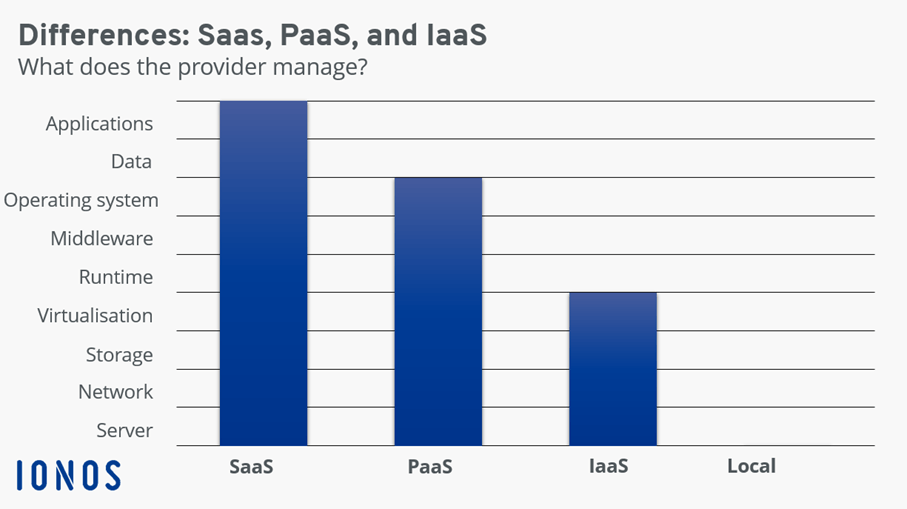
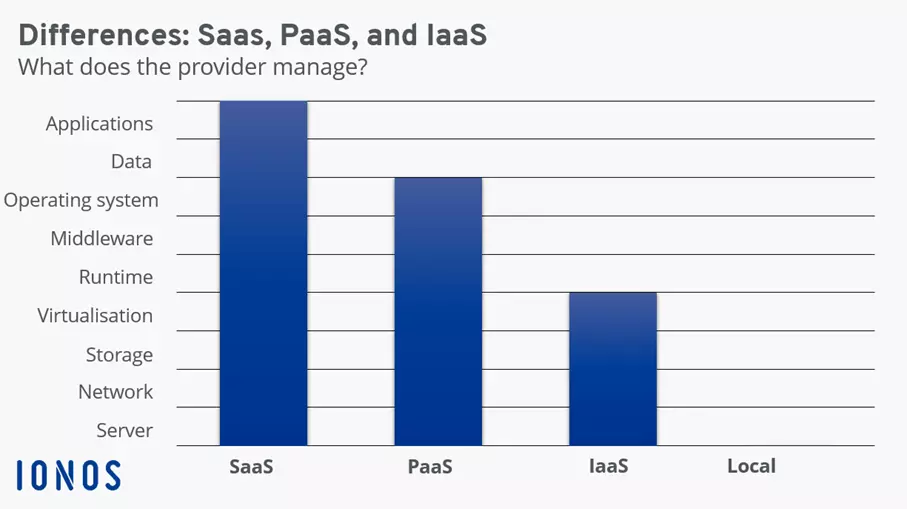
The differences between the presented cloud service models, on the one hand, are based on the scope of the application they’re used for, and on the other hand, in the administrative effort that developers outsource to the provider during use.
In the case of SaaS, for example, the complete administration of the server, data management, and the storage used sits with the provider. As a result, users with SaaS usually don’t have to worry about administration at all.
With IaaS, users have the greatest administrative effort out of the three cloud computing services. For example, while the server and the network are provided by the provider, the applications and the data used are managed by the user.
The following diagram shows the differences based on the components that need to be managed:
Reviewer

Christian Heldmaier
Christian Heldmaier is an experienced online marketing and SEO specialist from Karlsruhe. He has been working as an SEO Manager at IONOS since July 2020.