What is a private cloud?

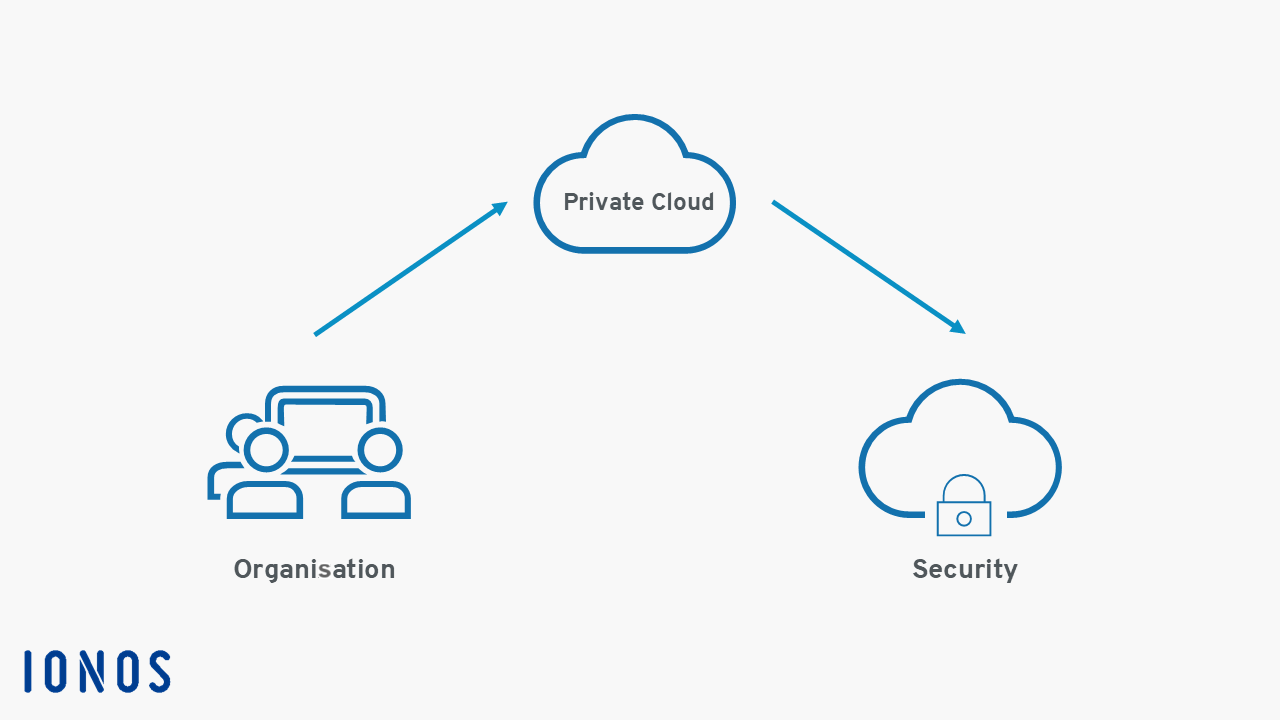
A private cloud provides cloud computing services exclusively to authorised users over the internet or a private internal network. Unlike a public cloud, its resources are neither public nor shared—they’re dedicated, offering a higher level of security and control. At the same time, businesses benefit from advantages like scalability and elasticity, and they can operate their private cloud either on-premises or in a data centre. This allows for applications, storage, and network operations to be tailored precisely to specific requirements.
- Total control over your data
- Benefit from the highest security standards
- No vendor lock-in for maximum flexibility
How does a private cloud work?
The private cloud’s technical foundation is virtualisation. Modern virtualisation strategies make it possible to decouple IT services and resources from physical devices. Applications no longer have to be run locally on end devices or servers, instead they can be made available virtually, on the cloud.
A private cloud is an ideal solution for companies that have to comply with strict data security and processing requirements. Compared to the public cloud, private clouds offer not only a significantly higher level of security and control, but also a flexible application, since the services are scaled according to the company’s individual requirements, which enables a more efficient way of working.
Check out our article ‘Private Cloud vs Public Cloud’ for a detailed comparison of how private and public clouds differ.
Authorised users can access private cloud applications through a company’s intranet or a secure virtual private network (VPN). To do so, users are granted the necessary permissions to authenticate with the cloud services. In most cases, external access to a private cloud is protected by a firewall. Simply put, a firewall shields individual computers or entire networks from unauthorised external access.
Who is a private cloud suitable for?
A private cloud is especially well-suited for businesses and organisations with high demands for data protection, security, and control over their IT infrastructure. It is often the preferred solution in regulated industries such as finance and healthcare, where sensitive data is handled.
Large enterprises also rely on this model to provide tailored IT resources that can be flexibly adapted to internal requirements. Additionally, organisations with complex compliance requirements—such as those related to the GDPR or industry-specific regulations—benefit from the ability to configure their IT environment according to custom security policies.
Private cloud solutions are also ideal for organisations that require high availability and reliable performance for mission-critical applications, offering a powerful and scalable infrastructure.
- Cost-effective vCPUs and powerful dedicated cores
- Flexibility with no minimum contract
- 24/7 expert support included
The different kinds of private cloud available
Depending on your needs, budget, and available resources, there are four main deployment and management models for operating a private cloud:
- Internal private cloud: With an internal private cloud, the entire IT infrastructure is hosted on-site and operated, maintained, and managed by the company’s in-house IT team. This setup offers full control over data and systems but requires significant investment in expertise, staff, and hardware.
- Managed private cloud: In this model, the infrastructure is hosted on-premises but managed by an external service provider. Companies benefit from the flexibility and customisation of a private cloud, while the provider tailors features to the client’s needs. This increases efficiency and provides businesses with a reliable point of contact for all cloud-related concerns.
- Hosted private cloud: A hosted private cloud is operated in an external data centre by a cloud service provider. The provider manages the infrastructure on behalf of the business and delivers the appropriate applications to users. This eliminates the need for in-house hardware, though the security and reliability of the provider are critical factors.
- Community private cloud: Several organisations—often from the same industry—share a private cloud infrastructure with coordinated compliance policies. This approach allows them to pool resources and reduce costs while maintaining a high level of exclusivity within the group. However, defining and aligning shared standards requires close collaboration between all participants.
Setting up a private cloud requires significant technical expertise and often demands a great deal of time and money. Most small and medium-sized businesses have limited access to these resources, making the setup of a private cloud a real challenge. In such cases, a managed or hosted private cloud is usually the most cost-effective choice for companies.
Advantages of a private cloud
Choosing a private cloud gives companies not only greater control over their IT infrastructure, but also a wide range of functional and financial benefits. While traditional IT setups are often associated with high maintenance efforts and limited scalability, a private cloud offers a flexible, high-performance, and secure solution. For organisations with strict demands around data protection, performance, and customisation, this model is especially appealing. Here’s an overview of the key benefits:
- Custom configuration: Cloud applications can be tailored to the specific needs of the company.
- Infrastructure capacity: Increased infrastructure capacity for demanding computing and storage needs.
- Enhanced security: Operating in a dedicated environment helps minimise security risks.
- Cloud features: Users enjoy exclusive access to cloud performance and bandwidth, with no slowdowns due to shared usage by third parties.
Take advantage of enhanced security through dedicated hardware and physical infrastructure used solely by you with the IONOS Private Cloud. The pay-as-you-go model also gives you per-minute billing for maximum flexibility.
Overview of other cloud models
In addition to the private cloud, there are several other established cloud models that vary depending on business needs and use cases:
- Public cloud: In a public cloud, providers like AWS, Microsoft Azure, or Google Cloud deliver IT resources over the internet to a broad user base. Businesses only pay for what they use (‘pay-as-you-go’), making this model particularly cost-efficient. With its easy scalability and low administrative overhead, the public cloud is ideal for companies with fluctuating resource demands.
- Hybrid cloud: The hybrid cloud combines private and public cloud environments, allowing businesses to keep critical and sensitive data secure in the private cloud, while running less sensitive workloads in the public cloud. This setup offers high flexibility and cost savings, as IT resources can be allocated based on specific needs. It is especially beneficial for companies with compliance requirements.
- Multicloud: A multicloud strategy involves using multiple cloud providers simultaneously, allowing businesses to combine different services for optimal performance or to ensure redundancy and reliability. This reduces vendor lock-in and enables organisations to leverage the best cloud services for specific workloads. Distributed usage also allows for performance and cost optimisation based on real-time demand.
- £5,000 to spend on IONOS products
- Individual support from cloud experts
- Secure solutions, hosted sustainably