
Which are the best alternatives to Adobe Photoshop?

Adobe Photoshop is an image editing software from Adobe Systems and is part of the Adobe Creative Cloud (formerly Adobe Creative Suite). Photoshop is considered one of the most feature-rich software applications in the field and is virtually the standard in the image editing industry. However, since the suite is very expensive and often too extensive for personal use, Photoshop alternatives are becoming increasingly popular.
Key Takeaways
Adobe Photoshop is the industry standard, but high costs and complexity make free alternatives a popular choice for many users.
- GIMP offers extensive open-source features including layers and masks for various platforms.
- Photopea enables professional PSD editing directly in the browser without software installation.
- Krita specializes in digital painting and illustration with high color depth and brush engines.
- PhotoScape X and Pixlr provide easy tools for quick photo optimization and web-based design.
Why are Photoshop alternatives in such high demand?
While Adobe Photoshop’s quality is rarely criticised, its cost remains a widely debated topic. Photoshop is only available through an Adobe Creative Cloud subscription, which has seen price adjustments over the years. Although Adobe provides more affordable options like the Photography package and special rates for students, there is no version available without a subscription. In comparison to the numerous free image-editing programs, Photoshop is often considered expensive.
In addition, Photoshop is geared toward professional use and therefore relatively difficult for non-experts to handle. Extensive features, large project files, and GPU-accelerated processes also mean that you need very powerful hardware for Photoshop.
- Intuitive website builder with AI assistance
- Create captivating images and texts in seconds
- Domain, SSL and email included
What Photoshop alternatives are there?
Due to its high level of recognition, Photoshop is the first solution many people think of for editing images and photos. It’s no coincidence that the term ‘to photoshop’ is commonly used to describe the digital post-processing of images or photos – regardless of whether Photoshop is actually used. However, there are several excellent Photoshop alternatives that compete with the industry leader and offer similar features. Here, we present the best Photoshop alternatives to you.
| Name | Operating system | Usage type | Strengths | Pricing model |
|---|---|---|---|---|
| GIMP | Windows, macOS, Linux | Local | Very extensive range of features, layers & masks, plug-ins, open source | Free (open source) |
| Photopea | Independent | Browser | Very high PSD compatibility, Photoshop-like interface | Free with ads, optional Pro version |
| Krita | Windows, macOS, Linux | Local | Ideal for illustration & digital painting, high colour depth, layers | Free (open source) |
| PhotoScape X | Windows, macOS | Local | Easy to use, batch processing, collages & GIFs | Free (basic), paid Pro version |
| Pixlr | Independent | Browser | Fast editing, AI tools, web & social media focus | Freemium (Plus/Premium subscriptions available) |
GIMP
The GNU Image Manipulation Program (GIMP) has been one of the best-known free alternatives to Photoshop for many years. The open-source software is available for Windows, macOS, and Linux, is continuously being developed, and is suitable both for basic image editing and for more demanding retouching and compositing tasks.
Since the 2.10 series, GIMP has become much more modern and flexible. The program now fully utilises the GEGL engine, allowing for a colour depth of up to 32 bits per channel. This enables photo and graphic editing with a broader dynamic range, minimising early quality loss. While GIMP 2.10 offers live previews for many GEGL filters, these are typically applied destructively. Non-destructive filters will primarily be available in GIMP 3.0.
GIMP offers a broad set of features, including but not limited to:
- Layers
- Masks
- Paths and selection tools
- Colour and contrast correction
- Image retouching tools
- Creation of complex compositions
With the integrated plugin system, the software can be further extended, for example with CMYK support, special filters, or additional file formats. PSD files from Adobe Photoshop can be opened and edited, although complex layer effects or smart objects are not always fully preserved.
The user interface may initially seem less accessible to beginners, as many functions are deeply nested in menus. However, users benefit from a very active community, extensive documentation, and numerous tutorials that help ease the learning process. GIMP is therefore primarily aimed at budget-conscious creatives who seek powerful image-editing software with no ongoing costs and are willing to invest time in learning the tool.
| Advantages | Disadvantages |
|---|---|
| ✓ completely free and open source | ✗ requires more time to learn |
| ✓ high colour depth up to 32 bits per channel | ✗ user interface less intuitive than Photoshop |
| ✓ layers, masks, and many professional tools | ✗ limited compatibility with complex PSD files |
| ✓ wide selection of plug-ins and extensions | ✗ no native CMYK workflow without plugins |
| ✓ active community and regular updates |
Photopea
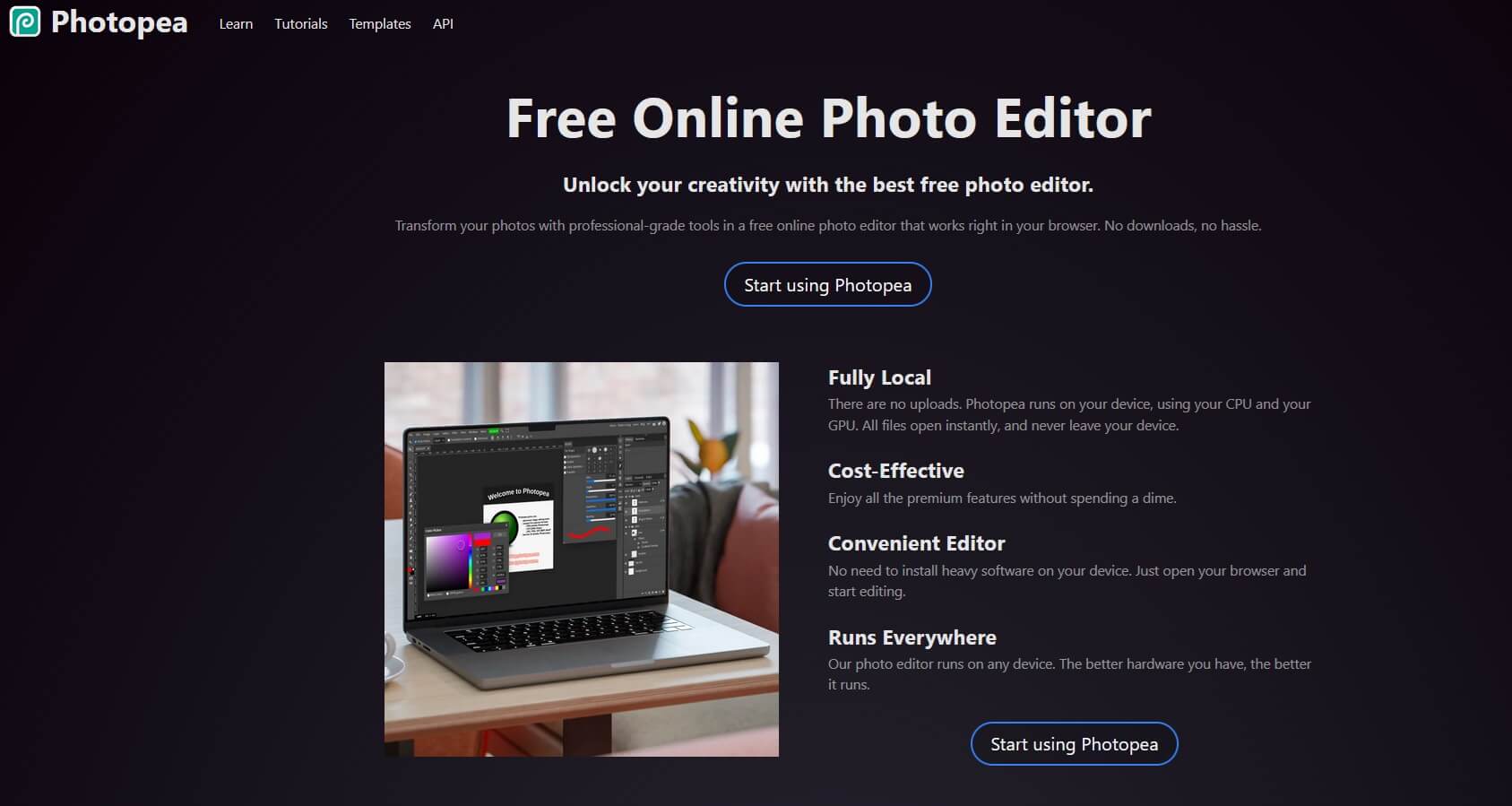
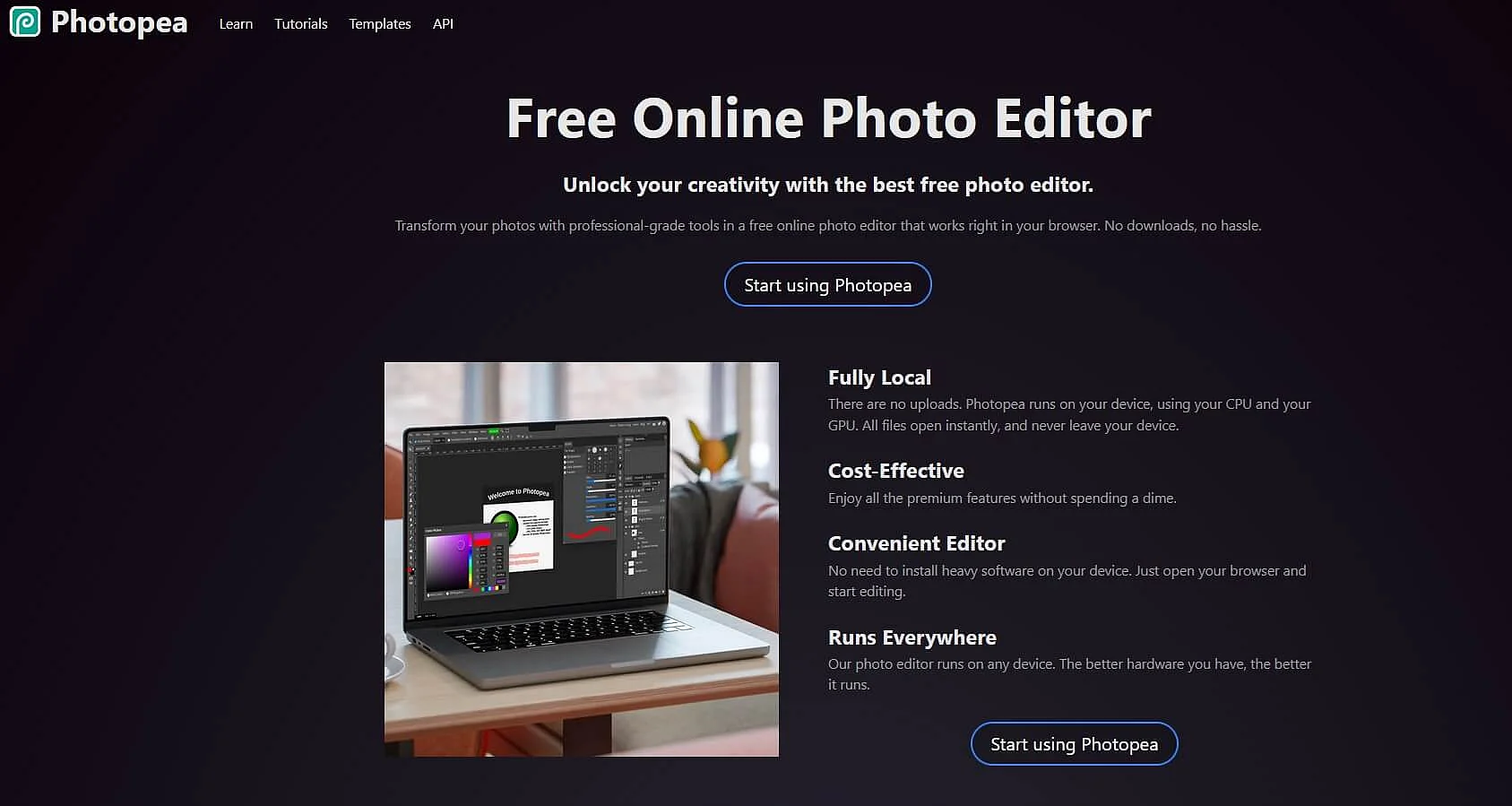
Photopea is one of the best-known free, web-based Photoshop alternatives and is aimed primarily at users who want to work without installing software and without high hardware requirements. The application runs entirely in the browser, making it platform-independent and usable on Windows, macOS, and Linux. Registration is not required for free use.
From a functional standpoint, Photopea is closely modelled on Photoshop. The interface, tool layout, and workflow logic are deliberately designed to be similar, so users switching from Photoshop can quickly find their way around. Photopea supports:
- Layers
- Layer masks
- Smart Objects
- Adjustment layers
- Paths
- Text tools
- Numerous filters and transformation functions.
A key unique selling point is its high compatibility with Photoshop files (PSD). Files can be opened with their layer structure intact, edited, and saved again as PSD. The software also supports other professional image formats such as XCF (GIMP), Sketch, XD, PDF, SVG, PNG, and JPEG.
Despite its web-based approach, processing is largely carried out locally in the browser, which can be an advantage in terms of data protection. Files do not necessarily have to be uploaded to external servers but can be opened locally. However, there is a limitation regarding colour space. Photopea works primarily in the RGB colour space. Although the tool also supports CMYK files and ICC colour profiles, its range of functions for professional colour management and prepress is clearly behind Photoshop. For web graphics, social media content, and UI design, however, the tool is well suited.
Photopea’s business model is based on advertising. In the free version, ads are displayed and some convenience features are limited. Anyone who wants to work without ads or use additional features can switch to a paid Pro version. For many use cases, however, the free version is sufficient, especially for occasional image editing or quickly adjusting existing PSD files.
| Advantages | Disadvantages |
|---|---|
| ✓ free to use, no installation required | ✗ ads in the free version |
| ✓ very high PSD compatibility | ✗ no full-featured CMYK workflow |
| ✓ Photoshop-like interface | ✗ dependent on browser performance |
| ✓ support for many professional file formats | ✗ limited offline use |
| ✓ application runs entirely in the browser |

Krita
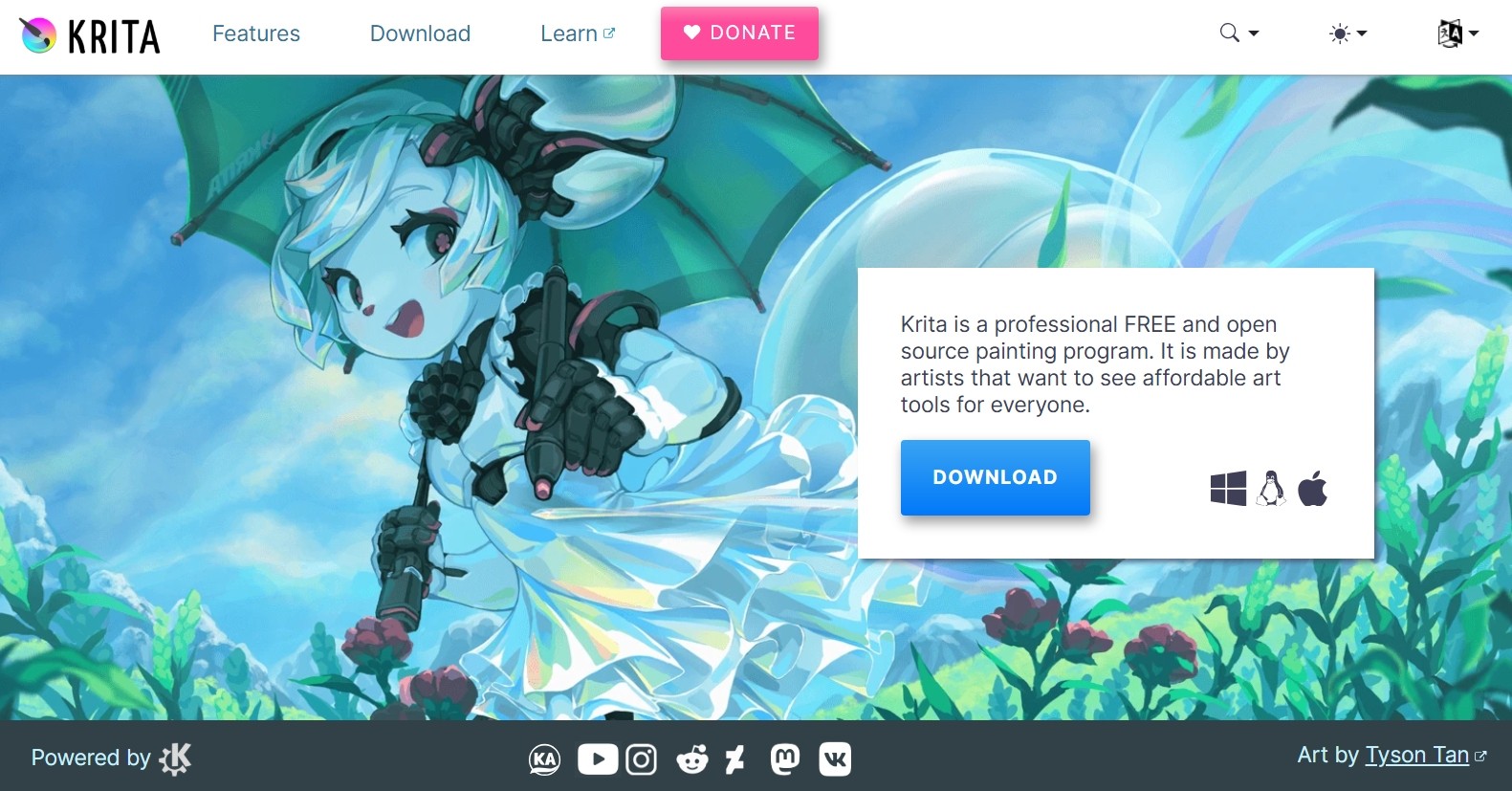
Krita is a powerful free alternative to Adobe Photoshop that originally focused on digital painting and illustration, but today is also suitable for classic image editing and retouching. The open-source software is actively developed and available for Windows, macOS, and Linux. At its core, Krita is aimed at creatives who work with layers, masks, and brushes and value precise control over colours, shapes, and textures. The program supports high colour depths of up to 32 bits per channel, modern colour management features (ICC profiles), and non-destructive work with layers and effects.
Krita offers a wide array of features, including:
- Advanced brush engines
- Selection and transformation tools
- Layer modes
- Filters
- Masks
- Vector shapes
PSD files from Adobe Photoshop can be opened and saved, with layers and basic structures generally preserved. However, with highly complex Photoshop files that use Smart Objects or special effects, there may be limitations. Additionally, for print, a full-featured CMYK workflow is not available to the same extent as in professional DTP programs, but the available support is sufficient for many creative workflows.
Krita’s user interface is modern and highly customisable, but it differs significantly from Photoshop. While newcomers from the illustration field can usually become productive quickly, traditional Photoshop users may need some time to adjust. Getting started is made easier with extensive documentation, active community forums, and numerous tutorials and sample projects. Krita is funded through donations, sponsorship programs, and optional purchases via platforms such as the Microsoft Store or Steam, but its core functionality remains completely free.
| Advantages | Disadvantages |
|---|---|
| ✓ completely free and open source | ✗ focus more on illustration than on traditional photo editing |
| ✓ high colour depth up to 32-bit per channel | ✗ limited CMYK workflow |
| ✓ layers, masks, and non-destructive effects | ✗ limited compatibility with complex PSD files |
| ✓ very powerful brush and drawing tools | ✗ Photoshop users need time to adjust |
| ✓ active community and regular updates |
PhotoScape X
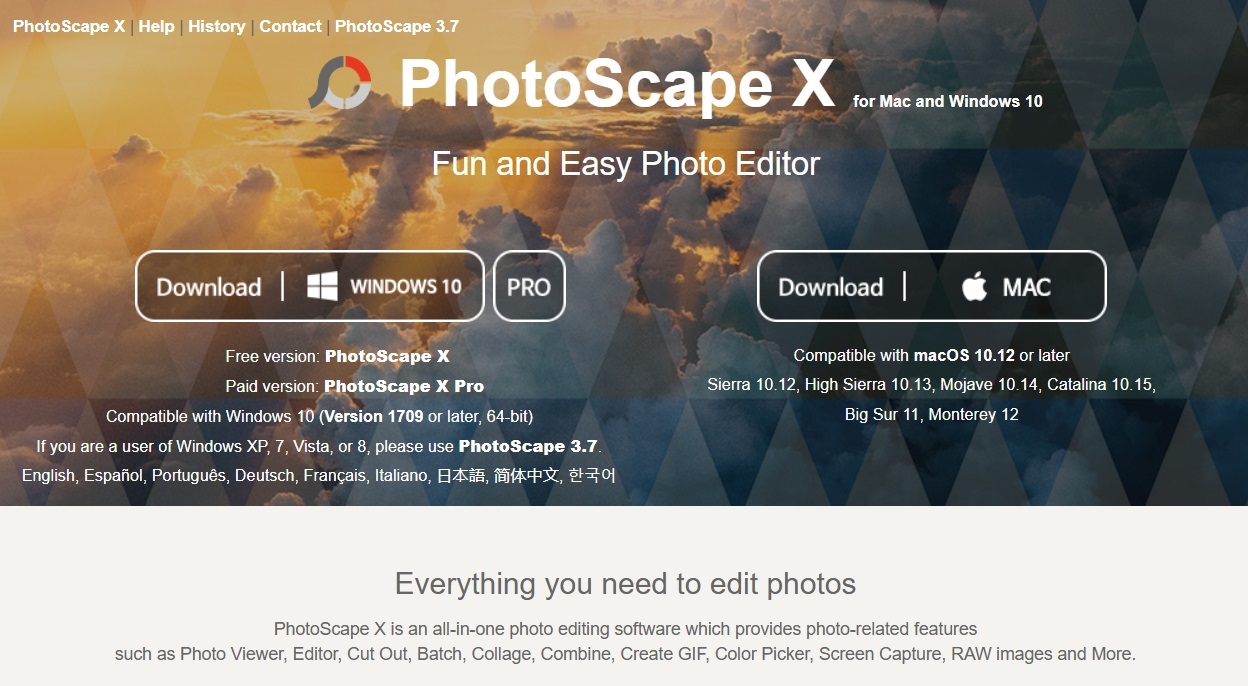
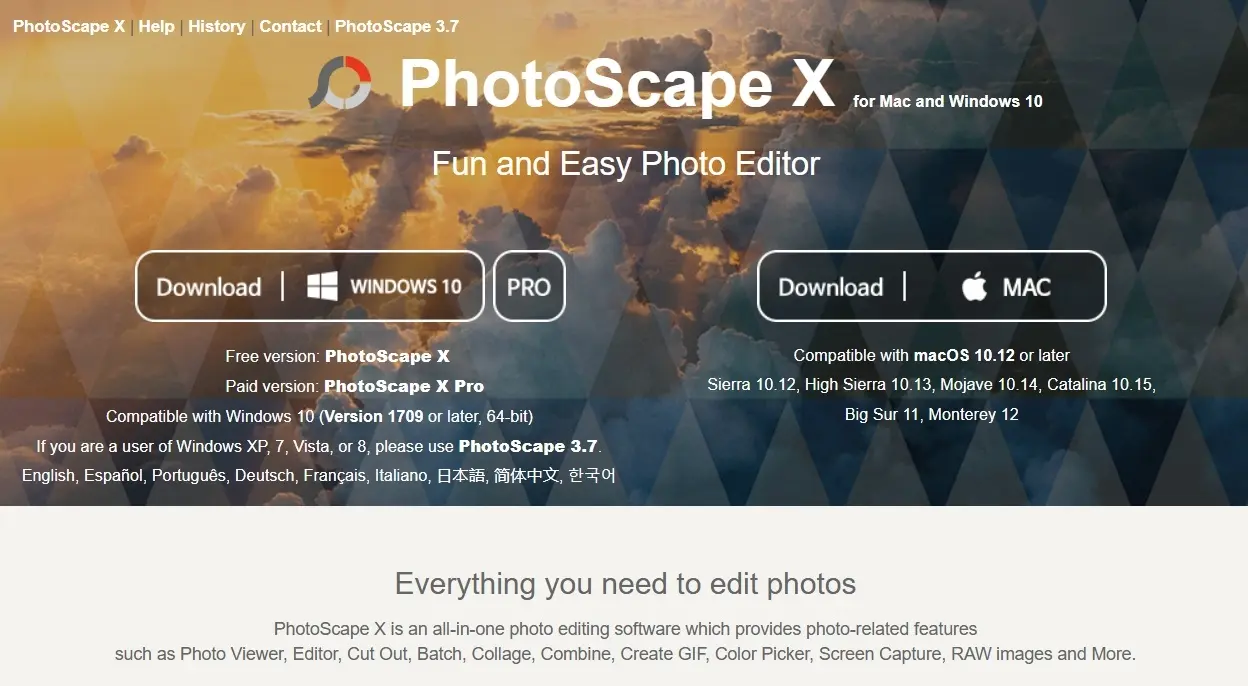
PhotoScape X is photo editing software primarily aimed at personal use and hobby photographers. Compared to powerful all-around programs like Adobe Photoshop, PhotoScape deliberately takes a simpler approach and focuses on fast, straightforward photo editing.
PhotoScape is currently offered in several versions. PhotoScape X is available for free and runs on Windows and macOS. In addition, there is a paid Windows version called PhotoScape X Pro with extended tools, filters, and export options. PhotoScape’s features are tailored to typical everyday tasks:
- Crop, rotate, and sharpen photos
- Adjust contrast
- Apply simple effects
- Integrated batch functions that let you rename, scale, or optimise multiple images at once
- Tools for creating collages, posters, and animated GIFs
- Convert RAW files to common image formats
Unlike Photoshop, GIMP, or Krita, PhotoScape does not support classic layer-based editing. Advanced retouching features, masks, or non-destructive editing processes are also not included. The focus is clearly on speed and ease of use. As such, the software is not suitable for professional workflows, detailed image compositing, or colour-accurate prepress work. However, for quickly optimising photos — for example, for personal albums, websites, or social networks — PhotoScape reliably serves its purpose.
| Advantages | Disadvantages |
|---|---|
| ✓ PhotoScape X can be used for free | ✗ some modern features only available in the paid version (PhotoScape X Pro) |
| ✓ very simple and intuitive to use | ✗ no layer-based editing |
| ✓ batch processing for photos | ✗ not suitable for professional retouching |
| ✓ tools for collages and GIFs | |
| ✓ suitable for quick image optimisation |
Pixlr
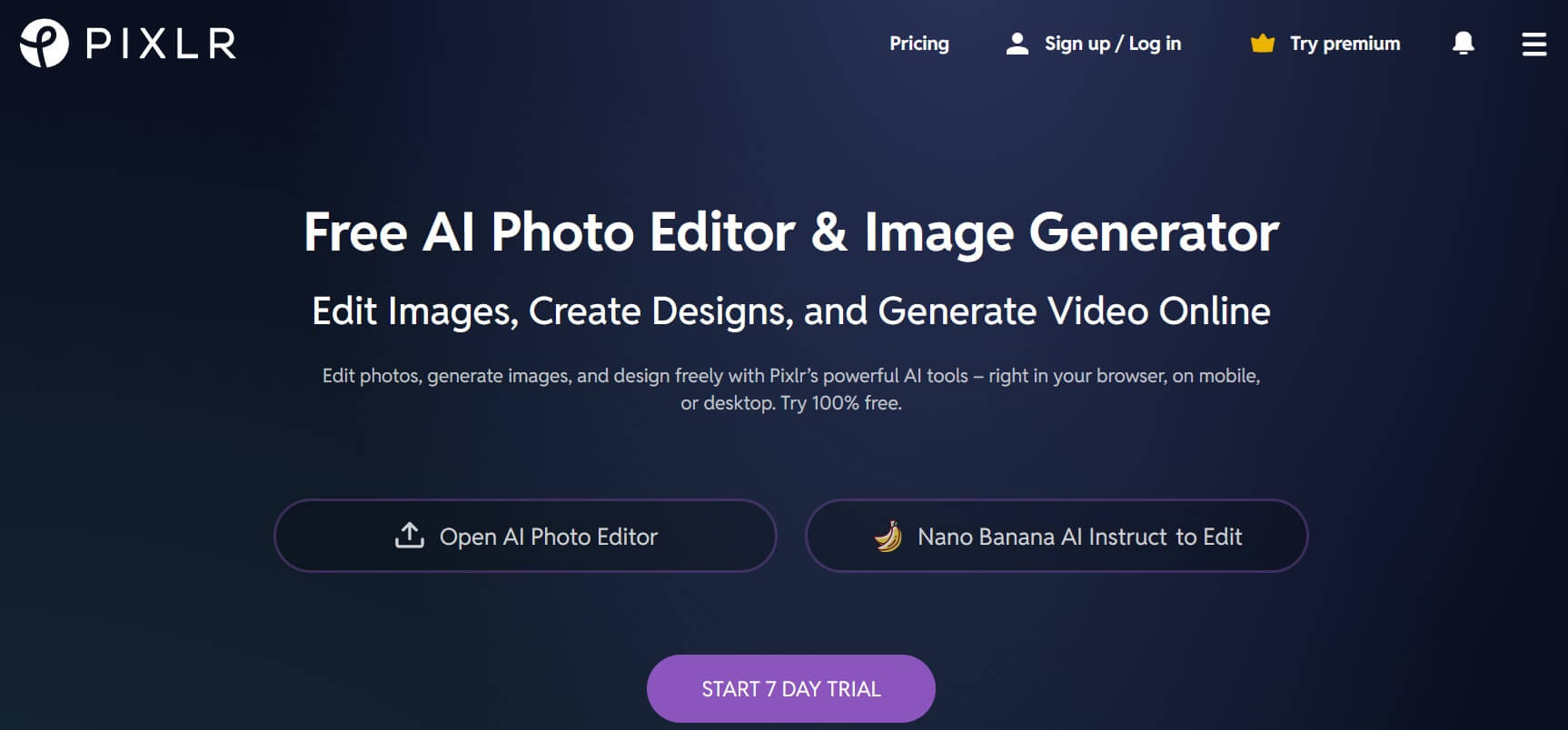
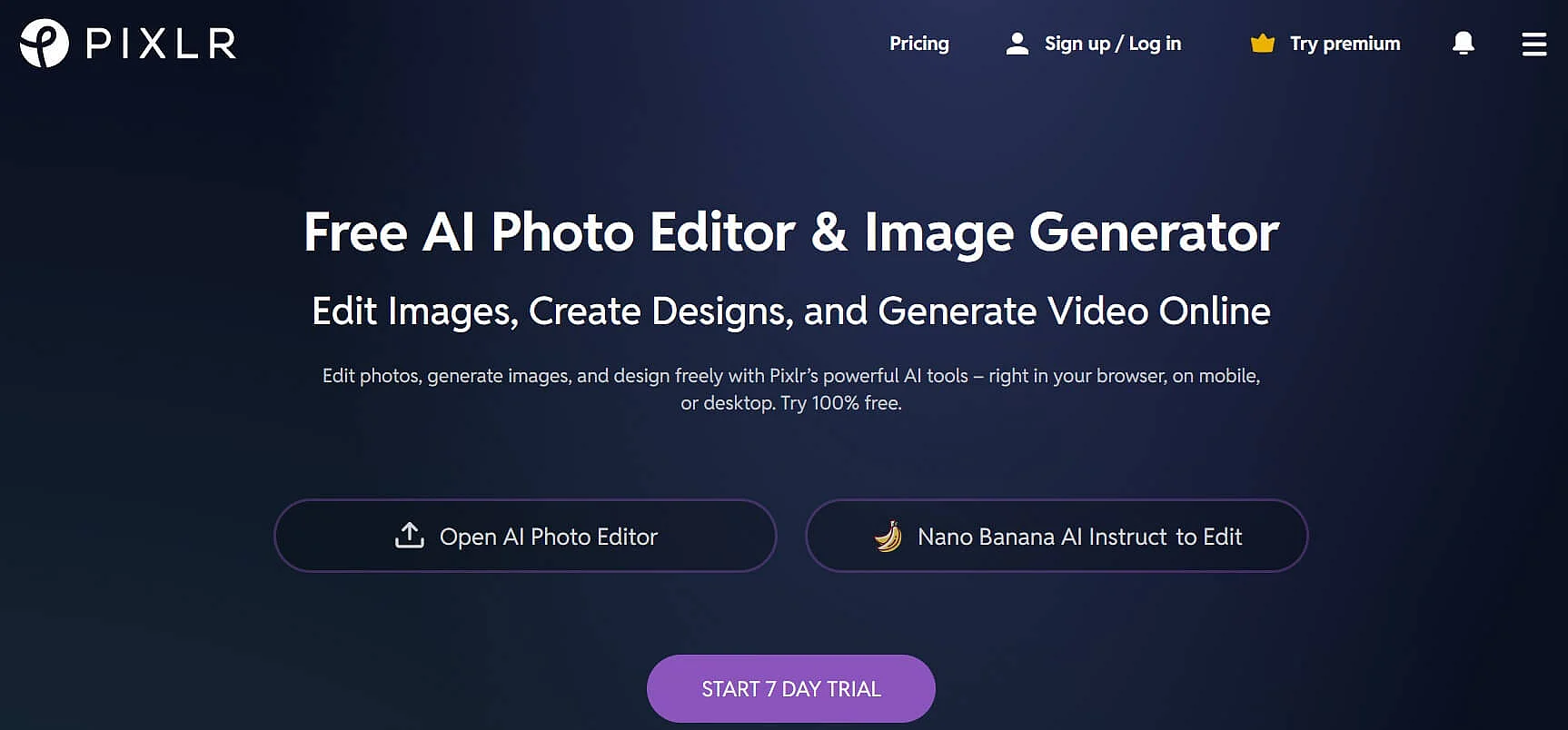
Pixlr is a web-based image editing solution that, as a free alternative to Adobe Photoshop, is especially suitable for quick work without installation. The application runs directly in the browser, so you can use it whether you’re working on Windows, macOS, or Linux. Pixlr also offers apps for mobile devices, targeting users who want to edit images on the go or create content for the web and social media.
Pixlr positions itself as a suite of editing and design tools, increasingly enhanced with AI features, such as:
- Background removal
- Object removal
- Generative features
For actual image editing, the suite offers several editor variants, including an advanced editor (Pixlr E) and a simplified interface. This means you can use Pixlr for typical tasks such as cropping, colour and tonal corrections, text, filters, and—depending on the editor—layer functions, all without installing local software.
Pixlr is a freemium solution. You can use it for free, but that typically comes with ads and limitations. Many advanced features (especially additional content/assets and AI tools) are available only through the paid Plus or Premium packages. Pixlr is particularly suitable for personal use, content creators, and marketing teams who want to quickly edit images or create graphics for web projects without installing software. However, for professional retouching, colour-accurate print preparation, or complex compositing, the tool reaches its limits.
| Advantages | Disadvantages |
|---|---|
| ✓ usable directly in the browser, no installation | ✗ free Pixlr X version with ads |
| ✓ Layer and mask editing with Pixlr E | ✗ no full-featured CMYK workflow |
| ✓ easy to use, quick to get started | ✗ dependent on browser and system performance |
| ✓ suitable for web and social media graphics | ✗ advanced features only available in paid packages |
| ✓ available across platforms |
Reviewer

Melissa Senn
Melissa Senn has been with IONOS since 2016 and focuses on website, e-commerce, social media, and AI in the Digital Guide. As a digital strategist, she uses her extensive SEO and GEO experience to transform complex technological trends into practical content.