
What is the UDRP (Uniform Domain-Name Dispute-Resolution Policy)?

The Uniform Domain-Name Dispute-Resolution Policy (UDRP) is an arbitration guideline introduced in 1999 to resolve domain name disputes. Various requirements must be met in order to use the out-of-court procedure.
What does UDRP stand for and what is its purpose?
UDRP is an abbreviation for ‘Uniform Domain-Name Dispute-Resolution Policy’, which is an international arbitration procedure for the resolution of disputes in connection with domain names. It was developed by ICANN (Internet Corporation for Assigned Names and Numbers) and introduced in 1999 to provide trademark owners with a quick and cost-effective way to take action against abusive domain registrations, in particular cybersquatting. The UDRP procedure allows complainants to request an extrajudicial decision on the transfer or deletion of a domain.
The UDRP generally applies to generic top-level domains (gTLDs) such as .com, .biz, .info, .net or .org. In addition, registry administrators of numerous country-specific top-level domains (ccTLDs) have also adopted the directive (sometimes with or without modifications). These include .ag (Antigua and Barbuda), .es (Spain), .mx (Mexico), .tk (Tokelau) and many more.
Why was the UDRP developed?
With the growth of the internet, or World Wide Web, and the increasing importance of trademark rights, the number of abusively registered domains also increased. Particularly problematic was the aforementioned cybersquatting, in which third parties register web addresses with well-known brand names in order to resell them for profit or damage the brand’s reputation.
Before the introduction of the UDRP, there was no uniform system for resolving such disputes. Trademark owners had to go through lengthy and expensive court proceedings to enforce their rights. The UDRP was developed to provide a quick, international and cost-effective solution for these types of conflicts.
What requirements must be met for UDRP?
To successfully file a UDRP complaint, complainants must demonstrate the following three points:
- Section 4(a)(i) of the UDRP: The domain is identical or confusingly similar to a registered trademark to which the complainant has rights.
- Section 4(a)(ii) of the UDRP: The current domain owner has no legitimate interest in the domain (e.g., because they are not using the trademark lawfully or have no connection with the trademark).
- Section 4(a)(iii) of the UDRP: The domain was/is registered and used with malicious intent (e.g., to profit from the trademark’s reputation or to extort the trademark owner).
ICANN defines ‘malicious intent’ as including the following behaviour:
- Registration with the aim of reselling the domain at a high price
- Used to deceive or mislead customers (e.g., phishing websites)
- Registration for the purpose of hindering competition
ICANN-accredited arbitration bodies provide administrative support and ensure that proceedings are conducted in accordance with UDRP guidelines. Currently, the following five institutions are authorised to conduct UDRP proceedings:
- WIPO (World Intellectual Property Organization): One of the most well-known arbitration bodies conducting UDRP proceedings worldwide; established team of experts specialising in intellectual property protection
- FORUM (National Arbitration Forum): A US-based arbitration body that’s particularly popular with North American companies
- ADNDRC (Asian Domain Name Dispute Resolution Centre): Responsible for UDRP proceedings with a focus on the Asian region
- CIIDRC (Canadian International Internet Dispute Resolution Centre): A relatively new arbitration board in Canada, authorised in 2019, offering its services in English and French
- CAC (Czech Arbitration Court): Institution in the Czech Republic that offers UDRP procedures at a very low cost and is known for efficient processing
How does a UDRP procedure work?
Compared to legal proceedings before UK courts or international tribunals, the UDRP procedure is a significantly faster alternative. One of its major advantages is its speed — the entire process is typically completed within less than two months. Here is how the procedure generally works:
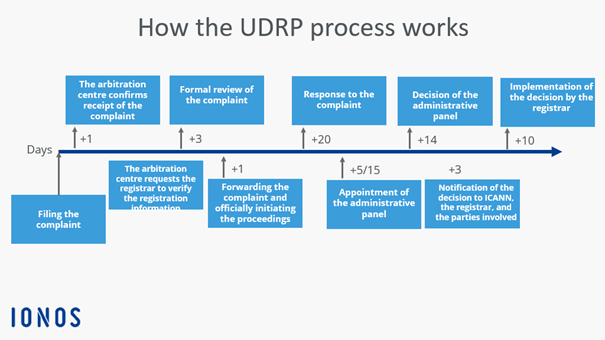
In short, the complainant files a complaint with one of the recognised arbitration bodies such as WIPO, which reviews and refers the case. The domain owner has up to 20 days to respond. An arbitration panel then examines the complaint based on UDRP criteria. The panel issues a decision within approximately 60 days. Both parties then have the opportunity to consult a regular court within ten days to have this decision reviewed. If no appeal is made, the arbitration panel’s decision is implemented, which usually means the transfer or deletion of the affected domain names.
The costs of a UDRP proceeding vary depending on the number of domains involved and the number of arbitrators appointed. At WIPO, for example, the fees for a single arbitrator proceeding are $1500 (over £1000) for up to five domains. Fees may be higher for proceedings involving three or more arbitrators.
UDRP practical examples
A prominent example of a company that has utilised the UDRP procedure is Bayer AG. Between December 12, 2022, and January 19, 2023, the pharmaceutical company filed six proceedings before WIPO against a total of ten registered domain names that infringed its trademark rights. Some of these domains, such as bayerr.com and bayer-cz.com, were used for fraudulent emails. In all cases, WIPO ruled in favour of Bayer AG and ordered the transfer of the domains.
The 2000 case of Sting v. Michael Urvan demonstrates that not all complaints from celebrities or trademark owners are successful. Musician Sting filed a complaint against Michael Urvan, who had registered the domain sting.com. Urvan, an American gamer, used the name ‘Sting’ as a pseudonym for his online activities and had already registered the domain five years earlier. The arbitration panel ruled in favour of Urvan, because, first of all, ‘Sting’ is a generic word and, second of all, Urvan used the domain in good faith for his own purposes.
Reviewers

Julia Hertler
With over 18 years of experience in content marketing, Julia Hertler has deep expertise in digital communications. For the past 10 years, she has specialised in the areas of domains and hosting at the IONOS Digital Guide, making complex technical topics easy to understand.

Christian Heldmaier
Christian Heldmaier is an experienced online marketing and SEO specialist from Karlsruhe. He has been working as an SEO Manager at IONOS since July 2020.