What is an AI translator and how does it work?

AI translators are programs that automatically convert text or spoken language into other languages. They help users quickly understand content, translate documents and facilitate communication with international customers.
What is an AI translator?
An AI translator is a system that automatically converts text or speech into another language. Unlike traditional dictionaries or older translation software, modern AI tools don’t translate word by word. Instead, they interpret the meaning of a sentence and then express it as naturally as possible in the target language. When you enter a sentence, the following processes typically take place in the background:
- Understanding: The AI analyses how the words relate to one another — who is acting, what the object is, and whether the sentence is a question, a request, irony or an idiom.
- Interpreting: Rather than simply swapping individual words, the AI builds an internal representation of the meaning, placing the sentence within a large network where similar content is grouped together.
- Rephrasing: It then produces the translation by choosing suitable wording in the target language, deciding on aspects such as word order, verb tense, level of politeness and style.
What technology do AI translators use?
Many modern translation tools rely on machine translation technology, specifically Neural Machine Translation (NMT) systems based on transformer architectures. These are neural networks trained on very large collections of bilingual texts and designed to process context effectively. Instead of focusing only on individual words, they analyse complete sentences and sometimes even surrounding sentences.
Through this training, the systems learn patterns such as:
- common sentence structures
- typical word pairings (‘collocations’)
- context-dependent translations of idioms
- differences in politeness, style and tone
Real-time speech-to-speech translation (S2ST) enables direct live communication across meetings and devices. Multimodal systems enhance this capability by combining text, audio and video to produce richer, more context-aware translations. In addition, the growing use of local, on-device (‘edge’) translation strengthens privacy, improves response speed and reduces dependence on cloud services.
- Makes appointments, gives advice, forwards calls
- Picks up immediately, day and night
- Can be seamlessly integrated into existing systems
- Test free of charge
Overview of key AI translation tools
ChatGPT
ChatGPT is especially useful for translation tasks when, beyond conveying the content, style, audience and tone also need adjustment. In the prompt, you can specify whether the result should sound formal, marketing-oriented or easy to understand. It can also provide multiple versions, explanations or a localised phrasing that reads more naturally. Its strength lies in its flexibility — instead of simply translating, it can reword, shorten, simplify or adapt text to match a specific brand voice.
Google Translate
Google Translate is a practical choice for quick everyday translations on the go. The tool stands out for its speed, wide language coverage and convenient features such as camera and voice translation as well as live conversation mode. Compared with ChatGPT or DeepL, control over style is more limited, but you typically receive a usable translation within seconds. The app is therefore well suited to short texts, spontaneous communication or situational translations while travelling.
DeepL
DeepL is often chosen when business texts need to sound as natural and polished as possible with minimal post-editing. Helpful features include document translation for Word and PDF files and, depending on the language, options for formal or informal tone. Compared with Google Translate, DeepL typically produces smoother wording, while compared with ChatGPT it focuses less on creative rewriting and more on clear, faithful translation.
Notta
Notta is less a traditional AI translator and more a tool for audio and meeting workflows. It lets you record, transcribe, translate and share results in one process. This sets it apart from Google Translate, DeepL and ChatGPT, which are mainly designed for text-based or direct translation. Notta is especially useful when conversations, interviews or meetings need to be documented and then converted into another language using machine translation.
Ask, create and research with the European alternative to ChatGPT. Robust security and unlimited chats give you peace of mind.
What are the advantages and disadvantages of AI translators?
AI translators can seem like a simple shortcut at first glance, with text going in and a finished translation coming out. In practice, however, the quality depends greatly on how complex the content is, how quickly the result is needed, and which language register you want to achieve. In a business context, another key factor is how securely sensitive content is processed and whether it meets data protection requirements.
| Advantages | Disadvantages |
|---|---|
| ✓ Very fast & scalable: large volumes of text in seconds / minutes | ✗ Hallucinations & shifts in meaning: especially risky for legal, medical, or security content |
| ✓ Consistent terminology possible: via glossary, style guide, or prompt | ✗ Idioms, irony, ambiguities: may be ‘smoothed out’ or misinterpreted |
| ✓ Language level can be controlled: options like ‘formal address’, ‘legal’, or ‘simple’ possible | ✗ Brand voice & tone: often inconsistent without clear guidelines |
| ✓ Multimodal workflows: audio can be transcribed and then translated | ✗ ‘False fluency’: content sounds perfect but is factually wrong |
Privacy and compliance when translating with AI
Privacy is a recurring topic with AI tools, especially when content is not only public but also internal, confidential, or personal. Depending on the provider and configuration, texts may be transmitted to external servers for processing, temporarily stored or analysed for quality and service improvement.
To ensure that using an AI translator in day-to-day work and business remains secure and compliant with applicable privacy rules, consider the following:
- Service agreements and data handling: Check the provider’s terms of service and privacy documentation. For business use, many vendors offer contractual data-processing terms (often called a Data Processing Addendum or DPA) that define how personal information is handled.
- Cross-border processing: AI services frequently operate global infrastructure. Confirm where data may be processed and whether the provider offers appropriate contractual safeguards and security measures.
- Data minimisation: Only submit the information that actually needs to be translated, and avoid including unnecessary personal or sensitive details.
- Training and logging: Review whether user inputs are stored, logged or used to improve models. Business or enterprise versions often allow training to be disabled and provide shorter log-retention periods.
- Internal policies: Establish internal guidelines defining which documents may or may not be uploaded to AI tools. This is especially important when handling regulated data (e.g., health, financial or client information) or confidential business materials.
Where are AI translators used?
AI translators are now applied in a wide range of scenarios, from quickly grasping individual texts to supporting structured business workflows. The deciding factors are the level of accuracy, tone and privacy required, and whether the aim is simple comprehension or preparing a publication-ready text.
Texts and content
For blog posts, product descriptions, landing pages, newsletters or social media content, AI translators are particularly useful because they can do more than translate — they can also adjust style and language level. LLM-based tools, in particular, help localise content and adapt wording to cultural expectations or specific platforms. A brief quality check is still recommended to ensure that claims, tone and brand messaging are accurate.
Documents and files
Many AI translation tools can translate entire documents such as proposals, handouts, one-pagers, instructions or internal policies. This is particularly helpful when similar materials are regularly required in multiple languages. Internal documentation, manuals, SOPs, training materials and technical FAQs can therefore be maintained more easily across languages. When combined with glossaries or defined terminology rules, wording stays consistent — an important advantage in technical or product-focused environments.
Customer communication, support, and chats
In customer service, AI translation tools can help teams understand requests in different languages more quickly and respond more efficiently. Typical use cases include support tickets, live chat messages, email conversations and knowledge base articles. They can also assist in maintaining a consistent tone (friendly, clear, de-escalating) and standardising replies.
Live conversations and spontaneous communication
For travel, events or spontaneous conversations, tools with voice and real-time features are particularly useful, for example when you quickly need to understand or express something in another language with the help of an AI translator.
Live translation can also support professional situations such as client meetings. Some AI translation tools can transcribe conversations and then translate them, which is helpful for meeting notes, summaries or sharing information with colleagues who could not attend. The same applies to interviews, podcasts or training videos when content needs to be available in multiple languages. However, for legal matters or high-stakes business discussions, a professional interpreter is usually the safer option.
How the IONOS AI Receptionist handles multilingual calls in everyday business
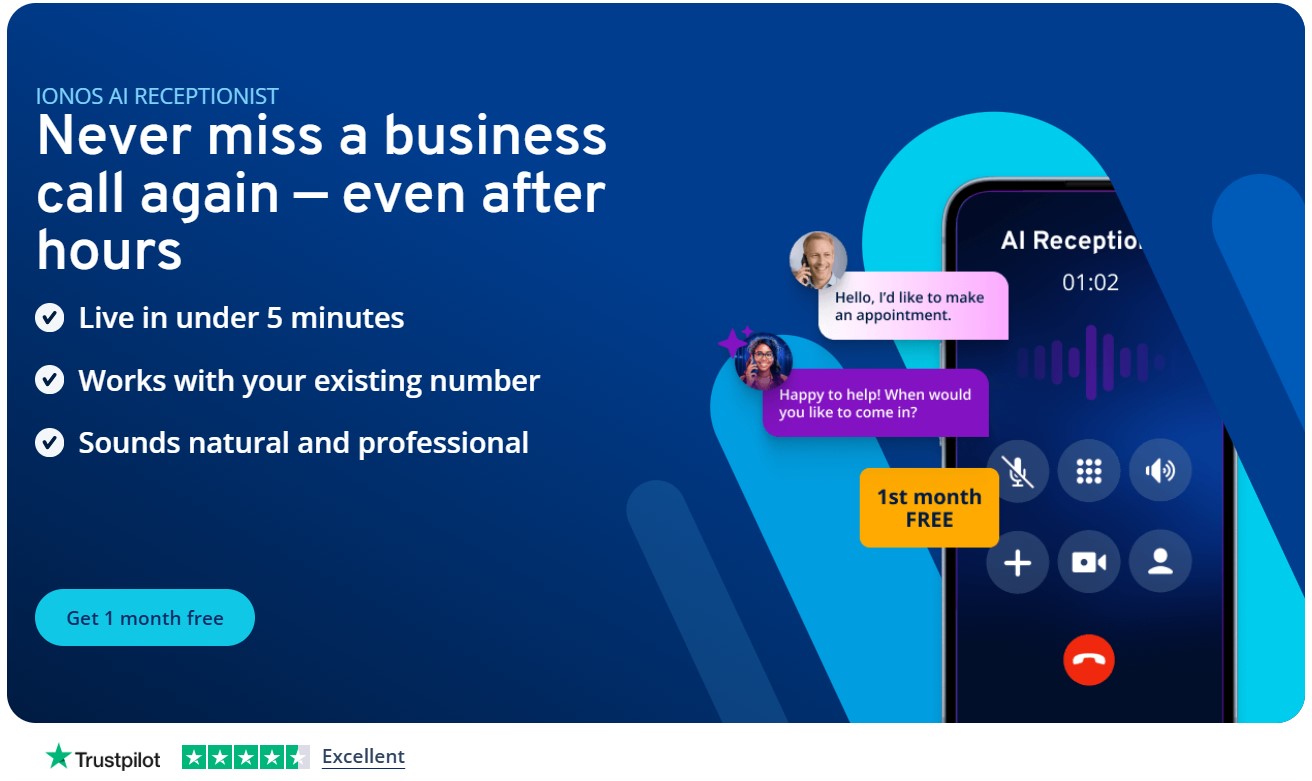
The IONOS AI Receptionist is a good fit if you regularly interact with international callers and want to handle inquiries more efficiently. During setup, you choose the voice, tone and, most importantly, the language. The assistant understands and speaks multiple languages and can address callers in either a formal or informal style, depending on your preferences.
In everyday operation, the AI tool handles calls around the clock, using configured company information and connected content sources. It asks follow-up questions and routes callers to employees according to predefined rules. After each call, you can receive an email summary to simplify follow-up. Depending on the setup and package, features such as appointment management and integrations may also be available. The service is also designed with security and privacy best practices for business environments in mind.

Reviewer

Jeanna Raffa
With over 18 years of experience in online marketing, Jeanna Raffa possesses extensive expertise in digital marketing. Since 2020, her focus has been on providing practical information regarding email, office, and cloud storage solutions.