

Augmented Reality: how Pikachu helps e-commerce

With over 75 million downloads in less than three weeks, the release of Pokémon Go made headlines all around the world. All over the world stories in the news told of hunts for the likes of Squirtle, Charmander and Co. Time and again there were reports on how augmented reality finally had its first big breakthrough. But amid all of the fanfare, one important detail seemed to go unnoticed for the most part: the technology behind Pokémon Go isn’t new at all. The term ‘augmented reality’ has been used by the computing and entertainment industry since the beginning of the nineties. What Pokémon Go managed to achieve, however, was to bring this technology to private users by making it available for anyone with a smartphone or tablet. Augmented reality presents enormous marketing potential, a fact that’s supported by the interesting wave of new e-commerce applications that have come about over the past few years: from virtual furniture stores, to fitting glasses via webcam, new approaches to this technology appear to cropping up more in more in our daily lives. And as this trend continues to grow, the industry will most likely react by releasing more and more applications. Companies that are quick to react will be able to make the most of users’ interest for augmented reality and potentially be able to tap into new customer groups.
Definition: what is augmented reality?
Augmented reality refers to any computer-assisted expansion to the way in which we perceive reality. While virtual reality users are fully immersed in their digital worlds, augmented reality simply adds digital aspects or content to the real world by relying on elements or features such as:
- The visual representation of additional information in the real world
- Adding additional information to videos or images
- Fading in virtual objects
Real living environments blend together with digital components
Virtual elements in your real environment? One simple example that most people seem to know of this comes from sports broadcasts. Often during a football game, television broadcasters add in additional information. Whether or not a player was offside is often easy to recognise, as the offside line is digitally faded onto the viewer’s screen. And when it comes to ski jumping, a digital line is projected across the screen in order to indicate to viewers whether or not the jumper has surpassed the distance of the current leading contender. In order to be able to experience augmented reality with a mobile device while on the go, one generally needs a camera, a tracking device, and the proper software. This technology can be implemented in many different areas; it can be used to help carry out complex tasks in industrial settings or can be used to support military and disaster management topics, for example. As previously mentioned, however, the entertainment industry has been responsible for most of the recent increase in attention surrounding the technology. Other fields, including architecture and medicine also employ this technology.
Augmented Reality as a new impulse in online marketing
The marketing sector has jumped on the opportunity to capitalised on increasing popularity of augmented reality components. Aside from the business argument, this new method of displaying content has the potential to add value to a customer’s product experience when implemented correctly. And this is an industry that stands to benefit from such new impulses, as it’s becoming increasingly difficult to win over new customers and retain them. This is due in part to the flood of advertisements that individuals are constantly bombarded with. Regarding the online advertising sector, the term ‘banner blindness’ is used here. What’s more, regular buyers are becoming more and more of a rarity these days, as the large selection of shops, offers, and sales means that loyalty doesn’t play much of a role any longer when it comes to shopping habits. The competition among competitors is fierce, which means that it’s all the more important to offer high-quality, innovative advertising formats. This is where augmented reality comes into play. The new formats and ideas grab customer’s attention and at the same time truly add value to the customer journey independent from the sector. As can be seen from the infographic below, almost half of the estimated potential of virtual and augmented reality falls into the entertainment sector, while a VR and AR market volume of over 16 billion US dollars is predicted for companies and the public sector.
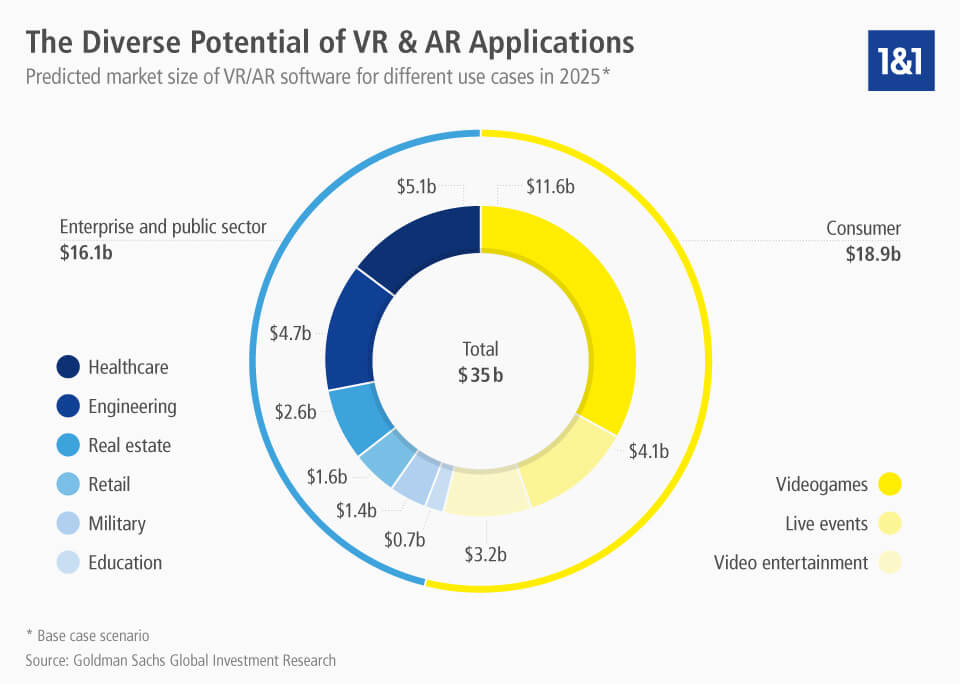
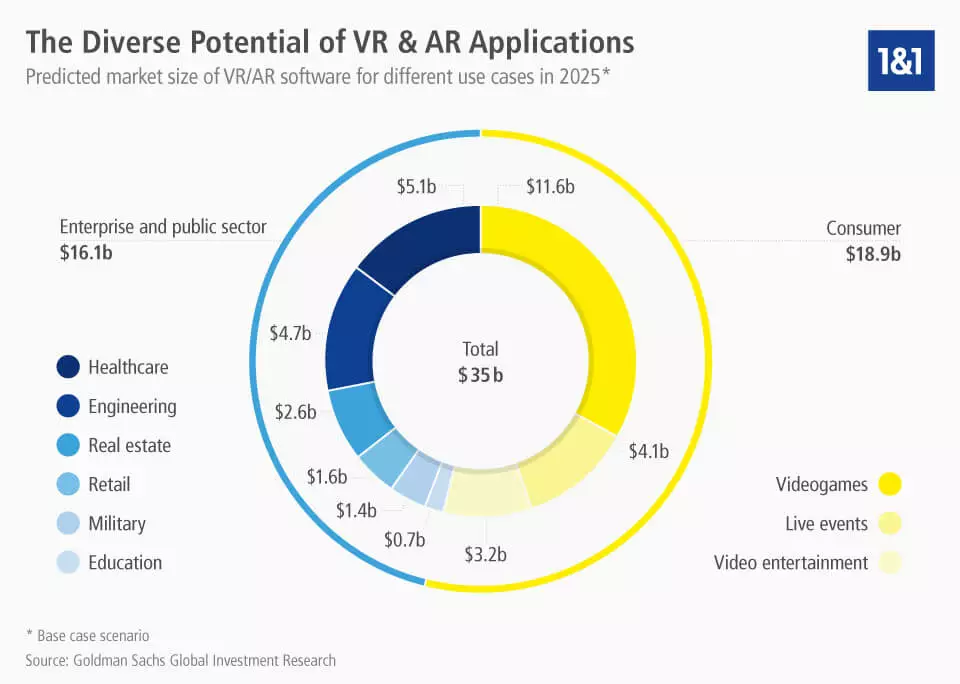
Click here to download the infographic about the prognosis of virtual and augmented reality.
How does augmented reality affect customers?
Augmented reality combines real life with digital components. When these two aspects blend together, such marketing mechanisms are able to fascinate their viewers, leaving a stronger impression behind with potential customers. But in addition to the attention that’s gained through augmented reality, this means of advertising also opens up new options for directly coming into contact with customers. Brands and businesses have the option of projecting information to their customers in real time. This tactic offers marketers the chance to get in contact with target groups on a more personal level. But why should customers be interested in allowing such interferences in their daily lives? The answer is because they too stand to gain from this increased level of contact with brands and companies, as examples from the e-commerce sector show.
Augmented reality in e-commerce
The concept of augmented reality can be used in online shops in order to optimise the customer experience. Mobile devices play a key role here. Customers are already searching more and more on their smartphones and tablets and these devices have long since become more popular than desktops. Smartphones enable access to larger target groups, so it’s understandable that augmented reality may one day be used in tandem with mobile commerce applications. Back to the applications themselves: one of the original augmented reality-based online applications for e-commerce are virtual fitting programs. With the help of a camera, users are able to see how products look that they’re interested in purchasing when superimposed over their own bodies. However, this technology carries with in the risk of making some clothing articles appear unnatural due to the way that sizes are sometimes displayed. When it comes to smaller items, however, this technology works very well. Online opticians provide a good example of how augmented reality can be successfully applied: When browsing through online glasses stores, one often has the option to try different frames on ‘in 3D’. The service is loaded via a flash application and the users only needs to allow the site access to their webcam. Glasses and sunglasses are then placed directly in front of a digital depiction of the viewer’s face.
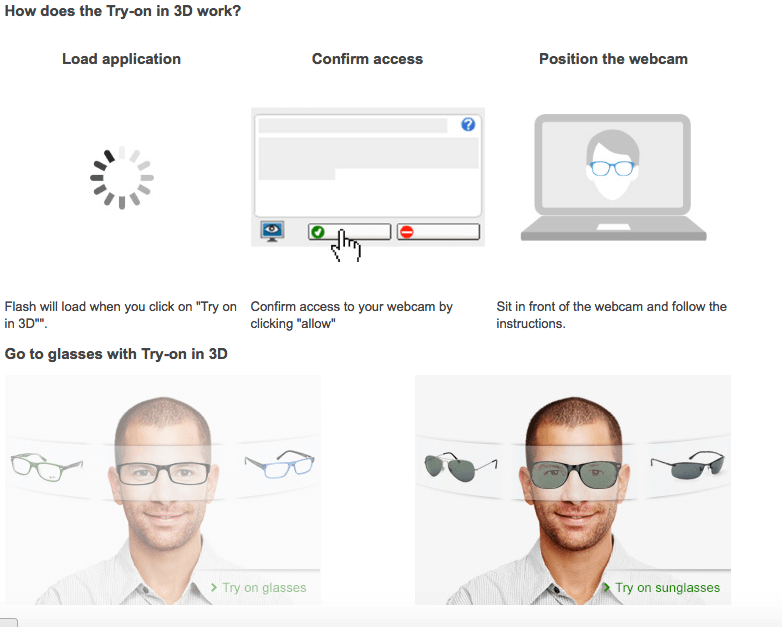
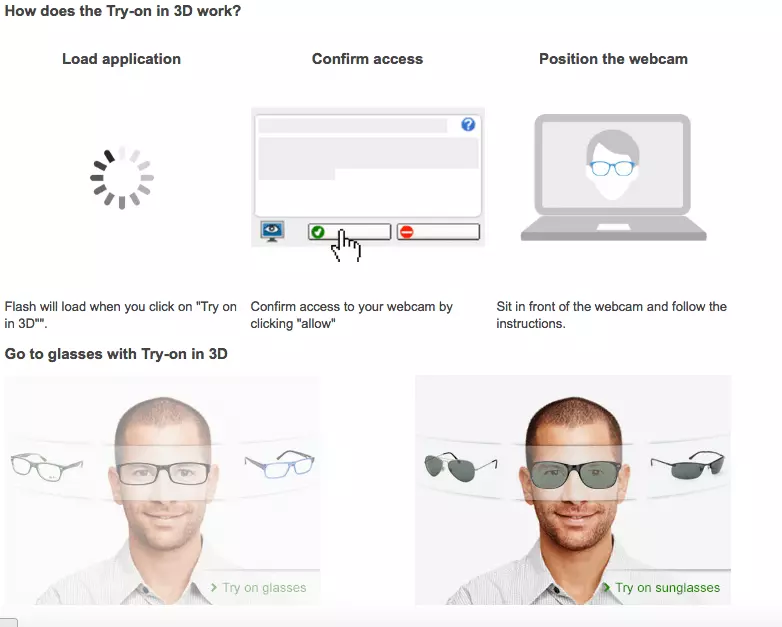
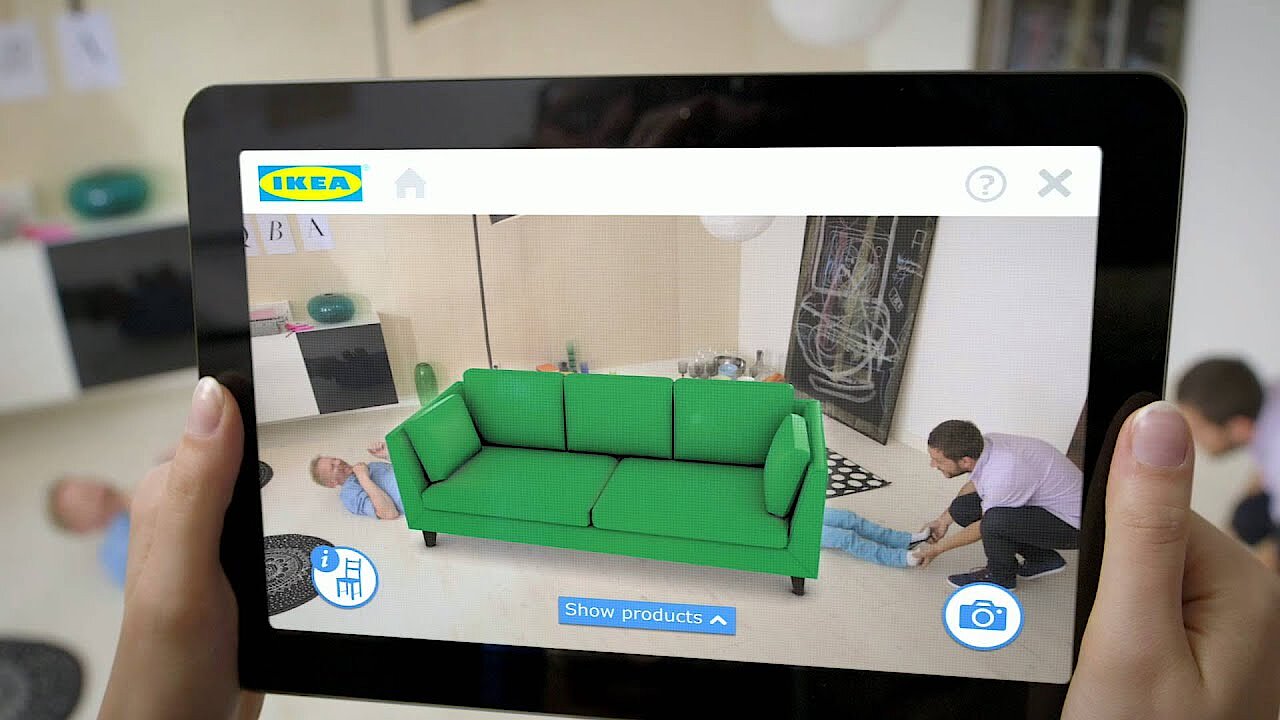
Augmented reality is also extensively used in the furniture and design industry. Known for its creative and innovative marketing and business practices, the Swedish industry giant, IKEA, began experimenting with AR technology as early as 2013. The idea here is to enable prospective customers to project furniture items from the current IKEA catalog into their own living room. True to scale, these projections allow shoppers to get an idea of how the item would look within the confines of their own private quarters.
The following video lays out how this technology works:
 To display this video, third-party cookies are required. You can access and change your cookie settings here.
Pair is a further company that is able to give perspective customers access to virtual showrooms with the help of augmented reality. The iOS app allows users to place furniture items within their own four walls. The concept is similar to that the IKEA application mentioned above but is even more advanced. Pair works together with various brands and producers and claims that its service helps customers more quickly decide upon a product, increasing the amount of augmented reality-driven sales in the process.
Pair is also an interesting tool for interior designers and architects. The app allows customers to view how the planned set-up would look within the customers’ space. Pair allows ideas to be more concretely visualised and makes planned room designs more tangible.
Prognosis: not just a fad
Many voices from the digital industry have already spoken and declared that augmented reality will be an important marketing trend for the next several years. The diverse array of approaches to this technology means that there’s great potential for expanding the reach of your products or services and enhancing your customer’s experience. Niche markets, in particular, stand to gain from this technology, as the example with trying on eye glasses shows. In any case, this technology can be implemented in many different areas, and the hype around apps like Pokémon Go only increase the notoriety of augmented reality, paving the way for future applications.
Reviewer

Melissa Senn
Melissa Senn has been with IONOS since 2016 and focuses on website, e-commerce, social media, and AI in the Digital Guide. As a digital strategist, she uses her extensive SEO and GEO experience to transform complex technological trends into practical content.