

Buyer decision process and types explained

The buying decision is at the end of the buyer decision process and refers to the decision to buy goods, services, inventions, companies or other things. The goal of a buying decision is usually to maximise benefits or sales. To understand how to plan marketing and business strategies, it is important to understand the types of buying decisions and the buyer decision process.
Buying decisions related to buying behaviour are rational or emotional decisions made individually, collectively, formally, or informally. Buying decision can refer to the final moment in the decision-making process as well as the entire decision-making process from perception to purchase. Buying decision is thus understood synonymously with buyer decision process.
What are the different types of buying decisions?
A buying decision can range from shopping in the supermarket to online shops to buying companies or services. For this reason, we do not talk about the buying decision, but distinguish between several types of buying decisions. What all buying decision types have in common: There is an overriding goal for the purchase, which is usually utility or profit maximisation. Buying decisions are also characterised by the fact that a written, verbal or tacit purchase agreement is concluded between the parties involved and tangible or intangible goods are acquired in return for payment of the purchase price.
To develop one’s own sales strategies and to understand the buying behaviour of customers, a distinction must be made between the following buying decision types:
Extensive buying decision
An extensive, i.e. extended, buying decision is defined as a comprehensive decision-making process. The rational and psychological processes and learning processes involved are deep, complex and anticipatory. Buyers take their time in the buyer decision process, making comparisons, analyses and evaluations to rule out risks and weigh up advantages and disadvantages. In most cases, targeted tangible or intangible goods are characterised by high prices and costs or involve potentially high risks. Examples are the purchase of companies, special equipment, real estate or cost-intensive technologies and special machines.
Limited/Simplified buying decision
The limited buying decision is also called a simplified buying decision because the decision-making process is not characterised by complex preliminary considerations or lengthy psychological processes. Buyers are usually familiar with the product or service category, have made a pre-selection or are guided by limited common criteria such as price level, material or awareness of brands and companies (e.g. when buying food, beverages, sanitary products or office supplies). The buyer decision process thus does not necessarily go through every step, is simplified and does not involve high financial risks or burdens.
Habitual buying decision
In habitual buying decisions, decision-making is based on habit and experience. Buyers usually target or automate products, manufacturers or service providers with which they are familiar. Prior actions such as comparisons or research basically do not occur because buying decisions are shaped by known product quality, manufacturer contacts or an optimal price-performance ratio. An example of this is the buying behaviour of regular customers or subscribers who remain loyal to a shop, manufacturer, product, service provider or brand.
Impulsive buying decision
A buying decision is described as impulsive if the purchase is triggered spontaneously, emotionally or by strong stimuli and does not require a lengthy psychological process. Financial or material risks are low. The purchase may be triggered by a sudden feeling of pleasure such as ravenous hunger, emotional triggers, lack of time, urgent need, or external influences such as special offers.
Here’s how the buyer decision process works
Sellers, businesses or service providers should not leave buying decisions to chance. Those who analyse and evaluate both the types of buying decisions and the phases in the buyer decision process can influence the buying behaviour of customers and control it through targeted marketing. Buying decision depend on cultural-social, individual, financial and psychological criteria and factors, depending on the category, situation and person. Nevertheless, they can be divided into essential phases in B2C and B2B situations as well as in e-commerce and stationary retail.
Which phases are involved depends on the phase model used to illustrate the customer journey. The five-phase model according to John Dewey and the Consumer Decision Journey (CDJ) according to McKinsey are among the most established marketing models.
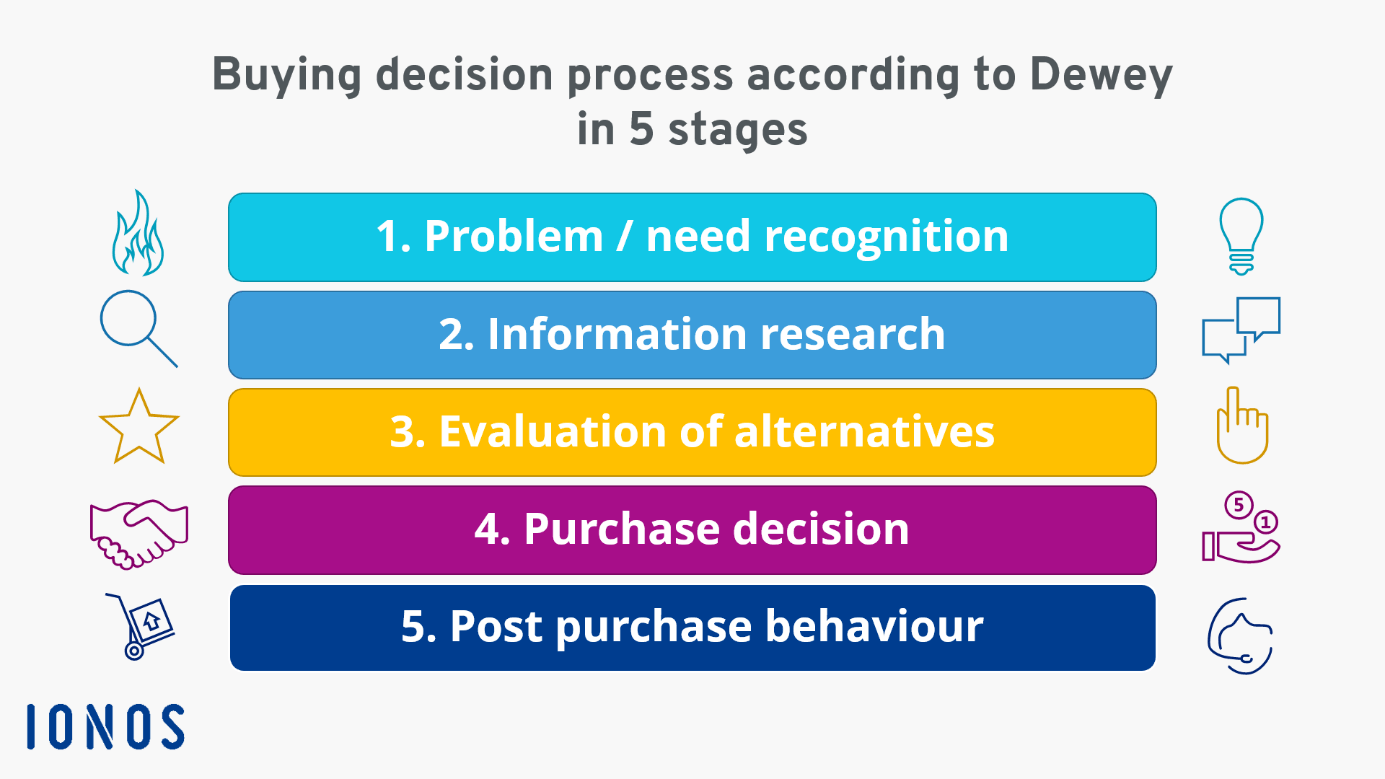
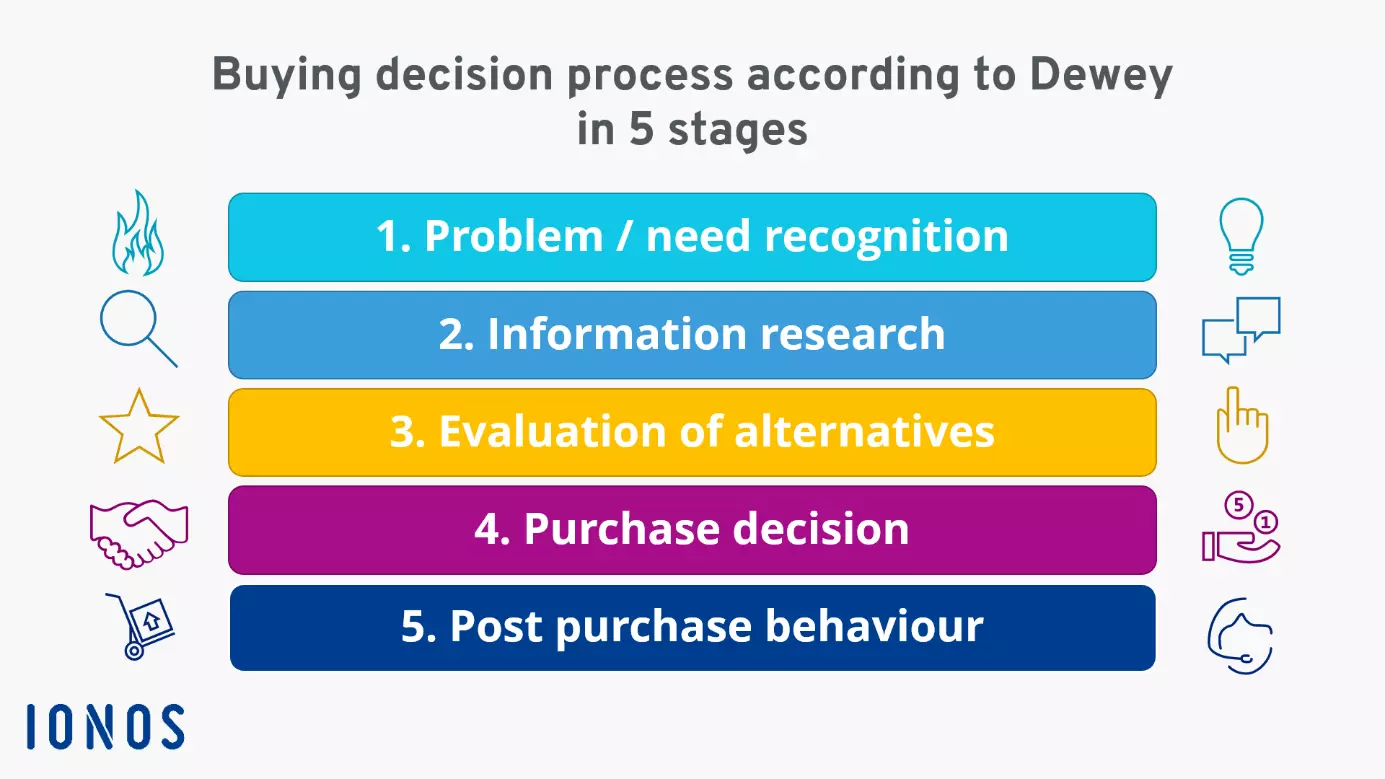
Five-phase model (Dewey)
If you want to align marketing and the evaluation of customer behaviour with John Dewey’s model, you should consider the following purchase decision phases:
- Problem identification (need): Customers and buyers have a concrete need that can be served by appropriate offers. This is stimulated or triggered by internal or external stimuli. Needs can also be specifically created through marketing and advertising.
- Information phase (research): To satisfy the need, customers go in search of information and conduct a search for suitable offers and product details. The scope of the research determines whether extensive or limited decisions are made. In this phase, decision-making from the company’s point of view can be actively influenced by a multi-channel strategy or evaluations of customer behaviour when searching for information.
- Evaluation/comparison of alternatives: Depending on the hoped-for or desired maximisation of benefits and profits, the buying decision is preceded by a comparison and evaluation of the closer choices. It is important here to communicate product features and benefits clearly and convincingly and to make them attractive through positive feedback, reviews, awards and USPs.
- Buying decision (buying act): The buying decision is the culmination of the preceding phases. The act of purchase brings about a written, verbal or tacit contract of sale. According to the American economist Philip Kotler, the decision in this phase can still be disrupted by negative feedback from other customers or by other individual factors on the part of the customer that are difficult to influence.
- Post-purchase phase (after-sales): The after-sales phase offers companies a wide range of opportunities to build customer loyalty, customer trust and customer retention, e.g. through after-sales services, customer service, product guarantees or additional information on offers such as those used by recommendation systems in e-commerce. Satisfied customers can thus become regular customers and the buying decision can become habitual.
Consumer Decision Journey (McKinsey).
The CDJ model is based on a study by the consulting firm McKinsey and maps the buyer decision process in the following phases:
- Consideration: Customers and shoppers compare offers and consider different options for a buying decision based on previous contacts or information gathered.
- Evaluation: Through various information channels, customers compare, analyse, and evaluate a selection of options. Companies can already use these channels to guide buying decisions.
- Buy: The final phase consists of the act of buying, which can be leveraged and influenced to maximise profits through flexible pricing models, low-cost shipping options, and low customer effort.
- Experience, Advocate & Bond: The after-sales phase provides multiple opportunities to make quality improvements in production, service, order and shipping processing, and customer satisfaction by following up with customers and analysing feedback.
Another model that defines phases and goals of sales-boosting marketing activities is the AIDA model. It includes the phases and advertising subgoals of attention, interest, desire, and action.
Special features of the online buyer decision process
Successfully influencing buying decisions in e-commerce depends heavily on companies knowing where their customer groups are moving, informing and exchanging information online. Anticipatory multi-channel and customer journey strategies can be used to analyse customer buying behaviour and improve visibility and reach, e.g. through customer journey mapping, customer profiles or personas and buyer personas as well as through visibility, accessibility and transparent communication. Here, it is important to know what expectations and requirements customers have of e-commerce services and online retailers.
The fact that more and more customers are making buying decisions online, makes a sustainable digital sales strategy including conversion rate optimisation and CRM in e-commerce indispensable and represents a clear competitive advantage in view of the digital information overload.
As special features of the online buyer decision process, the following customer expectations and criteria for a positive buying decision should be noted in particular:
- Convenient, free or low-cost shipping with flexible shipping times.
- Alternative delivery, shipping and delivery options
- Proven corporate strategies for sustainability and CO2 reduction
- Online reviews and digital presence/reputation of sellers, manufacturers and deliverers
- Shipping and delivery reliability
- Support for popular payment methods
- Modern online payment systems or POS systems (point-of-sale)
- High level of data protection and protection against identity theft online
- Smooth ordering and shipping processes through merchandise management systems for online shops and online shop software
In e-commerce you need a professional website. With IONOS you can register your desired domain, which offers you domain extensions as needed including wildcard SSL and domain lock.
Factors influencing a buying decision
The process of buying decision is influenced by various factors. If you familiarise yourself with criteria for a buying decision, you can use them in marketing or circumvent them, depending on the situation, to ensure an optimal customer journey and increase turnover rates.
The following influencing factors should be considered:
- Personal or emotional buying motives/incentives, e.g. physical needs such as hunger, thirst or eating habits, individual interests and preferences, technical requirements or wishes, aesthetic preferences and tastes, hygienic needs.
- Higher-level, rational purchase motives/incentives, e.g. maximum or minimum financial limits, family situations, business goals, special requirements, professional needs or equipment, hygienic demands
- External purchase motives/incentives, e.g. strategic display of products, artificial scarcity of offers, discounts, special offers, brand prestige, aesthetic/sensory marketing, word-of-mouth and customer recommendations, advertising campaigns and prominent advertisers or promoters, multi-channel marketing and omnichannel marketing
- Purchase restrictions, e.g. products or services requiring prescription, approval, or certification
- Purchase risk, e.g. preliminary financial considerations and action constraints, or safety and quality concerns of certain groups of buyers and shoppers
- Shipping and returns service, e.g. low-cost shipping including various shipping options and customer-friendly returns service