

Cross selling: the easy way to increase sales

Cross selling is an important marketing strategy to boost sales. It works by offering customers suitable alternatives to the products they are purchasing online. In this article, we’ll tell you what exactly cross selling is and how it works, the pros and cons of the method, and what you should bear in mind when using it in your web store.
- Free website protection with SSL Wildcard included
- Free private registration for greater privacy
- Free Domain Connect for easy DNS setup
Cross selling definition: what is cross selling?
The goal of cross selling is to increase sales per order by offering customers additional products or services that match their purchase. This is done either directly as part of the purchasing process – in an online store, for example, by means of overlays such as ‘Is often bought together’ – or after the product purchase via recommendation systems such as newsletters. The latter is primarily used to persuade existing customers to return to an online shop they’ve previously visited.
Cross selling: examples
Many people are familiar with this marketing method, especially in the context of online shops, but there are also cross selling examples from the offline world.
Regardless of whether online or offline, products or services are particularly suitable if they match the previously purchased product or if the need to continue purchasing arises from the purchased product. Some typical cross sales include:
- A smartphone case
- A keyboard and a mouse after buying a laptop
- A pair of training shorts to go with the football shirt a customer bought
- Care products applied by a hairdresser and subsequently offered to the customer for purchase
- A household insurance policy as a suitable supplement to the car insurance policy just taken out
- Suitable winter tyres for a new car.
In cross selling, it’s not unusual for products to be offered at cost price with high sales figures to be specifically combined with high-margin products.
Cross selling vs. up selling
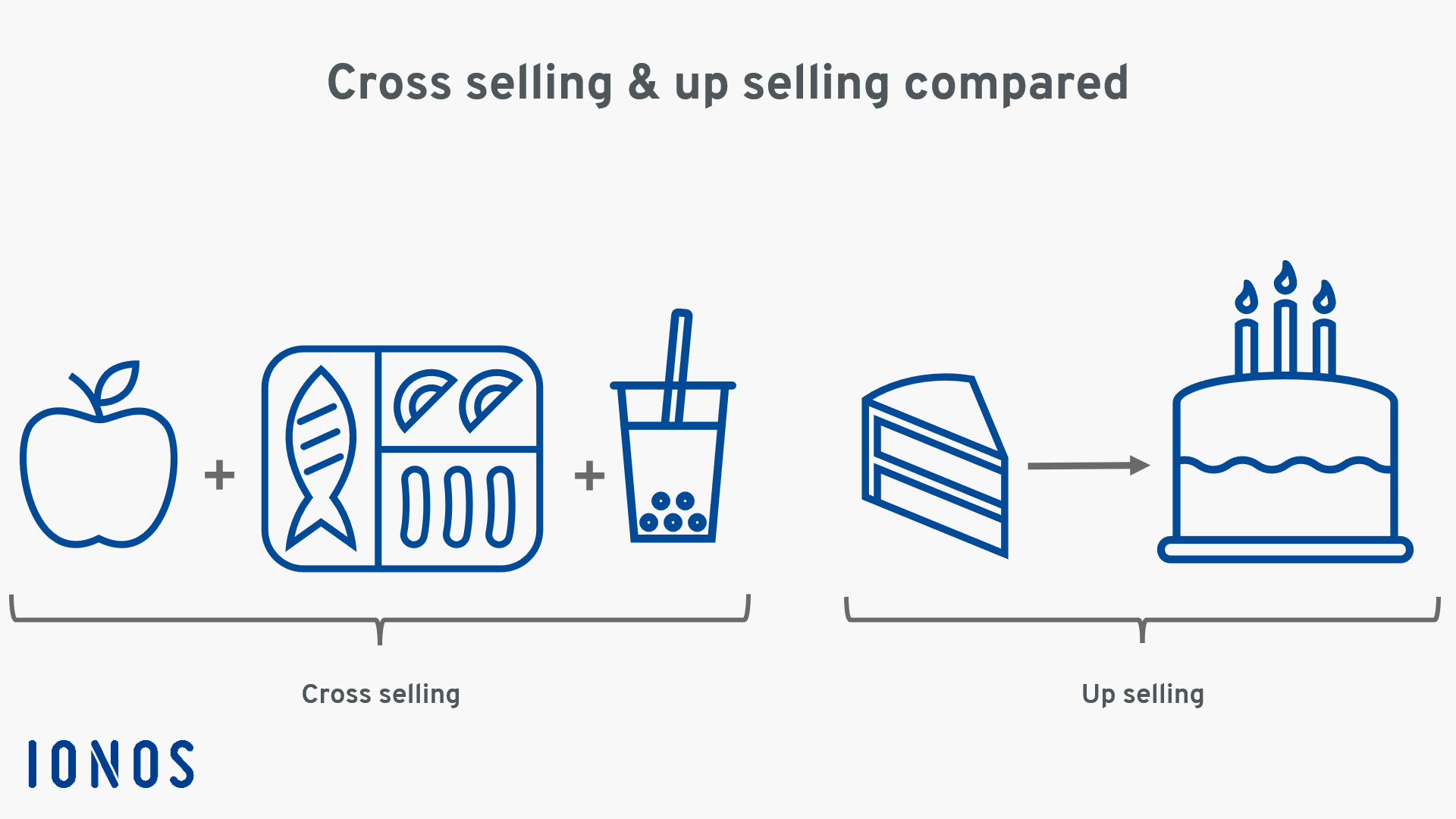
Another popular alternative to cross selling is up selling. Both marketing methods are aimed at boosting sales in brick-and-mortar retail or in online sales. To achieve this goal, however, the two sales strategies take very different paths: while cross selling aims to sell more items, up selling is about selling a more expensive variant of a product.
What are the benefits of cross selling?
When properly planned and implemented, cross selling offers real benefits not only to sellers but also customers. Retailers, for example, gain the advantage of being able to control the sale of select products or strengthen their assortment. Another advantage is that existing customers can be re-engaged. Since they are familiar with the shop and products, user acquisition costs lower. At the same time, existing customers are less price-sensitive: they are willing to spend a little more, so that even more expensive items may sell.
At its best, cross selling provides customers with real added value: being offered the right products or services at the right time via the right channel. Thanks to marketing automation, online store operators in particular do not need to keep track of each and every customer, but can automate the appropriate customer approach via the use of tools.
Launch your eCommerce business with IONOS and get a custom website created by professionals. Alternatively, you can set up your own online shop with IONOS that is fully adaptable to your scaling business requirements.
The meaning of cross selling in eCommerce
In online marketing and online retail, cross selling plays an indispensable role. It’s an opportunity for big shops with a broad product offering to introduce customers to the diversity of their product range. Besides high-end product imagery, informative descriptions, and a user-friendly structure, cross selling is considered one of the most effective tools to succeed in the world of eCommerce.
Check out our Digital Guide to find out how you can produce high-end product photos yourself.
Even novices can achieve great results and fast thanks to today’s technology: sufficient data makes it easy to (re)target customers and modern store software makes the maintenance of cross selling information child's play.
Note that offering a secure payment method in your online shop is an indispensable trust factor.
Technical possibilities for cross selling in an online shop
Depending on the shop software you use, there are usually different options for cross selling online:
- Keywords: If a customer searches for a specific product or keyword, other products and keywords are automatically linked to it and displayed to the customer.
- Item-based links: Other items are linked directly in the item’s data record in the shop system.
- Purchase and search history: Based on viewed, searched and/or purchased items, matching products are filtered and displayed to the customer. You can even use results not only based on individual customers, but also based on customer groups (with similar interests or buying behaviour) and incorporate corresponding cross sales suggestions.
Cross selling examples in the front end
As a customer, you’re probably familiar with many of the following phrases and representations of cross selling in online shopping:
- Is often bought together
- Customers who bought this item also bought
- Our recommendation
- Matching items
- Similar items
- Accessories for this item
- Best sellers or top sellers, etc.
Cross selling in online shops: tips and tricks
If you want to strengthen sales via your own online shop with the help of cross selling, there are some tips you can implement to get started:
Tip 1: Relevant cross selling bundles
Put together relevant cross selling bundles: First, analyse your product range and the purchasing behaviour of previous customers to find out what belongs or should belong together. Ideally, you will have extensive user data at your disposal, so that you don’t have to listen to your gut feeling, but can fall back on facts. In addition, always keep in mind whether you’re providing real added value to your customers and aren’t just trying to achieve the highest possible sales.
Tip 2: The right timing
Target the right customers at the right time. Here, too, user data can help you determine which customers are receptive to which offers. For example, a customer who has just bought a new computer is at a different point in their purchasing journey than a customer who already has all the accessories in their shopping trolley. CRM tools support the design of the customer journey.
Tip 3: Integrate cross selling into the marketing strategy
Integrate cross sales into your marketing mix. Often, cross selling is not only possible via your online shop or a downstream newsletter, but also, for example, when contacting customers via the service hotline or at events.
Tip 4: Integrate customers into your cross sales strategy
Get the most out of your existing customers. Establish forums or groups on social networks where customers can exchange ideas and share their experiences with your products. Influencers on Instagram and the like also often offer a lot of potential for cross selling.
Easily transform your website into a shop: Integrate the Social Buy Button and start selling your products on Instagram, Facebook, and other social sites.
Cross sales and SEO
For search engine optimisation, cross selling is an indispensable tool. Save for product descriptions, Google and other search engines crawl for little content that is used to evaluate the relevance of shop pages. Well-formulated CTAs and internal links, established by way of cross selling, are all the more important.
Today’s shop systems are well-equipped for this. Corresponding functions provide the support you need to realise a strong linking structure and ensure that all items (and also subpages) are sufficiently linked and can be easily found.
Build faster websites through prerendering and leaner hosting. Deploy them with IONOS.
Are there disadvantages to cross selling?
Less of a disadvantage and more of a danger of cross selling is that customers may perceive the cross references as inappropriate or miscommunicated. This can happen quickly when a customer is recommended the same products over and again at each step of their online purchasing journey. If, after purchasing a pair of shoes, advertisements for the same shoes appear in their email inbox, this tends to have a negative impact on customer satisfaction.
The disadvantages that can arise from cross selling are therefore mostly due to shop operators sending the wrong messages – presumably because the data at hand is being used incorrectly. Therefore, if you haven’t already done so, establish careful tracking of user data and invest sufficient time to set up a successful and sustainable cross sales campaign.
Never forget that there are customer groups that are not suited to cross selling. These could be customers who frequently return goods or complain to customer service, for example. Again, observe and analyse user behaviours to derive useful insights, and apply these to your online marketing strategy.