

How to organise sales in your web store

Your shop’s website is up and running and the products on offer are stored completely in the system. The advertising clock ticks on diligently, and your first customers find their way to your website. However, in order to maintain your success long term, you will have to plan further into the future: Sales is an indispensable part of marketing mixes.
Sales: The area within operational processes that deals directly with the sale of goods and services is known as sales. It primarily includes logistics, field service and contacts with dealers or other companies. The strategic decisions regarding distribution are collectively referred to as distribution policy.
In addition to continuously optimizing your shop in terms of offers, search engine rankings, user-friendliness and customer relationships, another long term task you need to keep in mind is being able to make all your products available to customers in accordance with the terms and conditions. All planning and measures necessary for this purpose fall within the scope of distribution policy. What possible options do you have with e-commerce? What do you need to pay attention to when organising a policy?
- Get started with stunning designs
- Grow with advanced marketing and admin tools
- Sell on social and online marketplaces
Different sales channels
Every business owner has to decide which distribution channels they want to use. In general, there are two different options: delivering directly to the end customer or going through an intermediary. Using a mix of the two can be a promising solution, especially in the e-commerce sector.
Direct sales
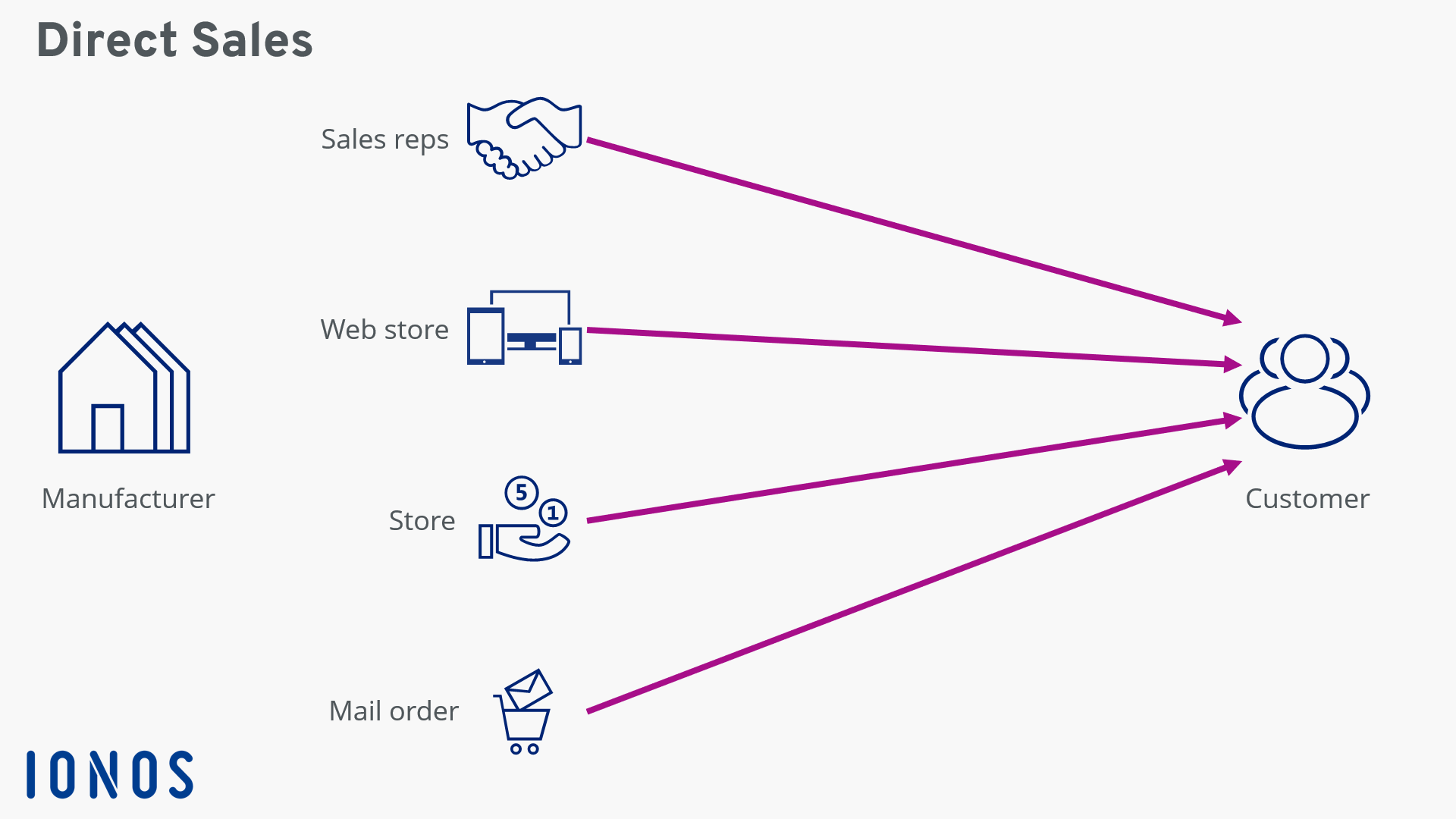
If you decide to sell your goods directly, then you are selling to the end customer. This can be done through a web store, or in a traditional store through an offline mail order service or by sales representatives at the store’s premises.
This means that you assume full responsibility for all trading functions, i.e. for the storage of the products as well as the receipt of orders and delivery. With this distribution system, you usually need storage space, which you will have to organise as efficiently as possible. Particularly when it comes to operators with a large assortment, it is recommended to use a goods management system that can help meet the logistical requirements of direct sales. There are three main options for getting your goods to your customers:
- You regulate transporting the goods yourself: These goods are centrally located in a large warehouse or multiple warehouses. You either use your own employees and means of transport, or those provided by the warehouse.
- You use a shipping service provider like DHL, UPS or Hermes to deliver the goods. Once again, you will need to have your own central storage facility. Using a shipping service provider will allow you to save on employees and transport vehicles, but you will be giving up on being able to regulate all aspects of the process that ensure punctual, reliable delivery.
- You link your online shop to local outlets where customers can pick up their goods. The goods are stored either on site in the respective branch, or in a central warehouse. You can arrange transport either through in-house employees or through the external shipping service providers already mentioned.
Direct sales are suitable for both B2C (example: online store for the customer) and B2B, for which you’ll probably need to set up a field service.
| Advantages | Disadvantages |
| ✓ Trading/profit margins remain with you | ✗ High capital requirements |
| ✓ Direct sales right to the end customer | ✗ All returns are your responsibility |
| ✗ Often a low degree of distribution |
Indirect sales
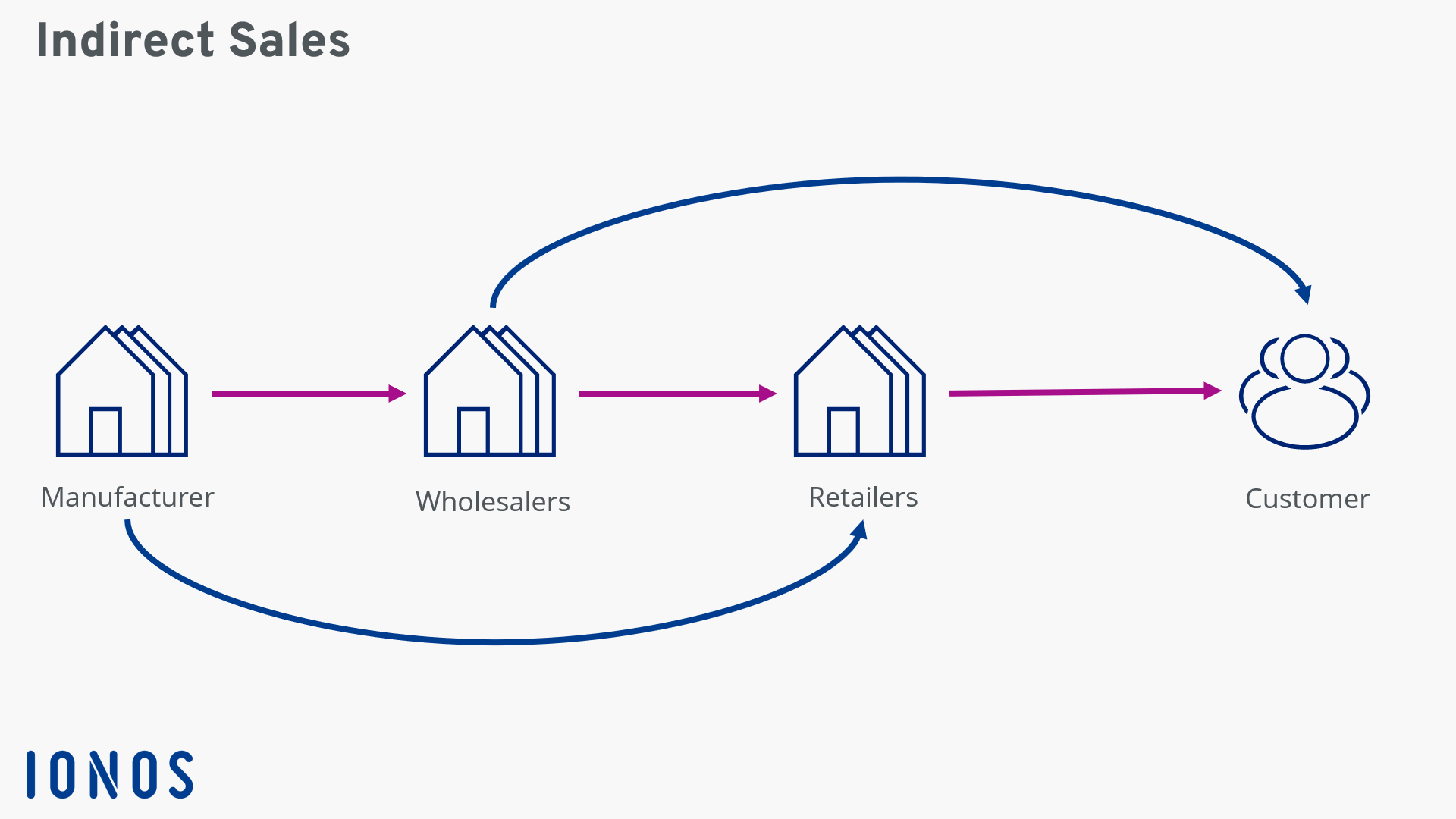
Unlike direct sales, you do not work alone when doing indirect sales. Instead, you work with non-corporate sales agents. You’ll have the choice between retailers and wholesalers, who take over all tasks for you from the moment you place the order. Contractually, you are required to record the profit share your business partner receives from the sale of your goods. This “drop shipping” (also known as route business) allows for the option of another kind of online shop, where you have no contact with the sales department: As an intermediary, you accept customers’ orders and forward them to the corresponding manufacturers.
| Advantages | Disadvantages |
| ✓ High distribution rate | ✗ Dependence on sales agents |
| ✓ High level of flexibility | ✗ Lower profit margin |
| ✓ Low equity requirements | ✗ Low control over the distribution of products and delivery |
| ✓ You don’t have to handle returns yourself |
When it comes to indirect distribution, several factors may (or may not be) be involved:
- Manufacturers
- Sales people
- Wholesalers
- Retailers
- Customers
Multi-channel sales
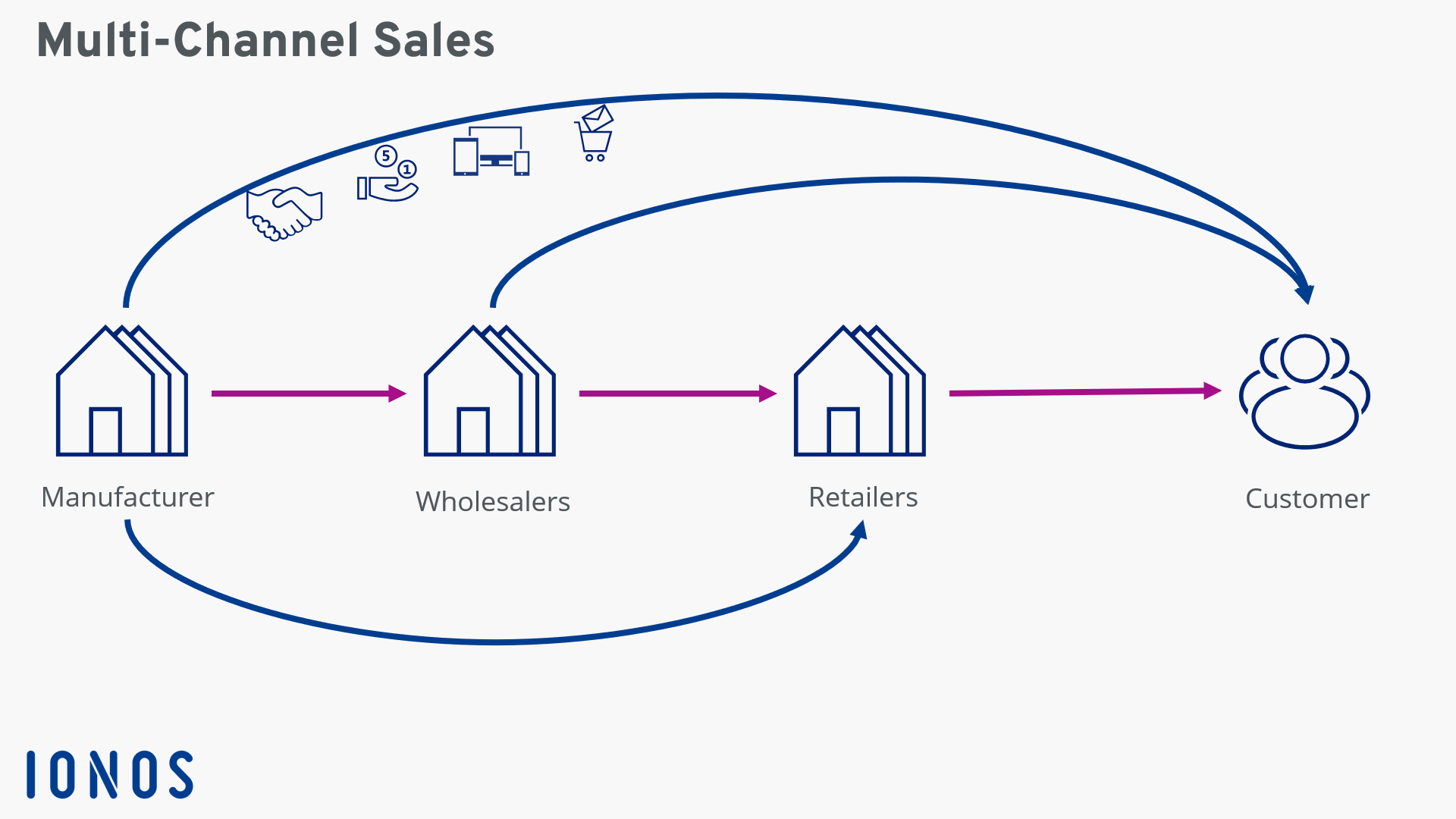
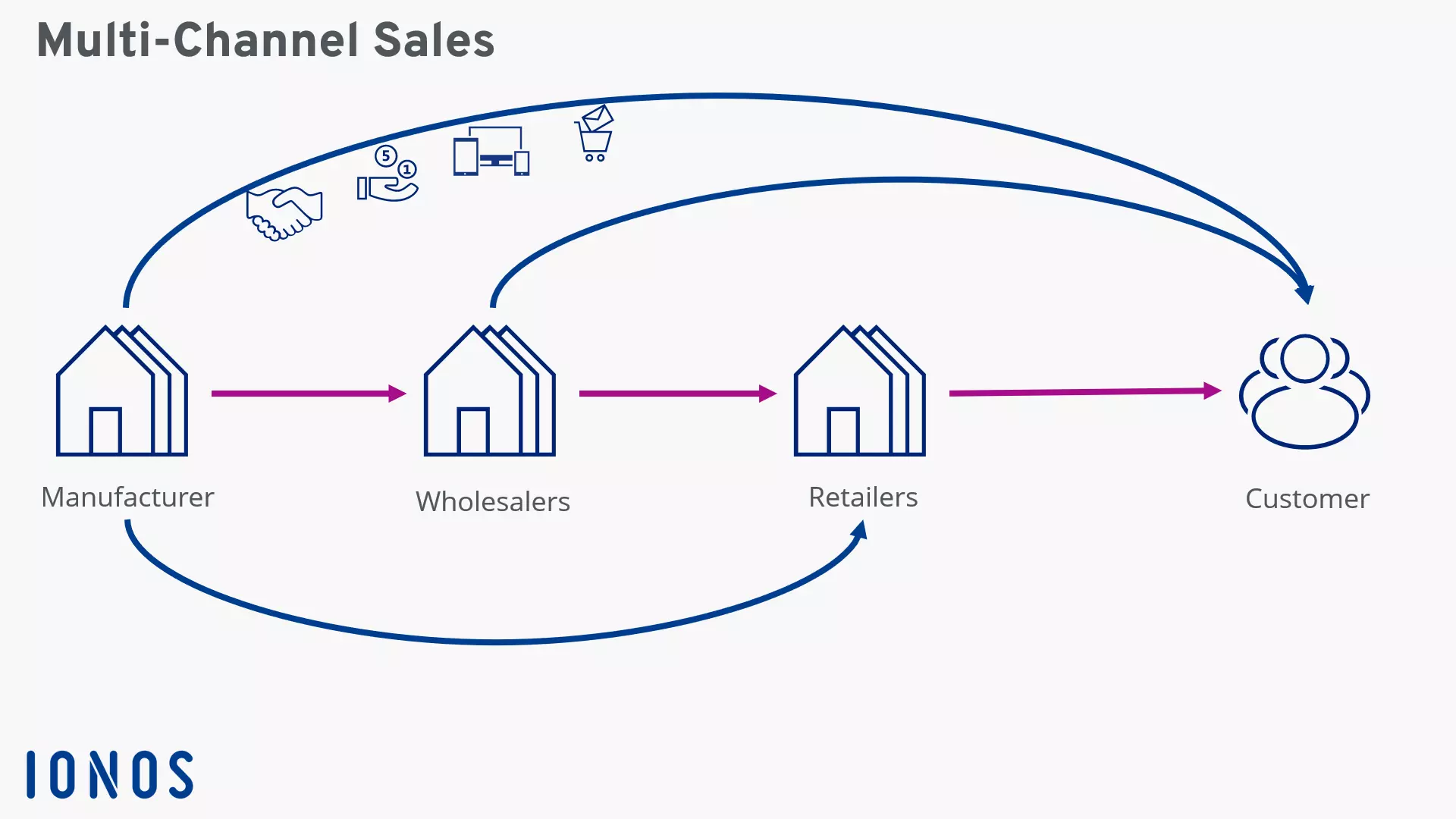
However, why choose just one? Sales can also be spread among multiple channels. Multi-channel sales use their own channels, as well as external ones, to create a mixture of direct and indirect sales. For example, you can maintain your own web store, maintain a mortar and brick store, and work with other retailers and sales platforms (e.g. Amazon) at the same time.
In this kind of scenario, you contact the final user through certain channels and offer your goods through an intermediary, which can significantly increase distribution reach. Which sales channels you should use, and to what extent depends on both the company’s goals and resources. However, there is not necessarily an increase in reach: If you already reach a large part of the target group through one channel, then a “cannibal effect” can occur when using multiple channels. For example, creating numerous stores can lead to a decline in online store sales.
It becomes particularly interesting if the product range is not exactly the same on all channels. If you adapt the selection to the sales channel and also the target group, it can often result in larger sales.
In the context of multi-channel sales, the terms “cross-channel” or “omni-channel” are also often used. This is a further development of dispersing sales channels. In classic multi-channel sales, the individual channels are treated completely separately from each other. The different points of sale have no links to each other. In cross-channel sales, on the other hand, the individual routes are closely related: The customer can order a product online and pick it up in a store. However, there should be connected warehouse management.
Omni-channel sales are a slight adjustment to the cross-channel variety. In omni-channel sales, the company tries to give the customer access to their entire range of products, no matter where they are. For example, customers should be able to browse the catalogue online while in store, where they can then buy their selected product directly.
You can also sell directly to the customer through external suppliers. Amazon and other online marketplace vendors are good examples of this.
| Advantages | Disadvantages |
| ✓ High market coverage | ✗ Possible cannibalization effects |
| ✓ Increased customer loyalty and satisfaction | ✗ High organizational effort |
| ✓ Increased brand awareness | ✗ Complex infrastructure required |
| ✓ Low effort required for warehousing | |
| ✓ More data for target customer analysis |

Tips for choosing the right sales channels
Distribution policy design can determine the success or failure of your company. Those who use the wrong channels reach fewer customers, or may not generate sales at all. To help you choose the right sale channels right from the start, we’ve put together a few tips for you.
Determine your goals
To begin with, you should be clear about what goals you want to achieve by setting up your sales distribution policy. Consider your entire policy, not just distribution itself. The purpose, of course, is to generate sales as high as possible, and therefore the highest profit possible. Instead, ask yourself which strategy approach is most appropriate for your business. Depending on the starting position, the following objectives may be suitable:
- Economically-oriented goals: Using your available funds sparingly and in an energy-saving way is a tried and tested measure, especially when you’re starting out. With this goal, you are not just setting a good price level, but also increasing sales volumes easily while keeping sales and logistics costs low.
- Ecologically oriented goals: It may be particularly relevant for your store to take into account the impact of the environment when storing and delivering your goods. Energy efficiency, emission reduction and adequate waste management play a major role here – however, something just as important to keep in mind is that the more environmentally friendly solutions often entail higher costs.
- Logistical goals: Especially if you want your store to grow quickly, logistically motivated goals should come first. The aim is, for example, to increase the degree of your goods distribution (i.e. their distribution on the market), to shorten delivery times and to optimise the reliability and availability of goods shipping.
- Competitive goals: With your sales concept, you want to do well with the competition in particular. It might even be your goal to deliberately push competitors out of the market, and you should make sure that the necessary measures do not conflict with other objectives.
Consider your business model
Not all distribution channels will be suitable for all companies. Depending on what you want to sell and what additional services you want to offer, certain sales channels may already be eliminated. An important factor, for example, is returns. If you do not have shops, and instead only use online stores as a sales channel, you have to develop solutions for return shipping, for example.
On the other hand, certain products are unsuitable for distributing through a catalogue, whether offline or online. High-priced items or very complex products are purchased by very few without having direct contact to the seller. Either you will want to inspect the product beforehand, or at least have a conversation with the vendor. Even tailor-made products in the B2B sector are rarely sold through an online store.
More information about your company and business model can be gleaned from a SWOT analysis.
Observe the target group
Target group composition is also crucial when choosing a distribution channel. Older customers are more likely to be reached through traditional, offline methods while a younger customer may prefer to make their purchases online through a mobile device. The product’s price and complexity also plays an important role in terms of the target group. As the price and complexity increase, most target groups will want personalised advice.
Observing the market
If you aren’t sure how your distribution policy should be structured, it is worth taking a look at the competition: what kind of strategy do others in the market use? A competitive analysis should only serve as a guide. There are two good reasons why you shouldn’t just copy another competitor’s strategy outright without extra consideration: On the one hand, you have to pay attention to your company’s capabilities. A market leader that has been successful for decades has other options than those of a start-up. Additionally, your company should be distinguished by a unique selling point. If you copy everything, you won’t stand out from the competition. However, if your competitors only have a few brick and mortar shops, you could probably reach new customers with a web store, for example.
Consider impact and corporate image
Different sales channels have different, serious effects. For example, direct sales via phone call can have some advantages, but many customers react negatively to these kinds of calls. Very elaborately designed shops can look high-quality but may deter customers in search of a bargain. It is precisely at this point that you can see just how important it is to choose the right sales channels for marketing.
Ideally, you can outline your company‘s performance intentions through a mission statement and vision statement.
Summary: Adapt your sales distribution policy to your goals and company
There isn’t one specific distribution channel you should definitely use. Be sure to adapt your distribution policy, bearing your goals and company in mind. Don’t forget, especially at the beginning, that you shouldn’t try too much at once. Especially when considering multi-channel sales, the sheer amount of options can cloud your overview of the company. First of all, focus on just one channel or a manageable selection, and be sure you are capable of conducting business professionally and competently within them – after all, sales is the true measurement of your company.
Reviewer

Melissa Senn
Melissa Senn has been with IONOS since 2016 and focuses on website, e-commerce, social media, and AI in the Digital Guide. As a digital strategist, she uses her extensive SEO and GEO experience to transform complex technological trends into practical content.