

Advertorials – The king of native advertising

With native advertising, companies place their ads in an editorial environment and adapt their advertising content into a mostly journalistic style, so that viewers ideally don’t notice that the intent is to advertise (the basics of native advertising are explained by this article in the digital guide). In this way, marketers can catch the attention of internet users who are otherwise affected by widespread banner blindness. The placement of good advertorials makes up the pinnacle of advertising disciplines. Anyone who manages to place high-quality and multi-valued content in the right place, and with the right approach to their target group, will benefit from the credibility and trustworthiness of the journalistic offer.
Advertisers can use the reach of respective publishers to get through to a lot of people. But depending on the product, a niche blog with a loyal audience can be worth just as much as a large news portal with millions of readers. Advertorials are an interesting form of advertising, because you not only benefit from the reach of your advertising partners, but also from their credibility. In this article, find out how to create advertorials to successfully advertise, and learn from companies who have been successful in doing so.
What are advertorials?
Advertorials are ads that are placed in an editorial setting on a website or in a magazine to give the impression that they are an editorial article instead of a paid advertisement.
The term advertorial combines the words advertisement and editorial. A classic advertorial combines the central aspects of advertisements and editorial presentation. A commonly used synonym is the word adverticle, i.e. a combination of advertisement and article.
Advertisers expect that advertorials will not be read as an ad by users, but instead as a natural editorial contribution. By using this tactic in the context of native advertising, advertisers benefit from the credibility of the corresponding journalistic site. In the best-case scenario, the reader is also given quality content that is perceived more clearly than the contained advert.
In addition, advertorials can help advertisers achieve a high level of content relevance. Publishers offer advertorial space mostly in the context of certain subject areas. As an advertiser, you simply look for the appropriately themed environment that will hopefully meet the interests of your own target group.
Critics argue that advertorials deceive the reader. This accusation of so-called ‘camouflaged advertising’ is unfortunately quite common.
Parameters, guidelines, and labeling requirements
Advertorials, often referred to as camouflaged ads, occur both in print and online. The setting determines the presentation – texts, photos, videos, and other multimedia content is possible. Theoretically, there is no limit to the design, but advertisers have to adhere to rules and guidelines if they want to enhance their marketing mix with advertorials. Clear guidelines are set by the ASA, or Advertising Standards Authority, to separate editorial content from advertisements. The separation is not only structural, but also has to be clearly recognizable by readers. Advertisers must make sure that their contributions, which may be stylistically adapted to resemble the publisher’s environment, are clearly marked as advertisements. In print, most markings take the form of a supplement (“advertisement” or “advertising”) at either the top or the bottom of the page. For online ads – whether on a large news site or a small blog – the phrase “Sponsored Link,” “Sponsored Post,” or “Advertisement,” is displayed on the page. There are guidelines and labeling requirements, but of course there are also many black sheep in the advertising industry who exploit the legal gray areas.
Google’s view on Advertorials
For many marketers, the webmaster guidelines of Google are almost equal to any FTC or press law. Whoever wants to become successful on the internet and stay that way is dependent on organic traffic from Google’s search engine – and so needs to play by their rules. First, advertorials need to be distinguished from so-called guest articles. Especially among bloggers, guest articles are often used as a classic link exchange or link purchase to improve their own backlink profile. But anyone who does this too much is risking punishment from Google. Using advertorials lowers the risk – if you behave correctly as an advertiser. Detailed information and explanations about link building and the meaning of PageRank and backlinks can be found in our advice on the topic of “SEO basics: link building tips”. Google insists on the principle that paid links don’t apply on PageRank, and so cannot influence the search engine rankings. Advertorial links must be distinguished with the attribute rel=”nofollow”. The Google crawler doesn’t use links with this attribute to calculate the link popularity. A nofollow-link also doesn’t enhance the link popularity of the linked website and procures no advantages for it in the Google rankings. More importantly, the clear identification of paid articles conforms to Google’s principles of readability. It must be obvious to users that the article or link are paid for. The identification should be easily understandable and clearly visible. How Google judges the use of advertorials is explained by Matt Cutts of the Google Webspam team in this video:
 To display this video, third-party cookies are required. You can access and change your cookie settings here.
 Advertorials in the marketing mix
When it comes to the backlink profile and PageRank of a site, of course follow-links are preferred, as nofollow-links are rather irrelevant for SEO. At first sight, they don’t send any relevant signals, don’t pass link juice, and have no positive influence on the search engine ranking.
But nofollow-links have another meaning in the search engine optimisation, as they indirectly provide additional visibility. This happens indirectly through other publishers, such as magazines or blogs, which are attentive to the customer and write about it or share the content. In the second instance, advertorials offer an opportunity to generate organic traffic. The prerequisite is, of course, that the advertorials are placed on large-scale pages and attract a lot of attention. The quality of the content is also an important factor. Quality, targeting, scale, and budget are crucial when it comes to whether or not an advertorial has the desired outcome for a business.
Advertorials are well suited to strengthen the branding of products or businesses. In combination with other marketing strategies, you can push a specific topic across several channels and place your products in an appropriate context. With the support of social media marketing, you can use this method to attract attention to a product or brand via the internet.
5 tips for good advertorials
Correctly implemented advertorials can significantly enhance the marketing mix. Advertorials offer businesses a way of getting around the so-called banner blindness that so many users have developed, while helping businesses better reach their target groups. If an advertorial is professionally designed and well written, it won’t be perceived as an advertisement. So how do you design a good and informative advertorial? The following 5 areas are of particular importance:
1. Topic relevance and target group appeal
Topic relevance is important in two regards: Firstly, it’s obviously important which topics are covered on the website or blog on which the advertorial is displayed. The main focus of the journalistic content on the site should be captured as much as possible in the advertorial. If not, the article will appear totally foreign to readers. On the other hand, the challenge is to find a possible cross-relevance to address the target group of the respective websites, even if they don’t necessarily completely match the subject of the product.
2. Content with added value
Adding value to content means addressing the user. An advertorial shouldn’t be an obvious advertising contribution, which places a product and its promotion as its focus. But offering information with added value, and finding interesting facts about companies and products that go beyond classic press and public relations content, is not always easy. In addition to precise and detailed information, the user and the target group should also be central to an advertorial. Try to bring things about both the company and the product together in a relevant context – and then answer likely questions of potential customers, or solve any common problems.
3. High quality content
Quality is also crucial with advertorials. Error-free, well-structured, and web-optimised texts are obviously a requirement for native advertising. Equally important as the use of media is a correct and clear structure. Working with lists or bullet points can help, and allows certain data to be accented. With all formatting, of course, you can’t forget to keep the common thread of the text in mind.
Online readers are more impatient, and it’s more difficult to convince them to give an article their full attention. Reading behaviour on the internet is usually different from offline reading, and presents marketers with its own challenges for the optimisation of advertorials.
4. Photos and multimedia content
The use of photos and multimedia content such as videos, slideshows, or animations is particularly recommended for advertorials. A photo or a video loosens up the text and should, if possible, add value and information for the reader.
For example, you can illustrate complex issues that are difficult to explain in the text through infographics. Videos can also provide the reader with deeper insight and make content more memorable.
Important: Photo and video material should always be high-resolution. The principle of high-value content doesn’t only apply to information content, but also to multimedia use.
5. Identification
It cannot be stated enough that the identification of advertorials is vital. If you don’t want to violate ASA regulations or Google’s webmaster guidelines, then a paid article must be identified as an advertorial. A clear separation between editorial content and paid content should be visible to users through a reference such as “ad” or “sponsored” placed in a noticeable manner. In the following advertorial examples, we will show you how to implement a professional advertorial with sufficient labeling and nofollow-links.
Best practice: Advertorial examples
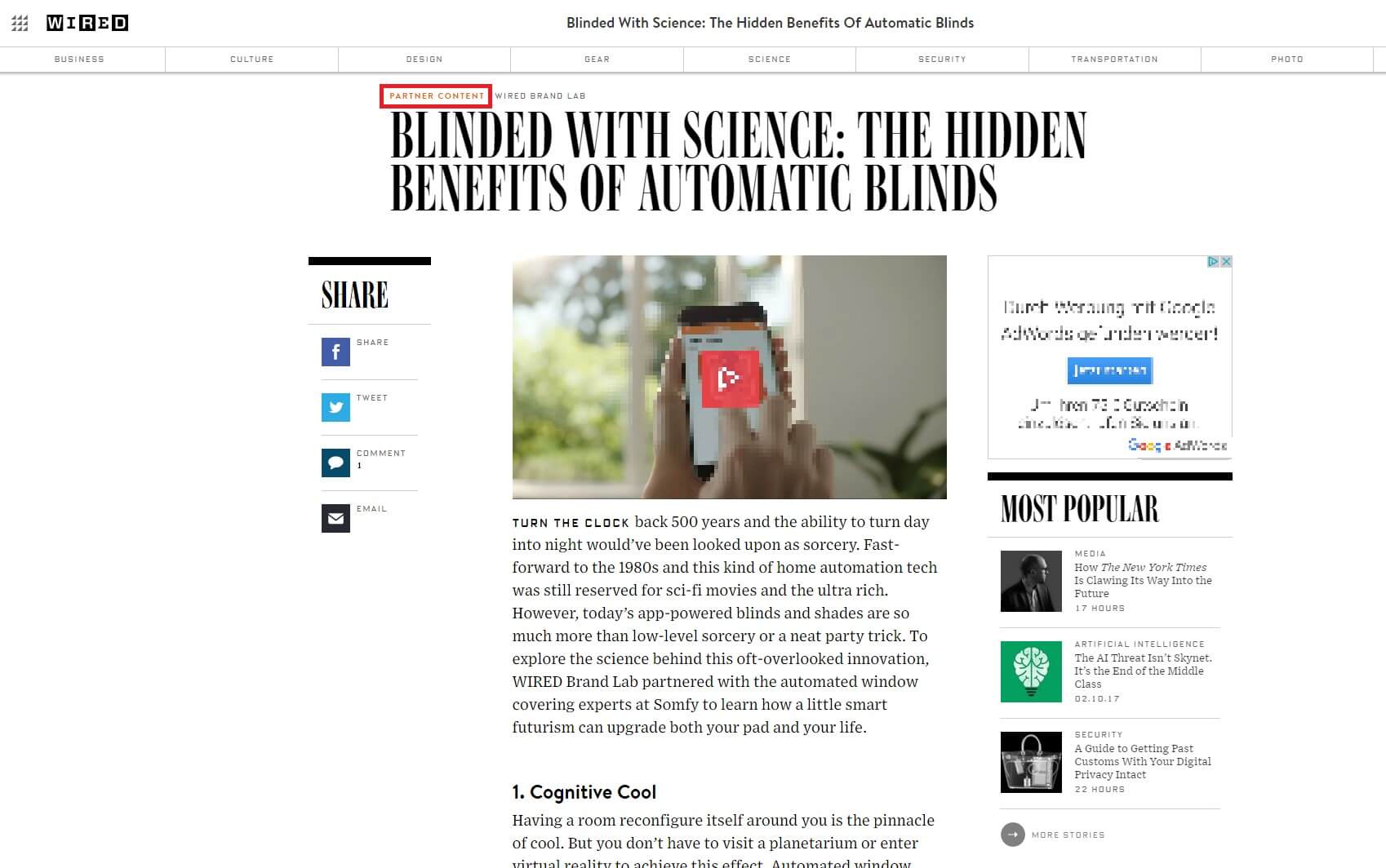
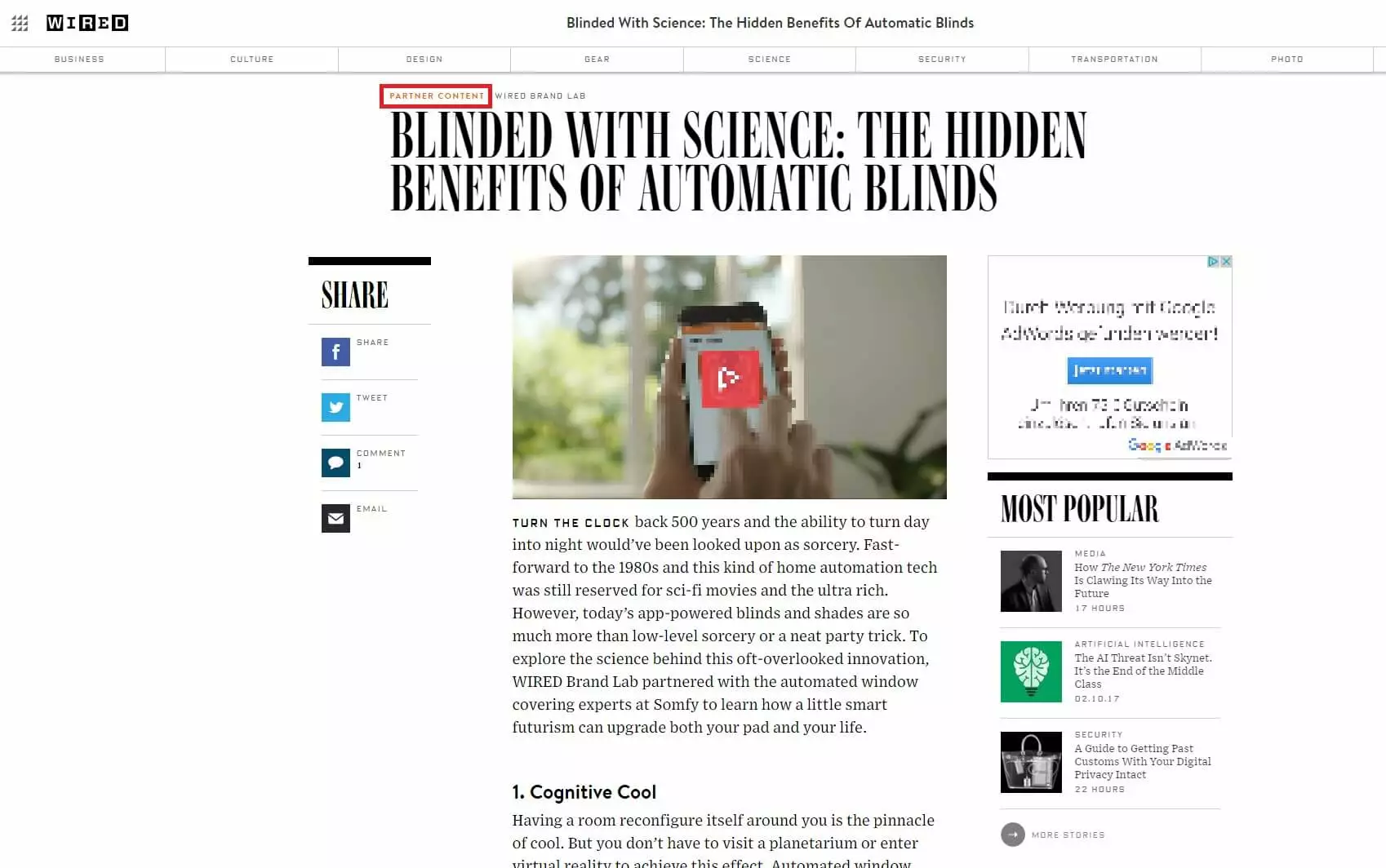
Our first example for the correct implementation of advertorials comes from Wired Magazine. The technology magazine is available both online and in print, and as a publication of Condé Nast, does a decent amount of work with advertorials. Customers can pay for web presence and collaborate with Wired staff to publish marked articles. Because texts are produced in collaboration, it helps the magazine avoid pure advertising or press releases. In the news stream, articles are marked as “Sponsored Content” or “Partner Content”. The label also appears on the article page, and a disclaimer is printed at the bottom of the content to declare that the text was written by the magazine in collaboration with the sponsor brand. The page is imbued with the nofollow-attribute as well, in accordance with Google’s guidelines.
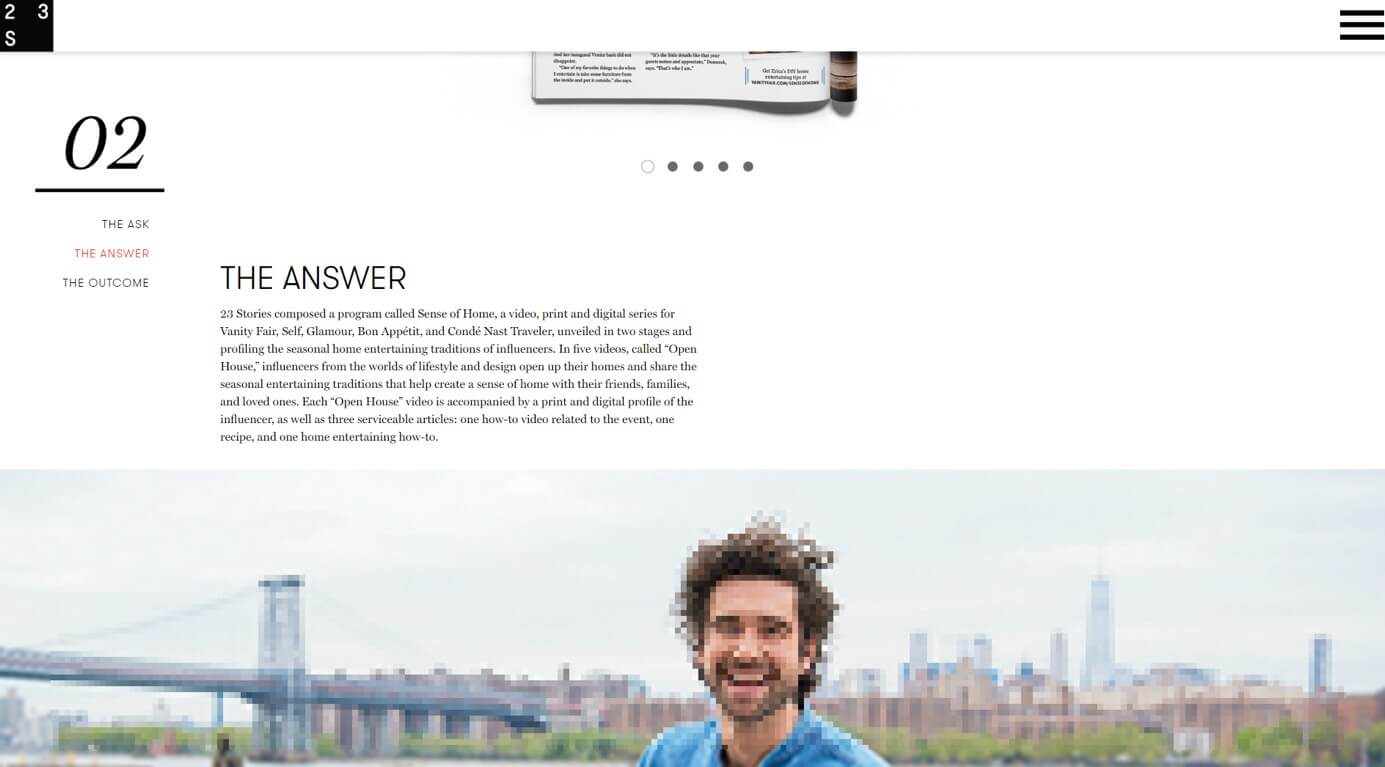
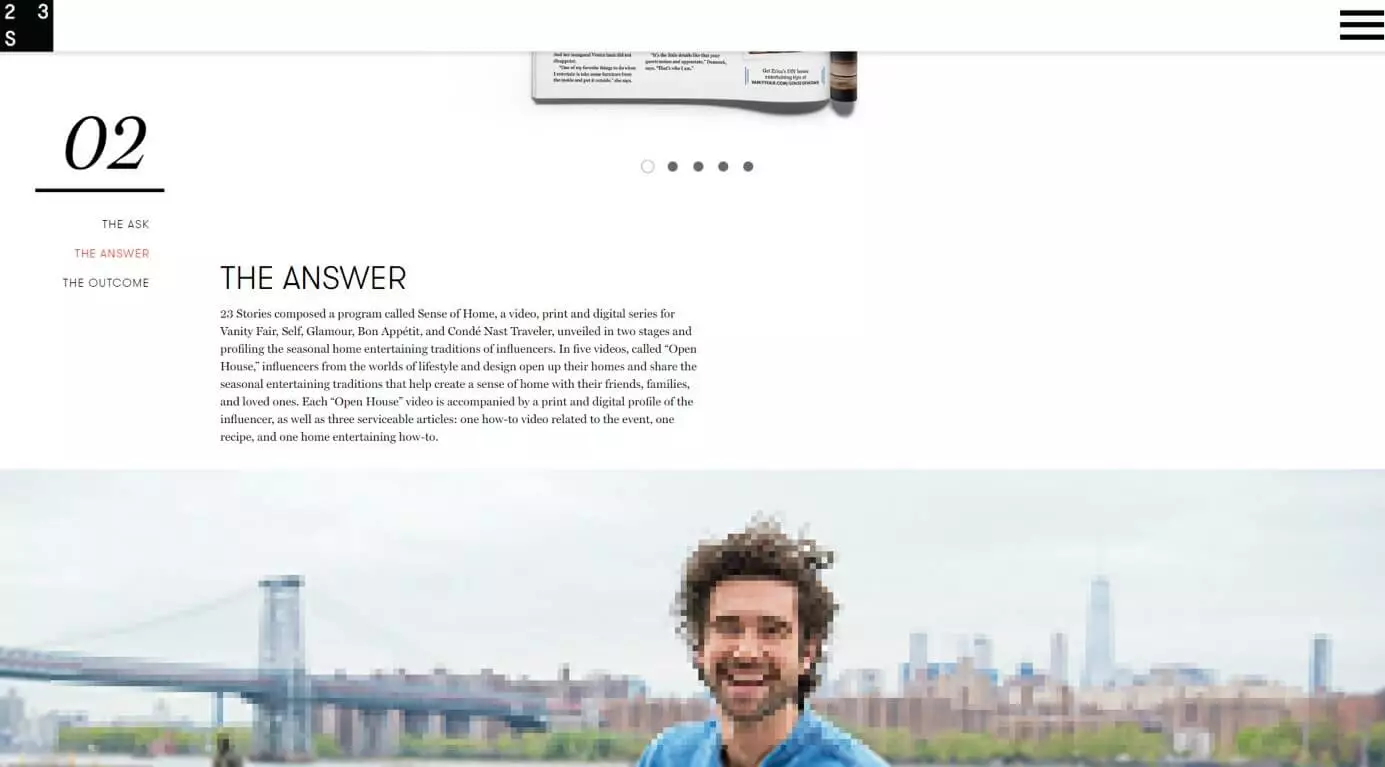
On the online publication 23 Stories started by Condé Nast you can also find advertorials; in fact, the site is devoted to them. 23 is where customers can go to have their story told by the editorial team at Condé Nast, and have their content published to the entire reach of the Condé Nast brand family. Their editorial team helps to create content and then distributes the sponsored texts or multimedia products to their publications that best suit the product. The advertiser not only gets use of Condé Nast’s considerable reach and their base of loyal viewers and readers, but also is helped by the expertise of the publication’s marketing team.
Bloggers must also adhere to the given guidelines, even if their native advertising operates on a much smaller scale than at large publications such as 23. When publishing content sponsored by an advertiser, it is just as important for blogs to declare the difference. The blog “The Pioneer Woman” commonly posts sponsored giveaways and product reviews, and so it is equally important for the blogger to declare when posts are not sponsored to avoid confusion and possible guideline violations.


Advertorial pricing
Many companies ask themselves, of course, which price bracket a campaign with professional advertorials is in. But numerous factors affect advertorial pricing, and a sweeping, all-inclusive answer doesn’t exist. Naturally, the main factors are the scope and trust of the publisher. A nationwide and wide-ranging medium such as GQ is obviously in an entirely different price segment compared to a small niche-blog. Most publishers don’t display a fixed price on their websites, and instead only give quotes on the back of individual requests. An important factor in the question of cost is whether the advertorial is created by the editorial team of the publisher, or if it’s created by the advertisers themselves. If you use the editorial resources of the publisher, the advertorial cost will obviously be higher.