
What is edge computing?

The Internet of Things (IoT) is all around us, with devices generating continuous data that needs to be stored, and for critical applications, evaluated in real time. Edge computing evaluates this data directly at the source, bringing about a paradigm shift in the age of cloud computing.
What is edge computing? A definition
Edge computing is a design approach for IoT environments that provides IT resources like storage capacity and computing power as close as possible to the devices and sensors generating the data. Edge computing is an alternative to traditional cloud solutions with central servers.
The term ‘edge’ alludes to the fact that in this approach, data processing does not take place centrally in the cloud but instead in a decentralised manner at the edge of the network. Edge computing is intended to provide what the cloud has not been able to offer so far: servers that can evaluate mass data from smart factories, supply networks or traffic systems without delay, allowing them to take immediate action in the event of an incident.
Edge computing basics at a glance
Edge computing uses established technologies in a compact design under a new name. Here is an overview of the most important terms of edge computing:
- Edge: In IT jargon, the ‘edge’ is the edge of the network. However, which components are assigned to the network edge depends on the situation. In telecommunications, for example, a mobile phone can be the edge of the network; in a system of networked, autonomously driving cars, the individual vehicle.
- Edge device: Every data generating device at the edge of the network functions as an edge device. Possible data sources are sensors, machines, vehicles or intelligent devices in an IoT environment. This could be, for example, washing machines, fire detectors, light bulbs or radiator thermostats.
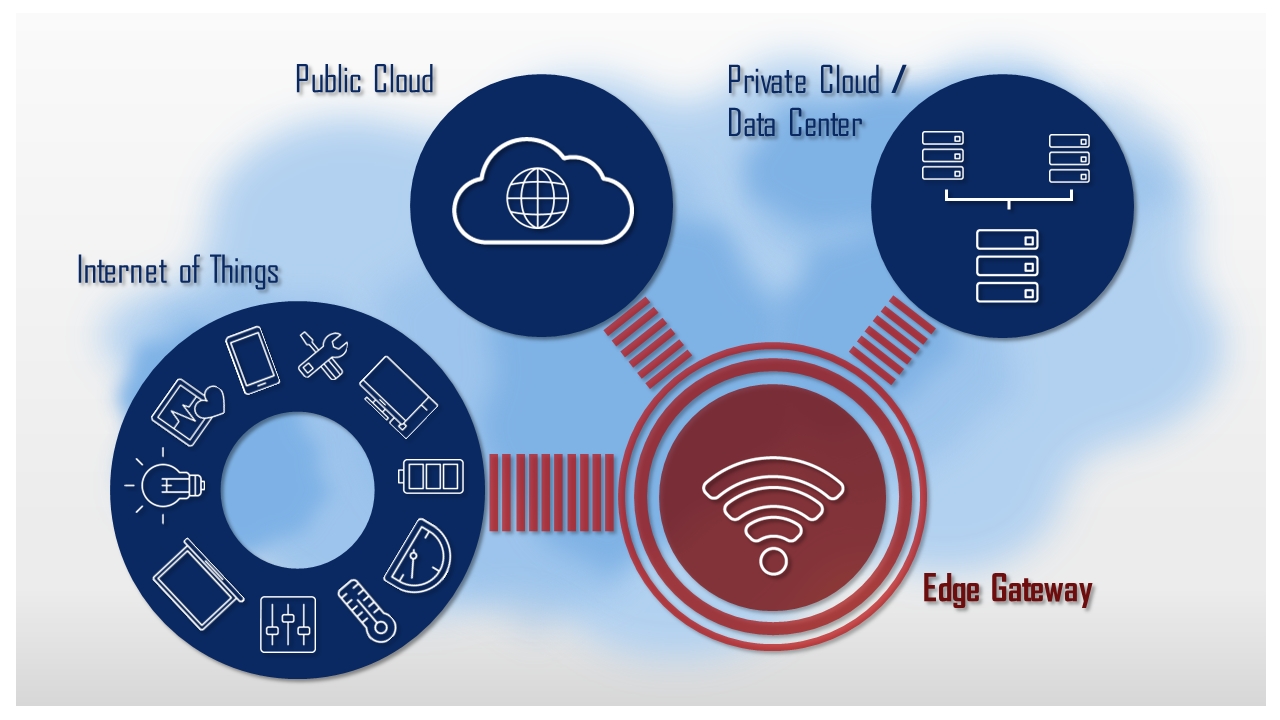
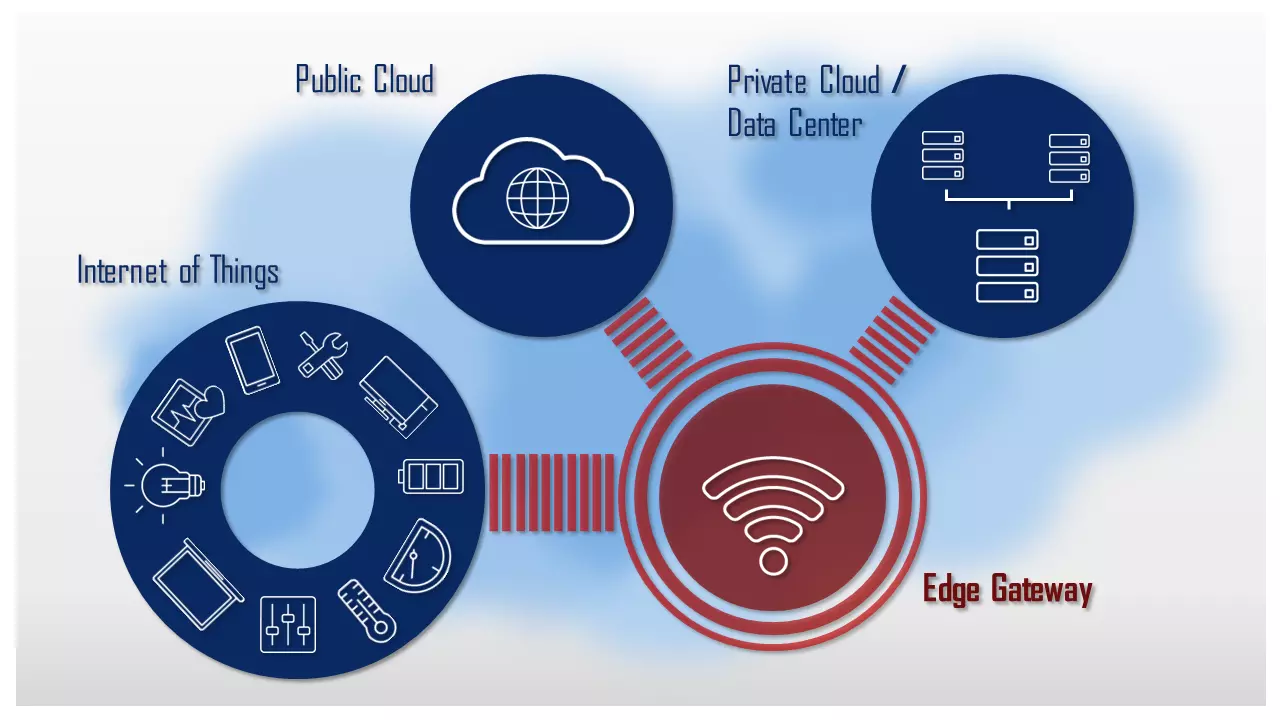
- Edge gateway: An edge gateway is a computer located at the transition between two networks. In IoT environments, edge gateways are used as nodes between the Internet of Things and a core network.
Edge computing vs fog computing
Adding local processing instances to the cloud is not a new approach. As early as 2014, the US technology group Cisco established the marketing term ‘fog computing’. Data generated in IoT environments is no longer sent directly to the cloud, but is first consolidated in small data centres, evaluated and selected for further processing steps.
Today, edge computing is seen as part of fog computing, where IT resources like computing power and storage capacity move even closer to IoT terminals at the edge of the network. A combination of both concepts is also possible. The following graphic shows an architecture with cloud, fog and edge layers.
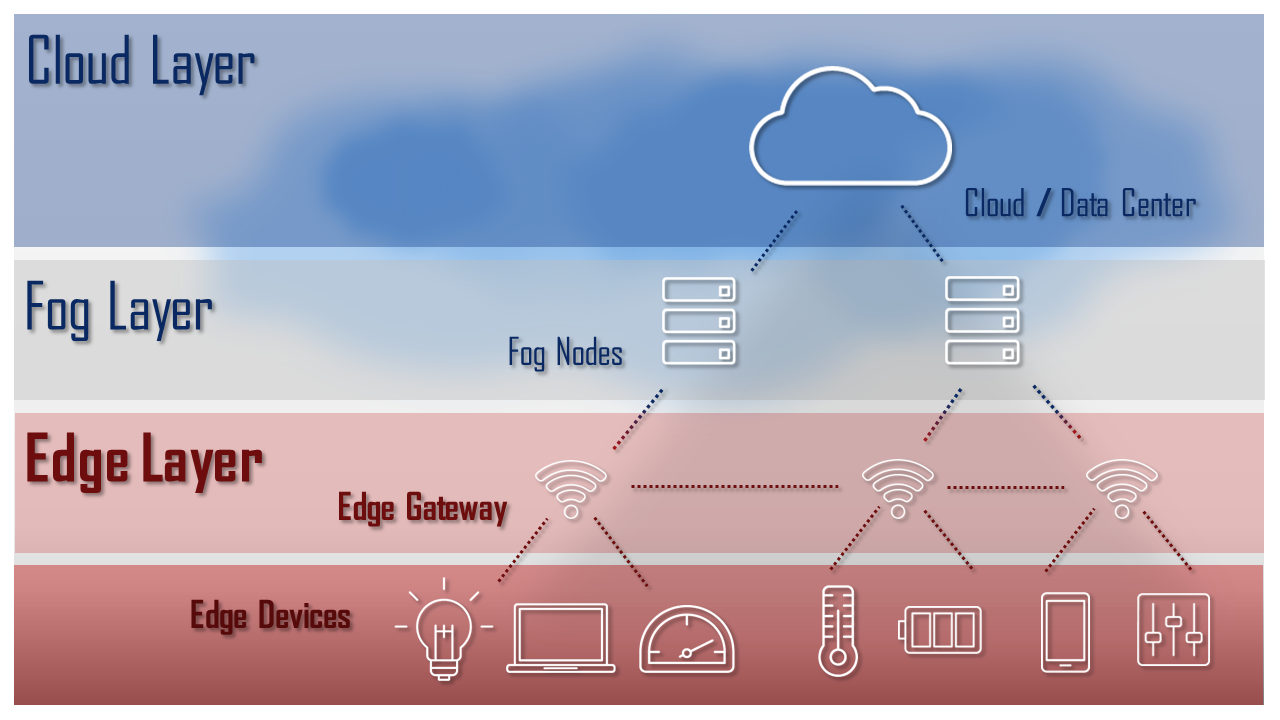
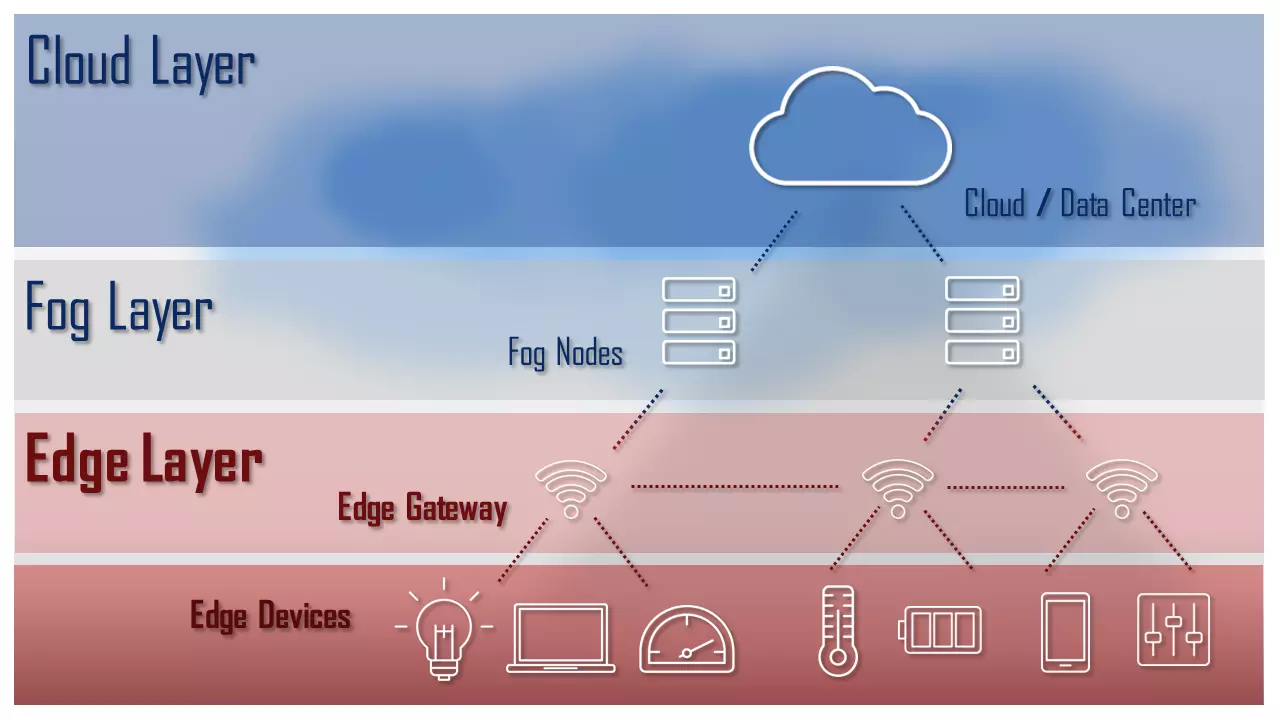
Reference architectures for fog and edge computing environments are being developed as part of the Open Fog Consortium, an open consortium of industry and academia.
Why choose edge computing?
Currently, central data centres carry the majority of the data load generated by the internet. Today, however, data sources are often mobile and too far away from the central mainframe to ensure an acceptable response time (latency). This is particularly problematic for time-critical applications like machine learning and predictive maintenance.
Predictive maintenance is set to revolutionise the maintenance and management of future factories. The new maintenance concept is designed to detect risks of defects using intelligent monitoring systems so that issues can be identified before an actual defect occurs.
Edge computing is not seen as a replacement, but as a supplement to the cloud, which provides the following functions:
- Data collection and aggregation: Edge computing relies on data collection close to the source, including pre-processing and data pool selection. Uploading to the cloud only takes place if information cannot be evaluated locally, detailed analyses are required, or data is to be archived.
- Local data storage: For large numbers of data, real-time transmission from the core data centre in the cloud is usually impossible. This problem can be circumvented by storing corresponding data decentrally at the edge of the network. Edge gateways act as replica servers in a content delivery network.
- AI supported monitoring: Edge computing enables continuous monitoring of the connected devices. Combined with machine learning algorithms, status monitoring in real time is possible.
- M2M communication: Edge computing is often used in conjunction with M2M communication to enable direct communication between networked devices.
The following graphic illustrates the basic principle of a decentralised cloud architecture, in which edge gateways act as an intermediary between a central computer in the cloud and IoT devices at the edge of the network.
How can edge computing architectures be used?
Uses for edge computing usually originate from the IoT environment. An important growth driver for edge computing technology is the increasing demand for real-time capable communication systems. Decentralised data processing is, for example, classified as a key technology for the following projects:
- Car-to-car communication: Edge computing is important for cloud-based early warning systems or autonomous means of transportation.
- Smart grids: Thanks to decentralised energy management systems, electricity grids should be able to adapt to power fluctuations. Data that is transported to generators makes it possible to react to changes in consumption in real time.
- Smart factories: Self-organising production plants and logistics systems can be implemented with edge computing.
What are the advantages of edge computing?
Compared to traditional cloud architectures, edge computing offers a number of advantages:
- Real-time data processing: Processing takes place closer to the data sources, helping to avoid issues with latency.
- Reduced data throughput: Due to local data analysis, significantly less data needs to be transferred across the network.
- Data security: Compliance requirements can be implemented more easily.
What are the disadvantages of edge computing?
Despite the many advantages, there are also disadvantages to edge computing that should be taken into account during implementation:
- More complex network structure: A distributed system is more complex than a centralised cloud infrastructure.
- Acquisition costs: Edge computing requires a lot of local hardware and therefore comes with enormous acquisition costs.
- Maintenance costs: Due to the large number of components, both maintenance and administration costs cannot be ignored.