

How to optimise for Voice Search (SEO)

Voice search is becoming more popular each year, increasing the importance of optimising it to help your target audience find you more quickly. Discover the latest advancements in voice search SEO and explore potential optimisation strategies for your website.
- The easy way to get your website online quickly
- Build your brand with your own domain name and email
- Includes maintenance and updates after your site is live
What is voice search SEO?
Voice search, like the one used on smartphones, significantly influences Google’s search algorithms. Which is why it is advisable to optimise your website for voice search, also known as voice search SEO.
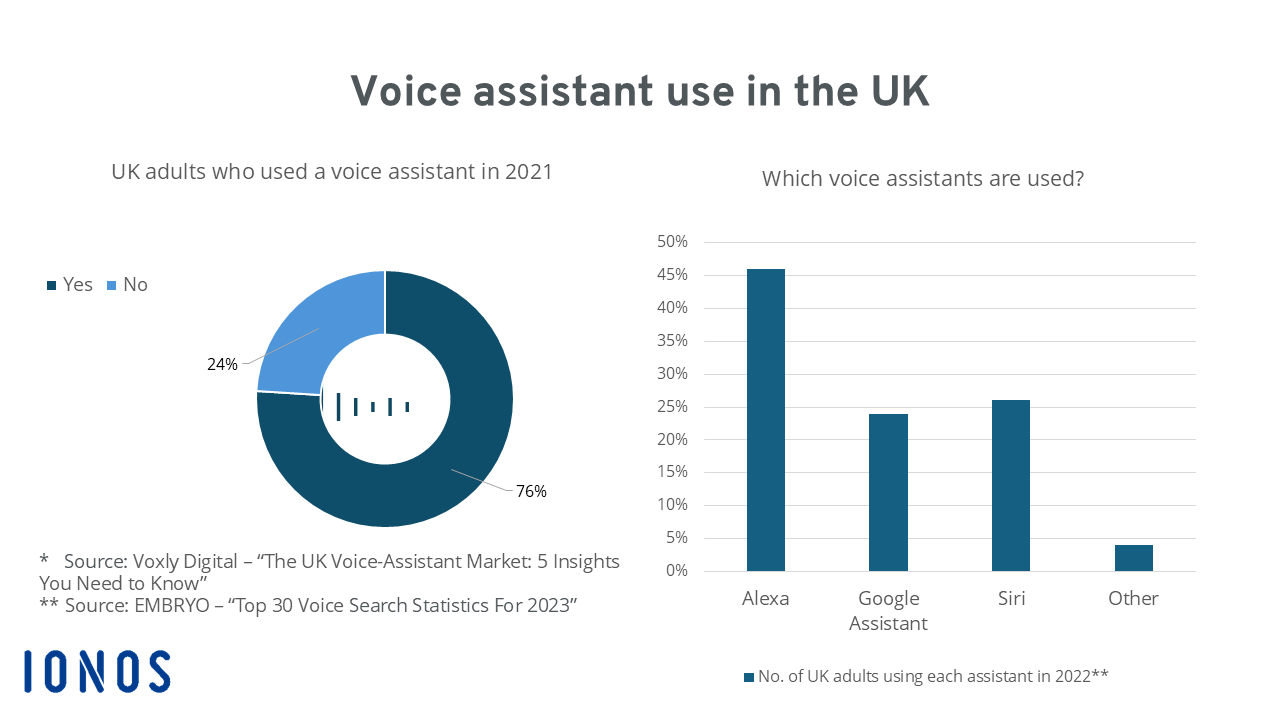
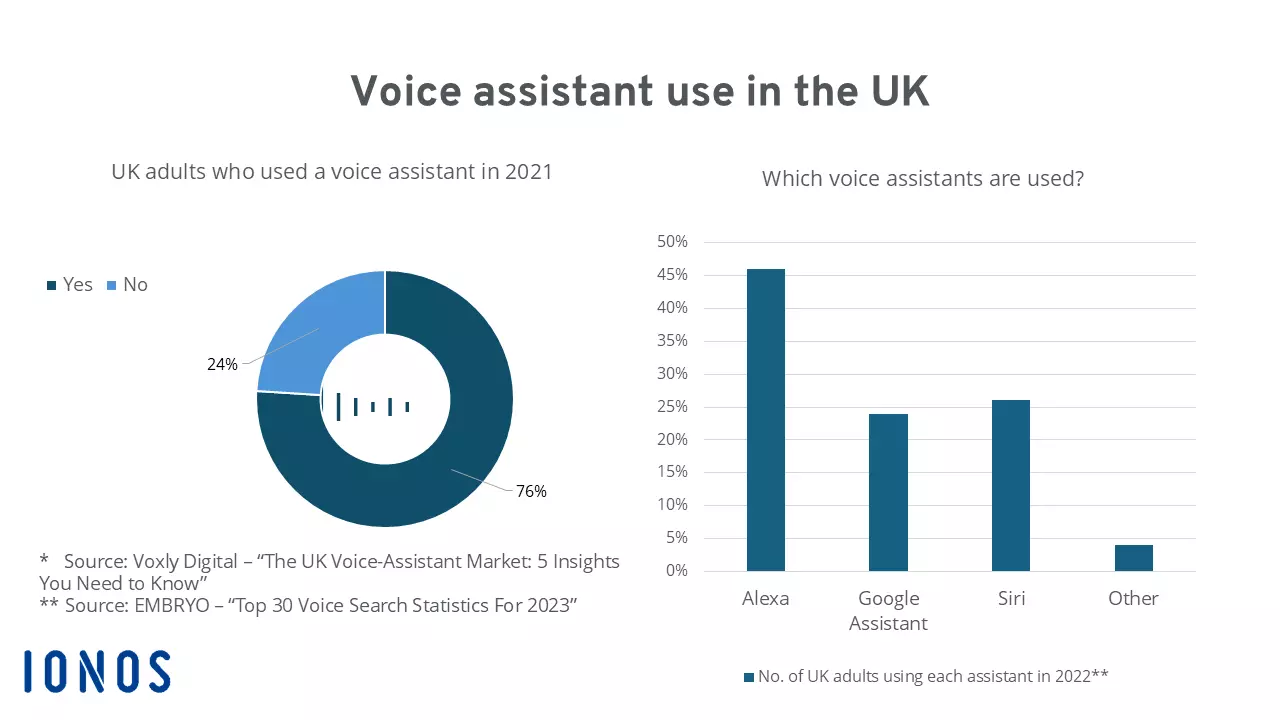
After the iOS voice assistant Siri was first introduced in 2011, it was followed by Google Assistant, Cortana (Microsoft) and Alexa (Amazon), among others. In line with the two-way communication model, the aim is to have an authentic conversation with a device or in other words – the person asks, the machine answers. This influences the further development of search algorithms, changes user search behaviour and has a decisive impact on SEO. According to a survey, Amazon Alexa was the leading smart speaker device in the UK in 2022, holding a 46% market share. Apple’s Siri and Google Assistant had comparable shares in the voice recognition market, at 26% and 24% respectively. Further surveys predict an increase in use over the next few years. Current surveys on voice search point unmistakably to a further increase in use in the coming years. In 2022, Demandsage predicted that voice search would be used by 27 percent of the global population, while around one billion voice searches would take place every month.
Considering the growing importance of voice search, you will need to make sure that your website is optimised for it. This is where it makes sense to consider voice search SEO, as it is becoming increasingly important for Google and other search engines.
Why is optimising for voice search so important?
To enhance your website’s voice search optimisation, it’s crucial to understand how search queries are evolving due to new technology. The most significant changes involve the language itself:
- Search requests are moving away from the standard written language and are moving more towards a natural use of language. This means that search requests will be longer. Instead of one to three keywords, which is usually what is typed into a search engine, voice searches consist of two to four keywords with an increasing trend.
- This also increases the relevance of long-tail keywords: Due to the more natural use of language, keywords are often embedded in questions. For example, if information on a public figure is required, the voice search performed will probably not be ‘Steve Jobs’, but rather ‘Who is Steve Jobs?’.
- W questions come up time and time again during the voice search so they need to be taken into consideration for voice search optimisation. Question words like ‘who’, ‘when’, and ‘where’ are used frequently. Voice assistants are also getting better at understanding prepositions, so that they now return much more appropriate results for voice search queries such as ‘flight from London to Glasgow’.
- This results in a further development that also affects the classic text search: the structural shift from keywords to content. Traditional money keywords are seeing a decline in search volume, while the importance of semantic contexts is on the rise. Evaluating natural language requests now focuses mainly on the intent behind the request. Research on user behaviour indicates that voice search is typically used for general information gathering, with more detailed queries and purchase decisions occurring at a later stage. Consequently, content that offers precise information to address search queries is the key factor that drives voice search traffic to your website, rather than individual keywords or specific products.
This new search behaviour, in turn, has an impact on the technology since its algorithms are constantly being developed. They are designed to meet the need for direct answers to the W questions. Newer algorithms are increasingly targeting personalised content to enable even more individual search results and tailored advertisements. For this personalisation, voice assistants provide detailed information as an interface between users, end devices and web search.
What distinguishes voice search SEO from classic SEO?
The advantages of the voice function are obvious: It is direct, fast and convenient and requires no manual input. It is used for general device functions (calls, composing messages, song selection, etc.) and for online search queries.
Who benefits most from voice SEO? Voice search is particularly popular for mobile search. It is used in particular to obtain directions or find local stores. This makes it particularly relevant for websites with high mobile traffic and local relevance.
The voice function offers freedom and convenience, as there is no need for manual input. This is why it is often used in front of the TV, in the car, when cooking, doing DIY or even when bathing - these are typical situations in which the voice function is used. In addition to social networks, corresponding blogs and advice sites (with recipes, repair or building instructions) could therefore also benefit from voice search SEO.
In general, younger user groups use voice search much more frequently than older ones. While teenagers use the function particularly frequently when socialising with friends and for homework help, adults often use it while cooking or dictating texts. Digital natives are more familiar with the new technology and the voice function is particularly suited to their user behaviour (keyword second screen. If you want to reach a younger target group in particular with your website, it is therefore advisable to optimise your website for voice search.
Checklist for voice search SEO
Voice search optimisation is an innovative field aimed at improving your website’s ranking. Here is a checklist of what to bear in mind when optimising your website for voice search.
- Improve your Google ranking without paying an agency
- Reply to reviews and generate social media posts faster
- No SEO or online marketing skills needed
Customise keywords
Even if keywording is not the focus of voice search optimisation, there are a few things you can keep in mind. If you want to optimise keywords for voice search, adapt them to the spoken language and place the most important question keywords in a prominent position. In general, your website will be more visible in language searches if you align terms, phrases and sentences more closely with the spoken language.
Additionally, place a stronger emphasis on optimising for longtail keywords to be found via voice search. Users often leave out filler words in text searches, but it makes sense to offer them for voice search optimisation. If your keywords correspond to natural language, the probability of appearing in the voice search results increases.
One danger of voice search is mispronounced brand names or brand names that are incorrectly understood by the voice assistant. Problems arise in particular with sayings, acronyms or proper nouns that are not in English. In this case, SEO for voice search becomes a challenge. The only hope in this regard is that speech recognition continues to rapidly improve.
Semantic evaluation instead of money keywords
Semantic correlations are becoming increasingly important for successful voice search SEO. This is particularly true when optimising websites for voice search, as voice search queries are evolving from individual keywords to semantically more complex search phrases. You can improve the semantic readability of your website by placing value on structured data. Internal links also help search engines to better understand the context of your content and also lead to better page indexing.
Working with services for structuring data
The Schema.org markup language was developed jointly by Google, Bing and Yahoo! in 2011 to standardise semantic annotations of websites. It provides standardised schemas for structuring data - the basis of the semantic web. This can enhance the machine readability of semantic relationships more effectively. Structured data is often underutilised, so incorporating Schema.org provides significant potential to differentiate from the competition.
You can also increase the relevance of your site by covering a wide range of topics. It makes sense to incorporate all aspects related to your offerings on your website. Prioritising is essential, meaning the most important topics, questions, and answers should be concise yet informative, and include search-relevant terms.
Give answers
Using question words is key to voice search optimisation. In order to comply with the frequent searches using W questions, you should integrate as many questions as possible into your content. Include all of the questions that you think might be asked relating to your offer. Make sure you include all answers on your website – including search terms. The classic FAQ structure can serve as orientation. One way to determine which questions might arise is to look in forums.
It is also useful to create custom ad groups or campaigns for voice searches that take question-based keywords into account. Note that some question words are used more frequently than others. In addition, providing microdata helps voice search users quickly find the right answers to their questions on your website.
As Google continues to provide more direct answers, it is recommended to create content that can be integrated into a knowledge graph. This approach also enhances the chances of being discovered through voice search.
Use local references
People primarily use voice search on mobile devices for local inquiries. Therefore, local optimisation is advantageous when optimising for voice search. Local businesses encounter specific challenges due to these shifts but can also greatly benefit from the rising number of voice searches.
Ratings and customer reviews are crucial for successful local SEO, as well as voice search optimisation. Regularly update your contact information and opening times on Google or YELP. It’s often worth listing your business in other local directories as well.
Customers are always thankful for clear and understandable directions. If you mention nearby landmarks, places, or other regional checkpoints, this is especially effective for voice search optimisation. Experiment with other ways to place local features as keywords. Users who want information about a region or city would then be more likely to come across your website over your competition’s.
Bear in mind that the voice assistant Alexa (Amazon) generates its search results for local providers from the assessment portal, YELP.
Keep your eye on the ball
Meaningful voice SEO is only possible if you know the developments of the relevant technologies and user behaviour. In particular, keep an eye on Google tools such as Direct Answers or RankBrain, which are aimed at understanding semantic contexts and integrating artificial intelligence.
The changes in consumer behaviour — such as the trend towards second screen — are also important for voice search optimisation. Optimising web content for voice search is therefore only possible if the rapidly changing technical conditions are taken into account.
Which are the most popular voice assistants?
In order to optimise voice search, you need to first deal with current voice assistants. They are designed to help you navigate and operate the device (app access, music playback, creating messages) and organising personal content (calendar, reminders, birthdays, etc.) using speech recognition. Voice assistants therefore also serve as answering tools and are used as voice search engines, which have great AI potential. They are often viewed critically in regard to data protection laws, which is why many users still prefer the traditional way of manually searching.
- Apple’s Siri meant that a voice assistant was accessible to a wider audience for the first time. The application starts up automatically with the words ‘Hey, Siri’ and was created to be a mobile assistant.
- The Amazon Group launched its own voice assistant on the market with Amazon Echo or Alexa. Also designed for home use, Amazon Echo is sold as a standalone device in the form of a loudspeaker. Using voice commands, it plays music, works as an alarm clock, answers questions and, of course, helps with shopping on Amazon. Alexa is the most frequently used voice assistant in the UK.
- OK Google is Google’s voice function and a central component of the Google digital assistant. It can be used for both Android and iOS devices and is the direct counterpart to Siri. The application responds to the words ‘OK Google’.
- Bixby is the Samsung voice assistant that can also do Smart Home. The main functions are Bixby Voice, Vision, Home and Reminder.
- Cortana has been firmly integrated into Microsoft’s operating system since Windows 10 and is also available for Android and iOS mobile, making it accessible to a wider audience.
Visit our guidelines to learn more about the differences between Google Home and Amazon Echo or how to boost your Alexa Rank.
- Free WordPress with .co.uk
- Free website protection with one Wildcard SSL
- Free Domain Connect for easy DNS setup
Reviewer

Melissa Senn
Melissa Senn has been with IONOS since 2016 and focuses on website, e-commerce, social media, and AI in the Digital Guide. As a digital strategist, she uses her extensive SEO and GEO experience to transform complex technological trends into practical content.