

Up selling: boosting sales made easy

In a nutshell, up selling refers to a sales method that encourages customers to purchase the more expensive version of a product. This is particularly relevant for online retailers. However, for up selling to work, customers must be convinced of the added value of a more expensive product. In this article, we’ll explain how this works, what the advantages and risks of up selling are, and what you as an online shop operator should bear in mind.
Ask, create and research with the European alternative to ChatGPT. Robust security and unlimited chats give you peace of mind.
Up selling: definition
Up selling is a sales strategy aimed at convincing the customer to buy a higher-value version of the actual product. It is based on the assumption that customers visiting a shop or an online shop have a rough idea of the product they are looking for. However, if their attention is drawn to an even better item (one that is faster, lasts longer, or looks better), given the right circumstances and with good reasoning, they may be persuaded to purchase the slightly more expensive item.
As a consequence, the customer feels satisfied after an up sale because they feel understood and well-advised – while shop operators profit from a higher turnover. What is often achieved in physical stores through a detailed sales pitch is achieved in online product sales by way of a successful mix of data, technology, and marketing strategy.
Do you want to present and sell your products online, and are currently looking for a suitable solution? IONOS offers custom-made websites created by professionals or alternatively, you can create your own online shop.
What is the difference between cross selling and up selling?
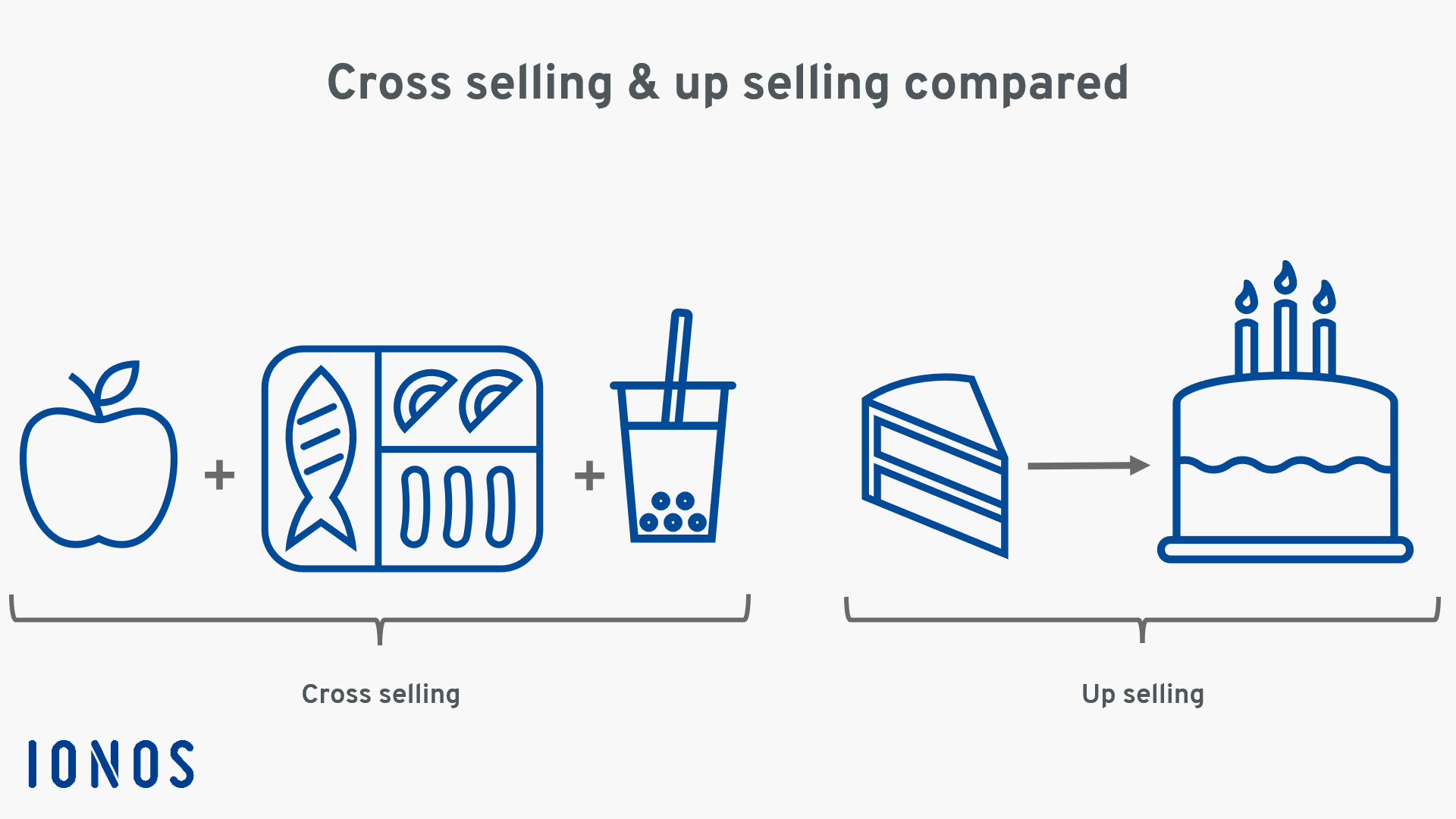
Often used synonymously, there is a crucial difference between up selling and cross selling: While up selling is about ‘upgrading’ the actual product, i.e. selling a better and more expensive variant, cross selling focuses on complementary products. The following diagram illustrates the difference:
Up sales: opportunities, advantages, and risks
From a brand perspective, up selling is primarily about making more money from a single sale. Good up selling is often based on a good customer relationship. Suitable up sales are proof that you understand your customers by demonstrating an additional investment that is worthwhile from the customer’s point of view. If the package doesn’t fit, there’s a good chance that you’ll earn more on a one-off basis, but the customer won’t necessarily become a repeat buyer.
To enjoy the opportunities and benefits of up selling, you should invest time from the start and …
- … check your product range with regard to up selling opportunities and design it accordingly. This means not only identifying items that are suitable for up selling, but also working out its benefits.
- … get to know your customers. There are numerous tracking tools for websites and stores to collect and evaluate data. But service hotlines or real experiences in stationary sales can also provide clues for up selling potential.
Once you have your foundation in place, there are various programs available that specialise in marketing automation alongside recommendation systems, through which you can run, optimise, and evaluate up selling campaigns fairly easily.
The importance of up selling for SEO
When running your own online shop, it’s often difficult to fully exploit factors such as covering extensive keyword sets, after all, the amount of text is usually kept to a minimum. This makes it all the more important to have a careful and well-thought-out linking strategy in place for your products.
Since up selling increasingly means working with references and links between products, the sales method has a positive effect on SEO. Not only do you provide added value for customers, but you also signal to search bots that you’ve placed a lot of value on links and click paths.
Shopping goes social: If you want to use the selling functions offered by Facebook and others for your business, then the Social Buy Button is a simple and solid solution for your website. You can find out more about the topic of ‘Selling on Social Media’ in our free whitepaper.
Exploring new opportunities with up selling
The following points show where up selling potential is hidden in your business or how you can uncover its potential. The focus is always on the customer.
- Use every opportunity you get to talk to your customers and gather feedback. Be it through a written or telephone survey on your product range or a specific product, or through conversations via a service hotline.
- Research the concerns of your potential customers. Conduct a target group analysis to find out which websites customers tend to visit or where they shop.
- Check where and how your products are used and whether people are talking about them in forums or social networks. Often, these are the places where product issues are discussed, how they can be resolved, or whether your competition might be a step ahead of you.
- Speaking of the competition, take a look at how competitors approach up selling and design their product offering.
- Analyse your sales: which products sell well, which do not? Where are you seeing high or low unit sales? It’s also a good idea to monitor the number of your returns.
If an item is being returned frequently, this could be due to a number of reasons. For example, you may have set the wrong expectations. To counteract this, you should rely on professional product descriptions and expressive product imagery – whether you’re shooting your own product photos or you’re hiring a professional to take them for you.
Risks of up selling
Operators of online shops where personal contact with customers before and after the sales process is at a minimum and shopping baskets are easily abandoned, note that there is a fine line between adding real value to justify an up sale and annoying a customer.
Discreetly point to an option for an upgrade and be sure that you can actually deliver on the promise of added value. Bear in mind that online shop visitors often use filter options to enter price ranges and other parameters, making certain areas and price reductions invisible to these customers.
Up selling in practice: here’s how
Based on your research, there are various ways to up sell. One important and central difference to cross selling is that up selling usually takes place before the actual purchasing decision. Once a purchase has been made, it’s unlikely that a customer will be persuaded to change to a higher-priced product. The exception are services or subscriptions, which can still be extended and adjusted at a later date.
In any case, an up sell offer must be comprehensible and beneficial for the customer. Therefore, implement your up selling strategy as follows, for example:
- Direct comparison between two or more items: Comparison tables that show the prices and performances of similar products next to each other are relatively easy to implement. In the best case, they will push customers to opt for the more expensive version instead of the basic one. Even better: place an expensive product next to an even more expensive one.
- Benefit from trust: In case of subscriptions, a subsequent up selling attempt can be successful. Once customers are convinced of the quality of your offering, they may be more inclined to take advantage of your offering for a longer time. An up sell may also result from a successful cross sell – for example, if a complementary product has been purchased that allows for sudden contract opportunities.
- Customer comments: Include reviews and recommendations for more expensive products on the product pages of less expensive items. It’s important that customer testimonials are authentic and comprehensible. They are some of the most persuasive factors in selling successfully.
- Show solutions to problems: If there are clear functional differences between the cheaper and the more expensive product, you can address them and advertise ‘For only xx pounds more, you won’t have this problem.’
The technical implementation of up selling campaigns is handled by special tools or extensions within store systems.
Don’t underestimate the power of tiny upgrades to your website. For example, a clear and convincing CTA can make a huge difference to completing a purchase.
Three up selling examples
In order to give you a better understanding of up sales and the various possibilities, we have compiled three very specific examples from different industries:
Example 1: Fitness studio membership
A gym offers different membership tiers. The least expensive one includes the use of equipment and attendance of classes. The more expensive one includes access to the pool and the sauna. The customer receives real added value when opting for the more expensive option. The gym has higher earnings, but doesn’t need to scale its offering because the pool and sauna are operated and paid for regardless of the customer’s choice.
Example 2: Technical extras in an online shop
An online shop sells TVs. A customer browses the basic models without smart TV functionality. The product details of the basic TVs include a highly visible teaser that point to the advantages of purchasing a smart TV – watch your favourite show and more streaming content any time – and offer a comparable smart TV for just £20, £50, or £100 more.
Example 3: Mobile phones and matching contracts
Smartphones, tablets, etc. are sold with corresponding contracts. A customer who has already signed a contract and purchased a device wants to purchase an additional tablet, but without the contract option. An up sale strategy could include contacting the customer to entice them with a more extensive contract that includes additional data volume and a second SIM card.
Online purchasing is of growing importance to customers and online shop operators. Learn more about various payment methods for your online shop or or choose payment methods from the IONOS eCommerce Website Builder.
Reviewer

Melissa Senn
Melissa Senn has been with IONOS since 2016 and focuses on website, e-commerce, social media, and AI in the Digital Guide. As a digital strategist, she uses her extensive SEO and GEO experience to transform complex technological trends into practical content.